

Both the Bank of England (BoE) and the European Securities and Markets Authority (ESMA) adhere to the foundational principle of "same risk, same regulatory outcome". Neither regulator is creating a diluted or separate "light-touch" regime for digital assets.
However, their supervisory approaches differ in policy structure, legal framework, and regulatory velocity.
Key Comparisons Across Core Domains
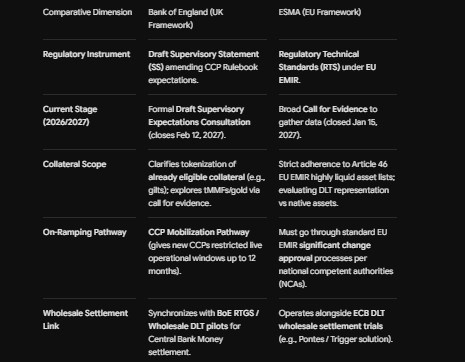
Core Areas of Convergence
In-Asset Liquidity & Price Discovery: Both regulators explicitly reject the idea that a tokenized bond inherits the liquidity of its paper/conventional counterpart. CCPs under both regimes must prove depth, pricing reliability, and order-book resilience for the specific token wrapper.
Aggregated Concentration Risk: Both frameworks mandate that CCP concentration caps must combine conventional and tokenized holdings of the exact same issuer into a single risk bucket.
Operational Resilience & Infrastructure: Both authorities require end-to-end operational oversight. Smart contract bugs, DLT consensus failures, hard forks, or key management lapses are treated as standard operational and outsourcing risks subject to penalty.
Distinct Differences in Approach
BoE’s Principles-Based Guidance vs. ESMA’s Rule-Based RTS:The Bank of England relies on a draft Supervisory Statement setting outcomes-based expectations. It gives UK CCPs room to evidence how their technical arrangements meet existing rulebooks without requiring sweeping primary legislative rewrites. ESMA, operating within 27 member states, must build formal, harmonized Regulatory Technical Standards (RTS) into EU EMIR to prevent jurisdictional arbitrage.
Legal Certainty & Property Rights: ESMA places strong emphasis on cross-border legal frictions across different EU member states (e.g., whether a ledger transfer constitutes full legal title transfer or merely a security pledge under local property law). The BoE’s focus is centered on single-jurisdiction legal finality under UK insolvency and settlement finality law.
Access to Cash & Settlement Money: The BoE requires clearing houses using tokenized collateral to ensure default liquidations can settle swiftly in Bank of England central bank money. ESMA’s framework must account for multi-currency euro-system clearing alongside European Central Bank DLT settlement initiatives (such as Eurosystem wholesale DLT trials).