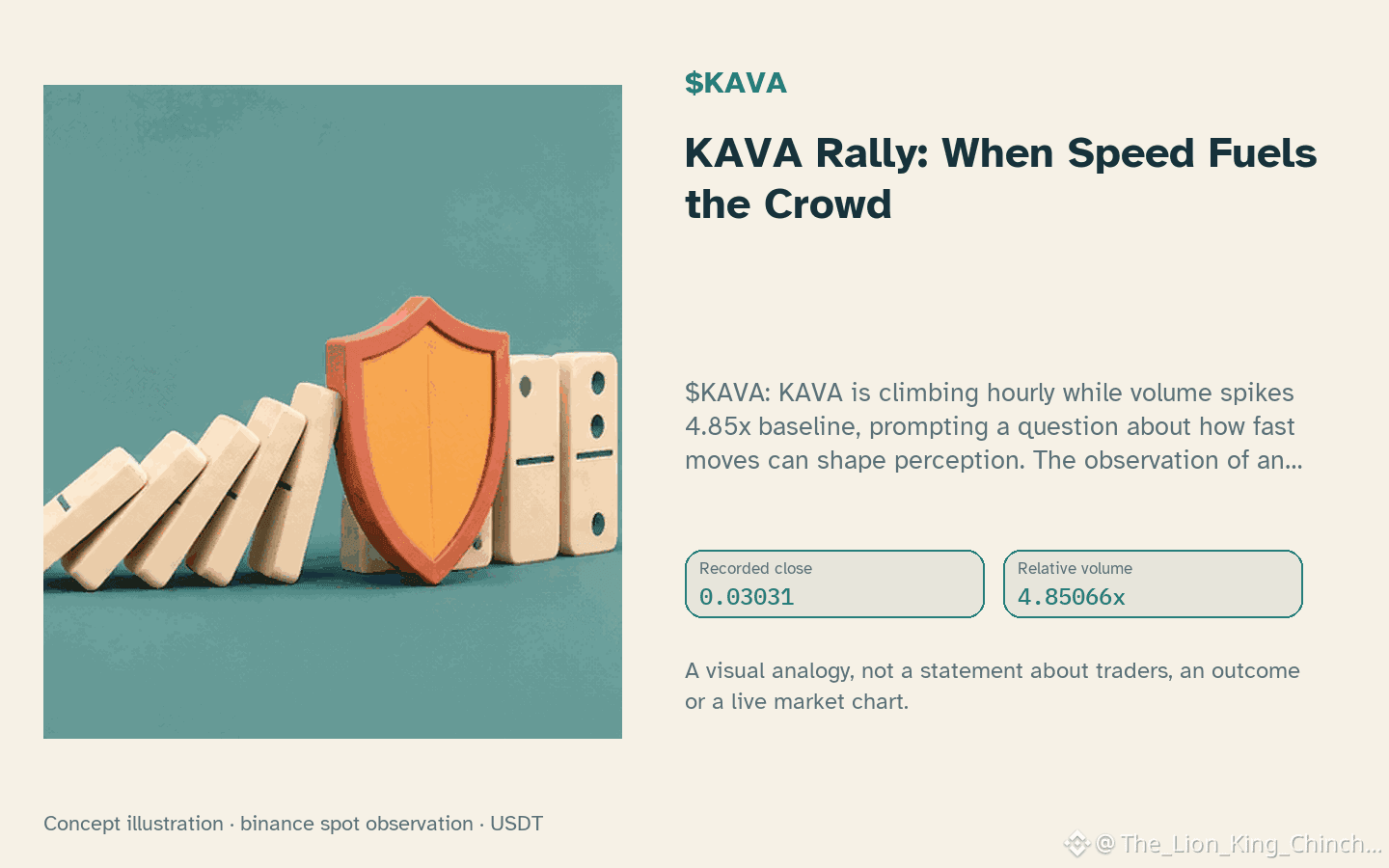
$KAVA: KAVA Rally: When Speed Fuels the Crowd
$KAVA: KAVA is climbing hourly while volume spikes 4.85x baseline, prompting a question about how fast moves can shape perception. The observation of an up direction and a range sitting above resistance creates a tempting shortcut: traders may assume the rally is justified because the market appears to agree. This shortcut mirrors the informational cascade bias, where individuals follow the apparent actions of others instead of re‑evaluating the underlying signal.
In this scenario, attention narrows on the rising price and high volume, anchoring expectations to the recent surge. The fear of missing out can amplify the cascade, as each participant rationalises that the crowd must have information they lack. Yet the price action alone does not prove a sustainable trend; the rally could be a short‑lived burst without deeper support.
A more careful interpretation would pause to test the bias. Check whether RSI 72.2 remains neutral or shows overbought pressure, and watch if subsequent candles revert toward the local support level 0.0281. A counterexample would be a flat or declining RSI paired with a sudden drop in relative volume, suggesting the momentum was thin.
Practical self‑check: before adding to a position, ask if the decision would change if the volume spike disappeared. If the answer is no, the cascade may be influencing the view more than fundamentals. Future evidence of a muted hourly change 5.83101% or a reversal toward the prior range would weaken the cascade hypothesis.
Probabilistic market research, not a recommendation or guaranteed return.
New evidence or a familiar bias?
#KAVA #TradingPsychology