The trade that quietly paid crypto traders for years just stopped paying — and Bitcoin just broke the level everyone was watching.
For years, the basis trade — buy spot Bitcoin, short the perpetual future, pocket the spread — paid a steady yield. Now, according to Talos data cited by CoinDesk, that yield has collapsed to around 3% to 5% a year, at or below what US Treasuries pay. The free money is gone, and the money is moving: traders are shifting to stock perpetuals instead.
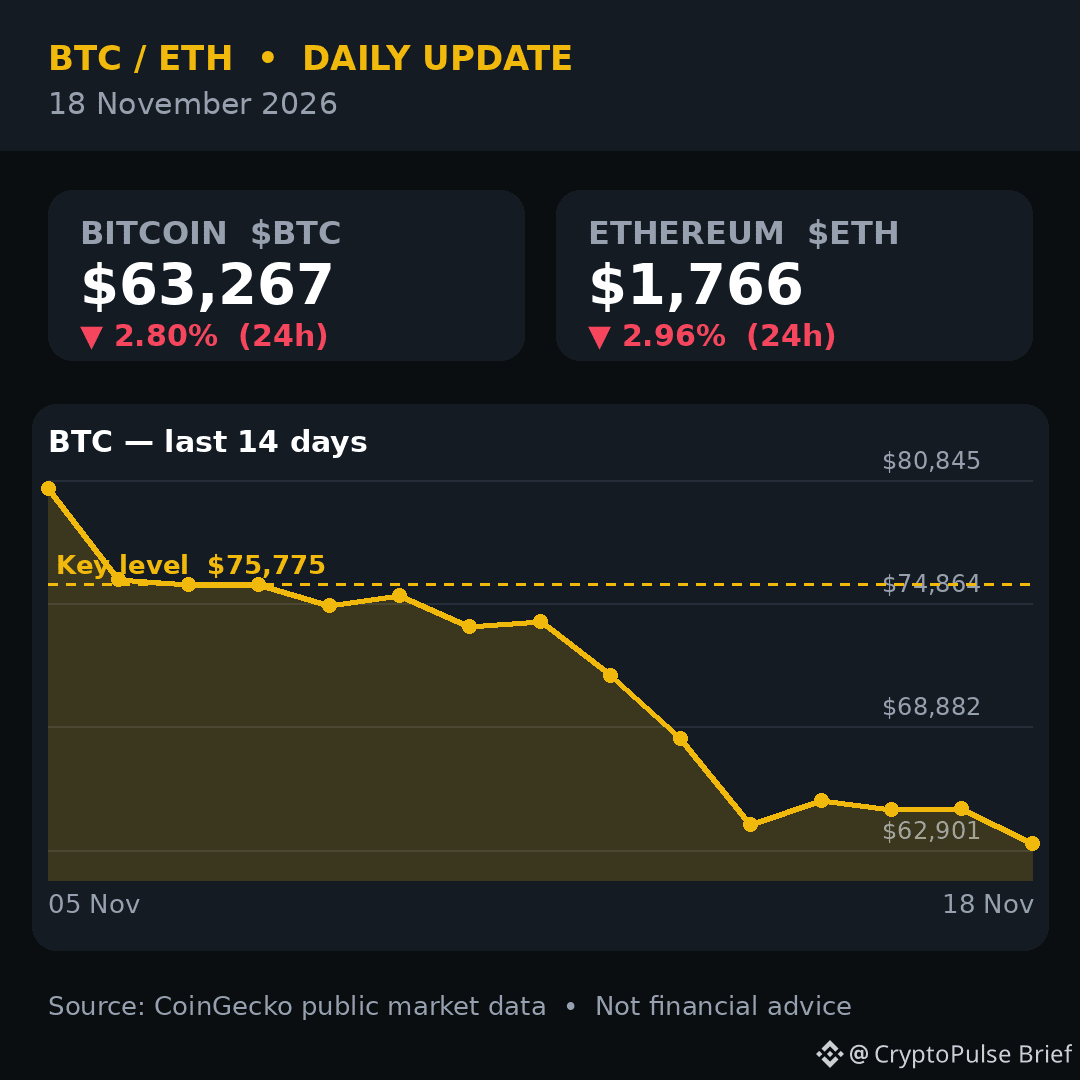
$BTC is feeling it. It trades near $63,300, down about 2.8% in 24 hours, after slipping under the $63,361 support level. It is about 26% below its October high of $87,200 and has now fallen six weeks in a row. Options traders are buying protection, not hope: five of the six most-traded Bitcoin options in the last 24 hours were puts, led by the $60,000 put expiring December 4 and the $63,000 put expiring November 27. Futures volume jumped 14.5% to $205.3 billion in a day — but open interest barely moved, up just 0.8% to $111.7 billion. That is churn, not conviction.
The Fear & Greed Index reads 11 — extreme fear. $ETH is near $1,766. One bright spot: NEAR Protocol is the day's biggest mover among the majors, up about 5.7% to $3.35. The Fed's October meeting minutes land at 19:00 UTC tonight, with markets pricing a 96% chance of a December rate hike.
My take: when the basis trade dies, the patient money leaves and only the fast money stays — that is why every bounce gets sold. Until the yield comes back or the Fed softens, $BTC is a trader's market, not a holder's market.
Levels to watch: support at $62,000, then $60,000; resistance at $63,361, then $65,268.
If the basis trade no longer pays, does $BTC need the Fed to blink before it can rally — or is $62,000 the level that finally brings buyers back? Drop your view below.
Source: CoinDesk, CoinGecko — 18 Nov 2026
Follow for daily crypto updates.
#Bitcoin #Crypto #FedMinutes
Not financial advice.