

DESCRIPTION
Brevis (BREV) jumped nearly 90% in 24 hours as Binance Spot buyers moved first and perpetual futures followed, trapping crowded shorts. This data-driven breakdown covers tokenomics, order flow, CVD, liquidity, open interest and funding behind the move, plus the January 2027 unlock cliff to keep on your radar.
Summary
While the broader market stayed sideways, BREV (Brevis) was the standout top gainer, rallying roughly 90% and trading around $0.11 after consolidating near $0.058. The move looks like a textbook case of liquidity transmission from spot to perpetuals, set against a low-float token structure.
Spot-led ignition: Binance Spot CVD began climbing before the breakout candle, signalling quiet accumulation at $0.055–$0.058.
Perp-led expansion: Futures CVD then surged to +6.07M, led by Binance Perp, forcing shorts to cover.
Crowded shorts: Open interest rose about sixfold while funding turned deeply negative, so shorts were paying longs every hour.
Low float: only 250M of 1B BREV (25%) circulate, and Team and Investor unlocks do not begin until January 6, 2027.
1. Market Snapshot
BREV stood out clearly against the other top movers over the last 24 hours. Whale positioning shifted sharply as well: on BREVUSDT, whales held about 60% of the long side versus 19% seven days earlier, while the crowd (retail) fell to 45% from 61%. Among whales, 185 were long with a combined $1.90M position (about 95% in profit), against 194 short with $1.29M (about 5% in profit).
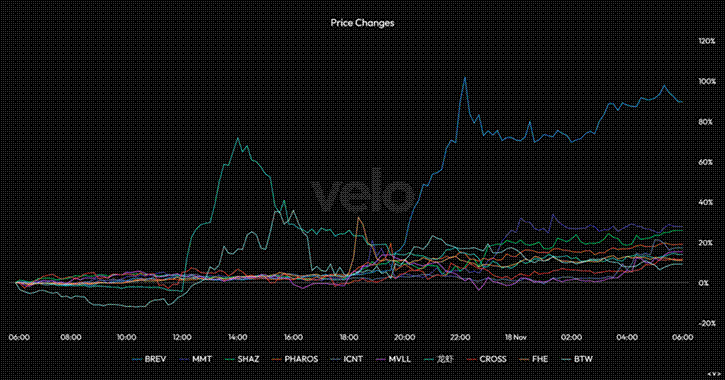
Price changes of the top movers over the last 24 hours (Velo)
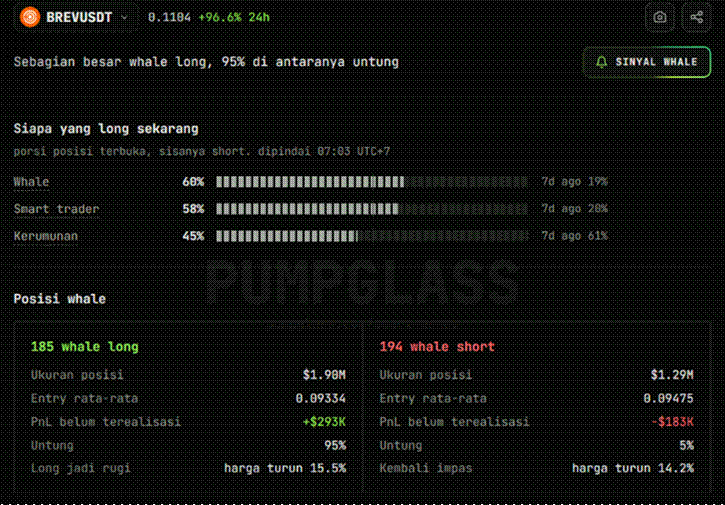
BREVUSDT whale vs. crowd positioning (Pumpglass)
2. Tokenomics: A Low-Float Setup
Brevis has a total supply of 1 billion BREV, but only 250M (25%) is circulating. That gives a circulating market cap of roughly $24.25M against an FDV near $97M. Until the end of December 2026, the only new supply is the monthly linear unlock from the Ecosystem and Community allocations. The first wave of Team and Investor supply arrives on January 6, 2027.
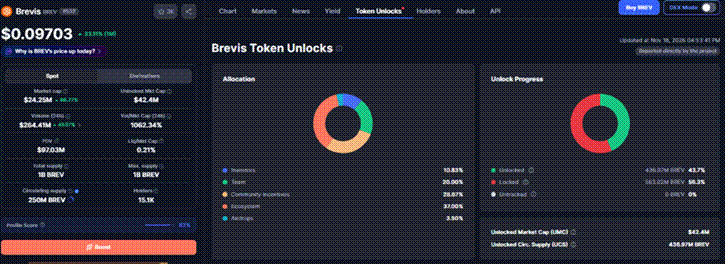
Brevis token allocation and unlock progress
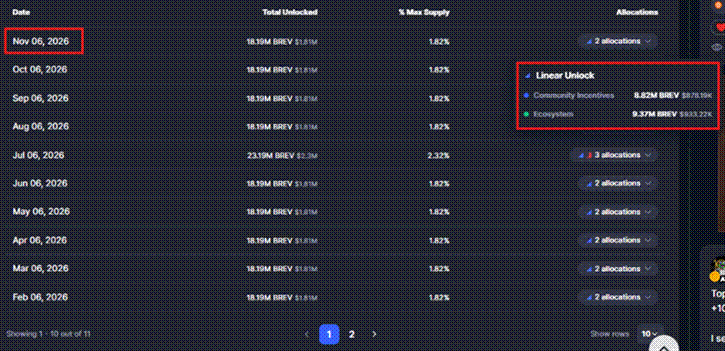
Past unlock schedule: a steady 18.19M BREV per month (1.82% of max supply)
3. Why the Timing Matters (Analyst View)
The points below are an interpretation of the structure, not confirmed intent. They explain why mid-November to December is an unusually cheap window for price expansion:
Pre-cliff window: with just one clean unlock left (Dec 6, 2026, 18.19M BREV), and a small circulating market cap, modest spot inflows can produce outsized price moves without private-round holders selling into them.
Investor cost basis: the seed round reportedly priced at an FDV of $60M–$75M ($0.060–$0.075 per token). With BREV dipping to about $0.055, early investors were underwater. A push back to $0.097–$0.115 restores margins before the first 4.51M BREV/month cliff in January 2027.
Exit liquidity and volume: thin liquidity could not absorb about $3.08M/month of new supply from January. The rally pushed 24h volume to $264.41M (Vol/Mkt Cap of 1,062%) and drew retail shorts in, rebuilding the order book and speculative interest.
Ecosystem allocation: the 9.37M BREV/month Ecosystem unlock, which funds market making and liquidity, gives liquidity providers ammunition to absorb supply on Binance Spot first, then lean on the short squeeze in perpetuals.
Taken together, the November rally may be a structural pre-positioning move using the last ~50 days of the insider-free window, before supply dynamics change in early January 2027.
4. Order Flow: Fresh Capital Led the Move
BREVUSDT climbed from a consolidation area near $0.058 to $0.1057 on aggressive new capital, confirmed by derivatives data.
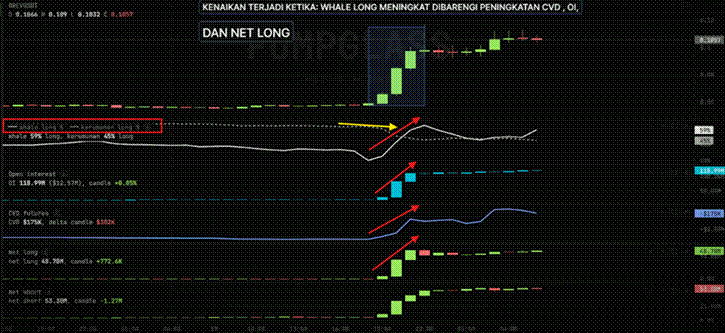
BREVUSDT order flow: whale long ratio, open interest, CVD and net positions (Pumpglass)
Whale vs. retail divergence: after a brief shakeout around 18:00, the whale long ratio jumped to 59% while the crowd long ratio shrank to 45%, a handover of positions from retail to smart money.
Open interest expansion: OI shot up with three impulsive green candles to 118.99M ($12.57M), showing fresh contracts rather than a thin-liquidity move.
Aggressive buying: the sharp CVD rise confirms taker buyers sweeping sell liquidity with market orders.
Squeeze fuel: Net Long rose to 48.70M while Net Short jumped to 53.30M, meaning many traders were fading the trend, which became fuel for liquidations.
5. CVD: Spot-Led Ignition, Perp-Led Expansion
The rally followed a classic sequence: real, unleveraged buying on Binance Spot started the move, and derivatives took over the momentum afterwards.
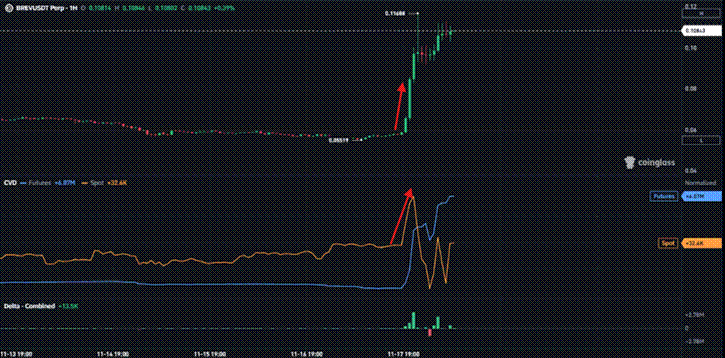
BREVUSDT perp (1H) with futures and spot CVD (Coinglass)
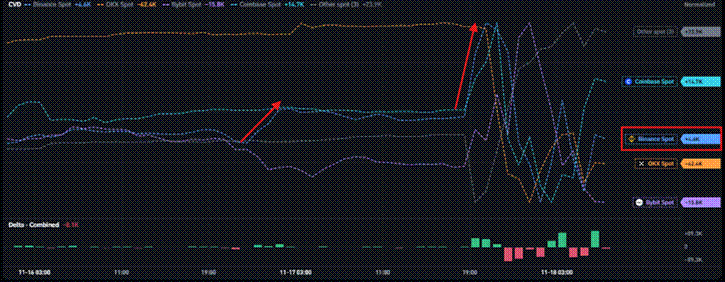
Spot CVD by exchange
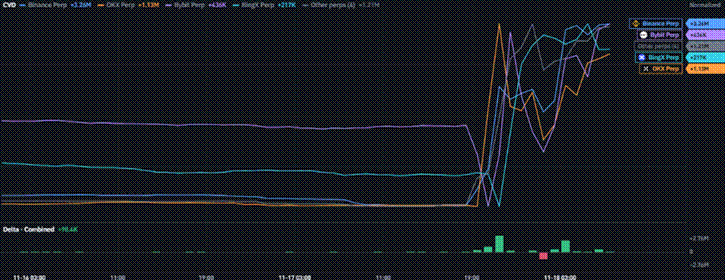
Perpetual CVD by exchange
Hidden accumulation (Nov 16 to early Nov 17): Binance Spot CVD climbed early and diverged from other venues (Bybit Spot was weakening), pointing to gradual absorption of supply at $0.055–$0.058 without premature volatility.
Breakout trigger (Nov 17, 19:00): combined Spot CVD spiked ahead of Futures CVD. Binance Spot swept the sell side first, followed by taker buying on Coinbase Spot and OKX Spot.
Perp handover: futures CVD surged to +6.07M, led by Binance Perp (+3.26M), Other Perps (+1.21M) and OKX Perp (+1.13M), pushing price to $0.11688 and forcing short liquidations.
After the peak, some spot participants took profit (OKX Spot net delta −42.4K, Bybit Spot −15.8K), while price near $0.1084 was held up by buying on Binance Perp and remaining inflows on Coinbase Spot (+14.7K).
6. Liquidity Heatmap and Levels
On a microstructure level, the move behaved like liquidity engineering: stacks of limit orders and clusters of short liquidations acted as price magnets, one after another.
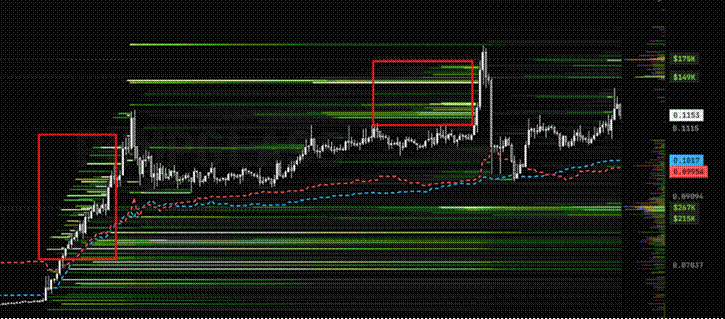
Liquidity heatmap (Pumpglass)
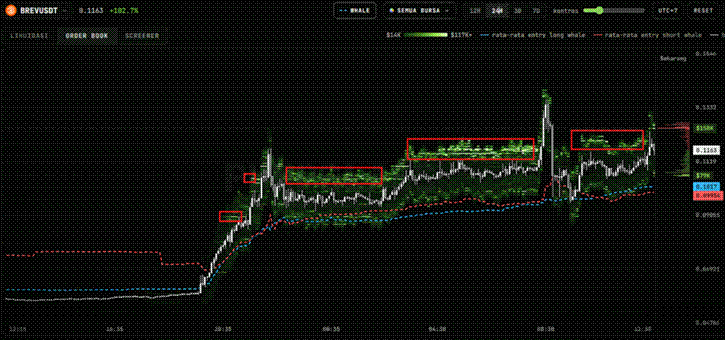
Order book view of BREVUSDT with whale average entries (Pumpglass)
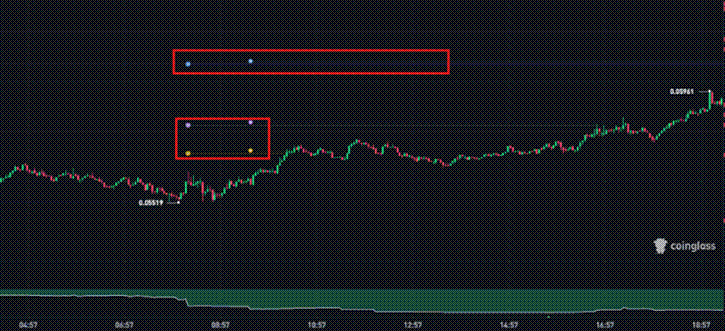
Liquidity levels swept before the breakout (Coinglass)
Pre-breakout sweep: after bouncing from $0.05519, price crept up toward $0.05961, sweeping three horizontal liquidity levels and clearing early supply overhead.
Ask wall absorbed, bid ladder raised: thick sell walls were eaten by taker buys while bids kept stepping up. Price broke through $0.1153, and the structure below is now supported by large bid blocks of $267K and $215K at $0.090–$0.095, with the next ask walls at $149K and $175K.
Layered short squeeze: new shorts created liquidation pockets at $0.105–$0.111 and a much larger cluster at $0.115–$0.120. Price pushed through both, wicking to $0.1318, then corrected to the $0.0965–$0.1002 zone, which is backed by a $107K bid.
Rising bids beneath price and stacked short liquidations above it create asymmetric upside: relatively small buying can trigger a domino effect of forced short covering.
7. Open Interest and Funding Rate
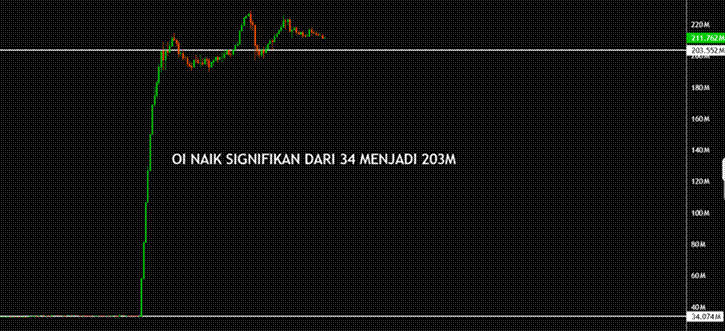
Open interest: a vertical jump from about 34M to over 200M
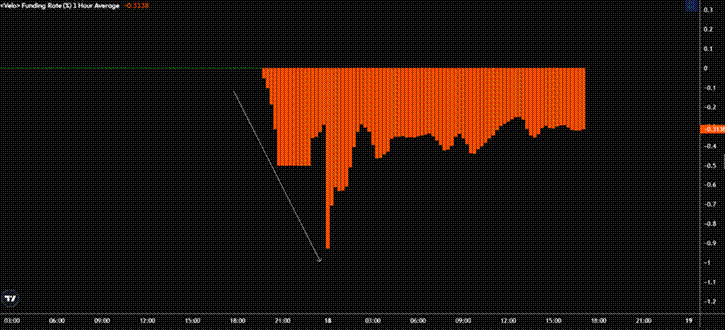
Funding rate (1-hour average) plunging into negative territory (Velo)
A vertical jump in open interest combined with a deeply negative funding rate is the signature of a structural short squeeze: most new contracts were shorts trapped against the trend.
Massive, sustained OI: open interest rose almost sixfold from 34M to a peak above 220M, then held in a 203.55M–211.76M range. Staying near the peak suggests large liquidity remains locked in the market with no mass unwinding yet.
Extreme negative funding: instead of turning positive on buying euphoria, the 1-hour average funding rate plunged from 0% to a low of about −0.92% around the date change on Nov 18, then held near −0.31%. Retail kept opening shorts to catch the top.
Long subsidy and perp discount: because the rally started with spot buying, perpetuals traded at a discount to spot, pushing funding well below zero. Shorts therefore pay expensive funding fees to longs every hour.
For whales, this is an asymmetric incentive: longs collect passive hourly yield from shorts while that cost pressure works to force shorts to give up and buy back their positions.
8. Technical Analysis
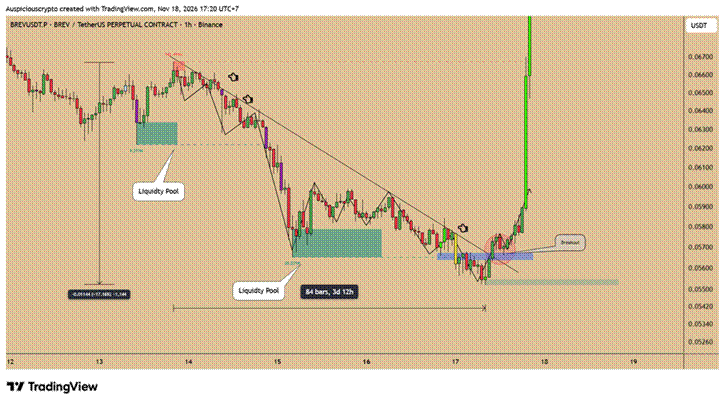
BREVUSDT.P (1H) technical structure, Binance (chart by Auspiciouscrypto on TradingView)
On the 1H chart, BREVUSDT.P moved from a structured correction into a markup phase through a series of sell-side liquidity sweeps, a descending trendline break, and a support/resistance flip near $0.0568–$0.0570.
Markdown and descending trendline (84 bars, 3 days 12 hours): price fell 17.16% (−$0.01144) from a swing high of $0.0667 to a low of $0.0552, with three rejections near ~$0.0655, ~$0.0645 and ~$0.0575.
Tiered sell-side liquidity sweeps: price swept a first pool at $0.0622–$0.0634 (9.277M), then a consolidation at $0.0565–$0.0578 (20.231M) that was broken down in a stop hunt into the $0.0552–$0.0555 demand block.
Trendline breakout and S/R flip: with sell-side liquidity absorbed, price reclaimed the $0.0565–$0.0568 zone, broke the trendline at $0.0570, then retested it as new support, confirming a bullish structure.
Impulsive expansion: a higher low after the retest triggered a vertical green candle that swept external buy-side liquidity at $0.0667 and accelerated toward $0.10+.
The breakout and retest around $0.0570 was the structural inflection point that bridged hidden spot accumulation with the derivatives momentum burst, flipping the market from lower highs to a parabolic uptrend.
Key Levels and What to Watch
Support: $0.0965–$0.1002 (bid-backed correction zone), then $0.090–$0.095 (large bid blocks).
Resistance and reference highs: $0.1153, the $0.11688 peak, and the $0.1318 wick high; ask walls at $149K and $175K above.
Positioning: whether OI stays elevated, funding remains negative, and whales keep their long dominance.
Supply calendar: the Dec 6, 2026 unlock (18.19M BREV) and the Jan 6, 2027 Team and Investor cliff that lifts monthly unlocks to 31.04M BREV.
Conclusion
$BREV rally combined three ingredients: a low-float, insider-locked token structure, quiet spot accumulation on Binance followed by a perpetual-led squeeze, and a crowd of retail shorts positioned against the trend. The setup is highly volatile, and the supply picture changes materially in January 2027, so risk management matters.
Disclaimer: This article is for informational and educational purposes only and is not financial advice. Crypto assets, especially low-float tokens and leveraged derivatives, are highly volatile and carry significant risk. Always do your own research before making any decision.