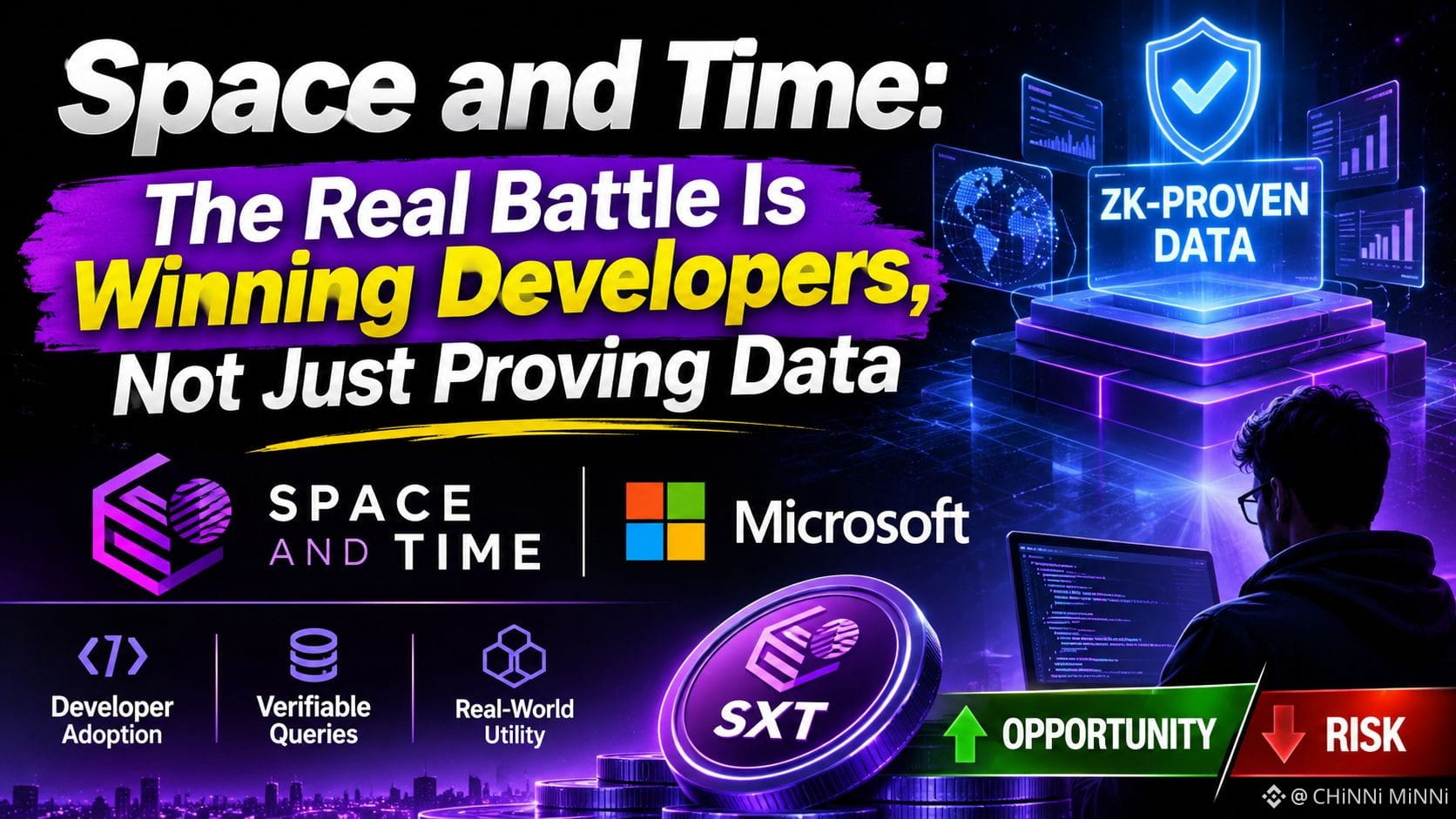
Space and Time: The Real Battle Is Winning Developers, Not Just Proving Data
I believe the next infrastructure winners in crypto will be decided less by technical demonstrations and more by how easily developers can integrate them into products people actually use.
That is an important lens through which I evaluate Space and Time (SXT). Its focus on ZK-proven data addresses a growing need: applications increasingly require complex information from outside blockchain networks, but traditional data pipelines introduce dependencies that are difficult to independently verify.
What interests me is the potential to make verifiable queries part of everyday application development rather than a specialized security feature. If that happens, Space and Time could become useful infrastructure for DeFi protocols, enterprise applications, and AI-driven systems that need reliable data processing.
However, integration friction is a serious obstacle. Developers already have established databases, indexing providers, and analytics tools. Switching infrastructure requires measurable improvements in cost, performance, and reliability, not simply stronger cryptographic guarantees.
I also think SXT's long-term economics deserve scrutiny. Network adoption does not automatically create proportional token demand. The relationship between query activity, payment mechanisms, and token utility needs to become economically meaningful.
Microsoft's backing may help establish credibility, but developers ultimately follow practical advantages.
For me, Space and Time's real test is whether verifiable computing becomes easier to adopt than the alternatives are to trust.
#sxt $SXT @SpaceandTime