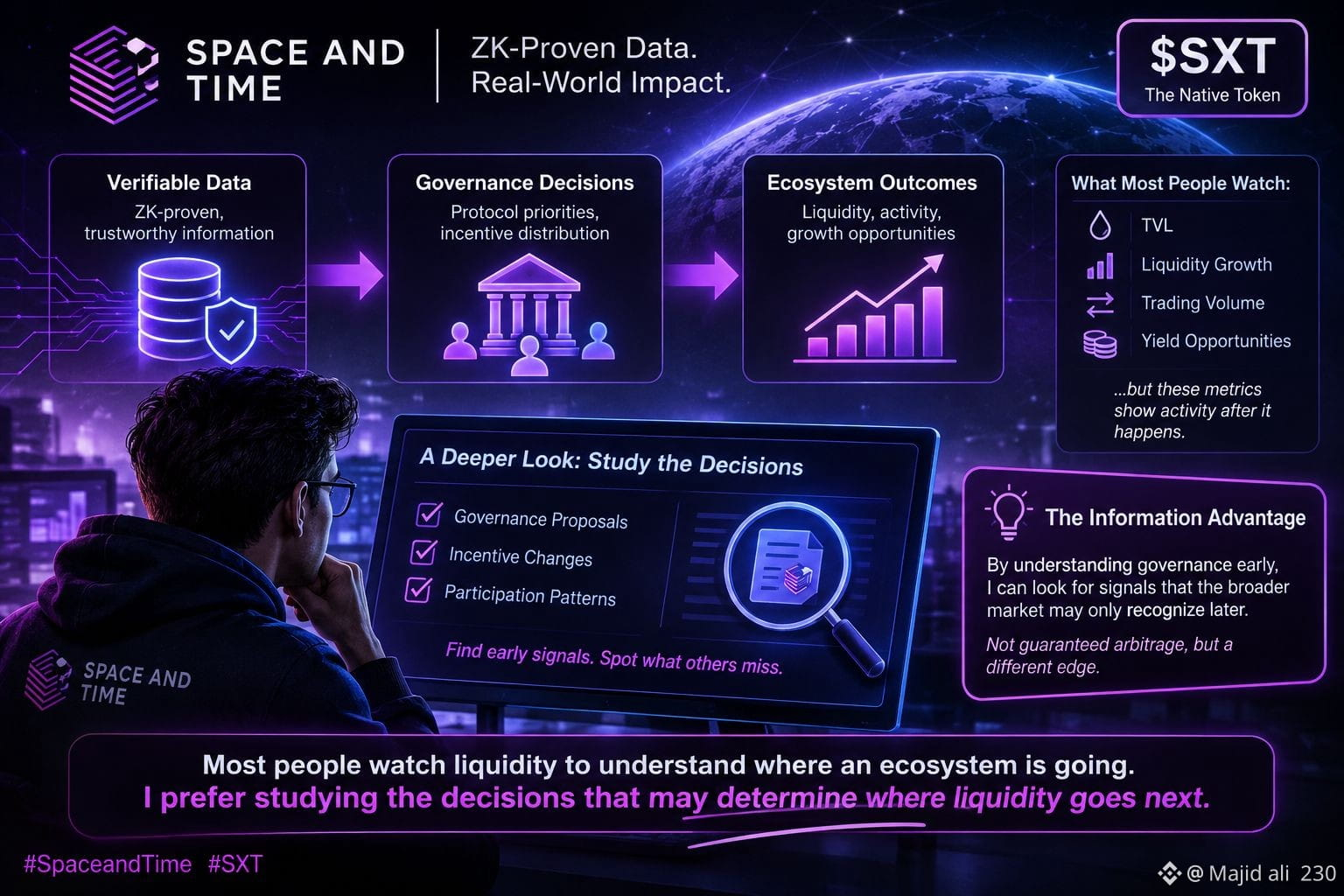
The more time I spend studying the Space and Time ecosystem, the more I think investors may be overlooking what happens before capital starts moving.
Most participants focus on TVL, liquidity growth, trading volume, and yield opportunities. I understand why, but these metrics reveal activity after it develops, not necessarily the decisions that helped create it.
The hidden layer is the relationship between verifiable data, protocol decisions, and economic incentives. Space and Time is a Microsoft-backed blockchain focused on ZK-proven data, while $SXT is its native token. Its approach raises an interesting question: how much does reliable, verifiable information influence the decisions made across an ecosystem?
That made me think about governance. Governance matters because decisions about protocol priorities and incentive distribution can influence where participation develops. These decisions may happen long before their impact becomes visible through liquidity or activity metrics.
What I find interesting is the potential information advantage. By studying governance proposals, incentive changes, and participation patterns early, I can look for signals that the broader market may only recognize later. This is not guaranteed arbitrage, but it offers a different way to evaluate emerging ecosystem activity.
Most people watch liquidity to understand where an ecosystem is going. I prefer studying the decisions that may determine where liquidity goes next.
$SXT @SpaceandTime #sxt