
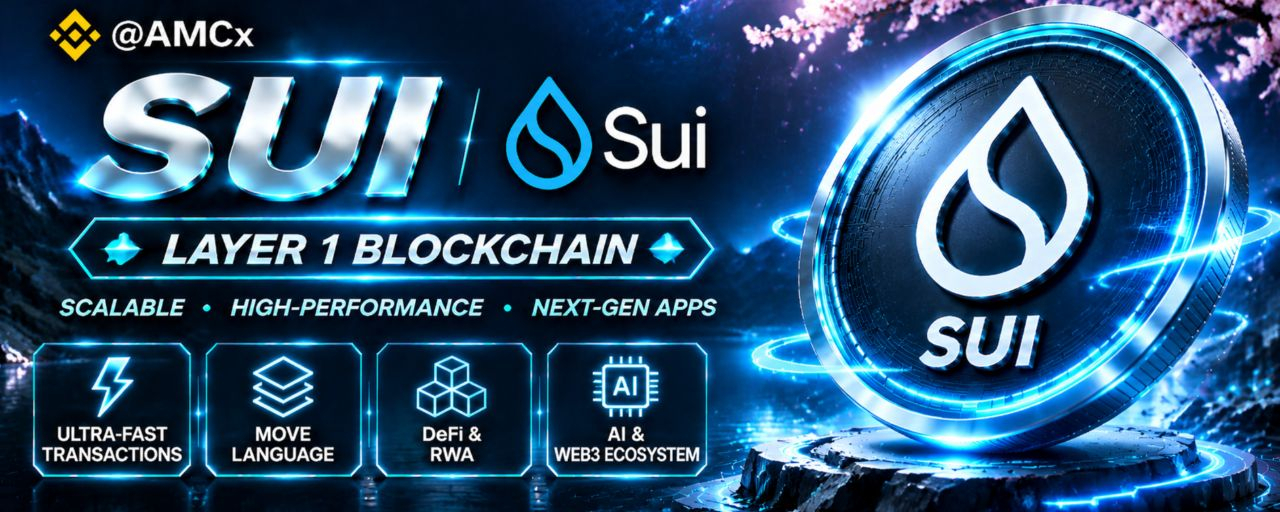
Sui (SUI) is becoming one of the most interesting Layer 1 blockchain projects in the cryptocurrency industry.
Developed by Mysten Labs, Sui is designed to support high-performance decentralized applications, digital assets, gaming, payments, and financial infrastructure.
Unlike traditional blockchain architectures, Sui uses an object-centric data model and the Move programming language to improve how digital assets and transactions are handled.
In 2026, the ecosystem expanded through institutional partnerships, stablecoin integrations, Bitcoin DeFi infrastructure, and artificial intelligence applications.
With developments involving Samsung Wallet, Hashi, Walrus, and DeepBook, Sui is attempting to become more than just another smart contract blockchain.
So, what makes Sui different, and what could happen next in 2027?
1. Understanding Sui (SUI)
Sui is a Layer 1 blockchain designed to provide fast transaction execution, scalability, and a developer-friendly environment.
Its native cryptocurrency, SUI, plays several important roles:
Paying network transaction fees.
Staking and supporting network security.
Participating in network governance.
Providing liquidity across decentralized applications.
Supporting the broader Sui ecosystem.
Sui uses the Move programming language, originally developed for secure digital asset management.
One of its distinguishing features is its object-centric architecture.
Instead of treating every asset simply as an account balance, Sui represents digital assets and other resources as programmable objects.
This architecture allows many independent transactions to be processed in parallel.
2. Mysticeti: The Technology Behind Sui's Performance
One of the most important technologies behind Sui is Mysticeti.
Mysticeti is Sui's consensus protocol, designed to reduce transaction latency and improve network throughput.
It uses a Directed Acyclic Graph (DAG) architecture that allows multiple validators to propose blocks in parallel.
The design provides several advantages:
A. Faster Transaction Finality
The consensus architecture is designed to reduce the time required for transactions to reach finality.
B. Parallel Processing
Independent transactions can be executed simultaneously when they do not compete for the same shared objects.
C. Improved Network Efficiency
The protocol aims to use validator resources more efficiently.
D. Scalability
The architecture is designed to support applications with demanding transaction requirements.
These characteristics make Sui particularly interesting for gaming, payments, trading, and other applications requiring responsive blockchain infrastructure.
3. Samsung Wallet Integration: Bringing Sui to Millions of Users
One of the biggest developments in October 2026 involved Samsung.
On October 8, Samsung announced a collaboration with Sui to bring USDC on the Sui network into Samsung Wallet for approximately 82 million eligible US Galaxy devices in the United States.
This development could make stablecoin payments more accessible to everyday users.
The integration is important because it connects blockchain technology with an established consumer technology ecosystem.
Potential benefits include:
Easier access to digital dollar transfers.
More convenient stablecoin payments.
Improved blockchain accessibility.
Greater visibility for the Sui ecosystem.
New opportunities for digital financial services.
An important distinction: the initial integration focuses on USDC on Sui, not direct support for the SUI token itself.
Nevertheless, it represents an important opportunity for the broader Sui ecosystem.
4. Hashi: Bringing Bitcoin Into Sui DeFi
Another major development is Hashi.
Hashi is designed to connect Bitcoin with decentralized financial applications on Sui.
Its objective is to allow Bitcoin holders to access additional financial opportunities without relying on traditional wrapped-Bitcoin infrastructure alone.
Potential applications include:
Bitcoin-backed lending.
Bitcoin liquidity.
DeFi borrowing and lending.
Yield-related financial strategies.
Institutional Bitcoin financial services.
On October 8, 2026, Sui announced that Hashi was preparing for its Mainnet rollout with more than $500 million in committed capital.
Anchorage Digital also joined the Hashi coalition.
This is an important development because Bitcoin remains one of the largest sources of capital in the cryptocurrency industry.
If Hashi successfully attracts users and liquidity, it could strengthen Sui's position in the Bitcoin DeFi sector.
However, committed capital should not automatically be interpreted as capital already deployed or guaranteed user deposits.
5. DeepBook: Building an On-Chain Financial Market
DeepBook is another important component of the Sui ecosystem.
It is an on-chain central limit order book designed to support decentralized trading.
Unlike automated market makers that rely primarily on liquidity pools, an order book allows buyers and sellers to submit bids and offers.
DeepBook is designed to support:
Spot trading.
Decentralized liquidity.
Margin-related financial products.
Trading applications.
On-chain market infrastructure.
On September 24, 2026, the DeepBook App launched with spot trading and prediction-related features.
According to the Sui Foundation, the underlying DeepBook infrastructure had supported more than $20 billion in trading volume.
This demonstrates the importance of on-chain financial infrastructure within the Sui ecosystem.
6. Walrus and Artificial Intelligence: Expanding Beyond DeFi
Sui's ambitions also extend into artificial intelligence and decentralized data infrastructure.
One important project is Walrus.
Walrus is a decentralized data storage and availability network designed to support applications requiring large amounts of data.
In October 2026, DATA Network and its Trace registry joined the Sui and Walrus ecosystem.
The initiative focuses on rights-cleared AI training data.
This is interesting because AI developers increasingly need reliable data provenance, access control, and verifiable information.
Potential applications include:
AI training data management.
Decentralized storage.
Data ownership verification.
AI agent infrastructure.
Programmable access to digital information.
The combination of Sui's programmable blockchain infrastructure and Walrus's decentralized data layer could create new opportunities for AI-related applications.
7. RWA: Sui Is Entering the Institutional Financial Market
Real-World Asset tokenization is another important development area.
Sui is working to attract institutions interested in bringing traditional financial assets onto blockchain infrastructure.
On October 1, 2026, Sui announced collaboration with OpenAssets through the Linux Foundation Decentralized Trust initiative.
The goal is to advance open standards for tokenized financial assets.
Potential applications include:
Tokenized investment funds.
Digital securities.
Private credit.
Institutional financial products.
Real-world asset settlement.
Another development occurred on August 25, 2026, when tZERO announced institutional-grade digital securities infrastructure on Sui.
These initiatives could strengthen Sui's position in the growing RWA market.
8. What Could Sui Develop in 2027?
Looking toward 2027, several important developments could shape Sui's future.
A. Quantum-Resistant Security
Sui is working toward supporting post-quantum cryptographic signatures.
The development includes NIST-approved cryptographic schemes such as ML-DSA-65 and SLH-DSA-SHA2-128s.
Native account authentication on Mainnet is targeted for Q1 2027, subject to testing and independent security audits.
B. Bitcoin DeFi Expansion
Hashi could introduce additional Bitcoin-backed financial applications and attract more institutional liquidity.
C. Stablecoin Adoption
Further integrations with payment providers and digital wallets could expand USDC and other stablecoin usage.
D. AI Infrastructure
The combination of Sui and Walrus could support new decentralized AI applications and data marketplaces.
E. Institutional RWA
More financial institutions could explore tokenized securities and blockchain-based financial products.
F. Developer Ecosystem
Improvements to Move, smart contracts, and developer infrastructure could attract additional application builders.
These are development opportunities and roadmap targets rather than guaranteed outcomes.
9. SUI Tokenomics: Understanding Its Supply
SUI has a maximum supply of 10 billion tokens.
Its tokenomics include several important components:
Staking rewards.
Network transaction fees.
Ecosystem development allocations.
Investor and contributor allocations.
Community and ecosystem funding.
Unlike Bitcoin, SUI has a scheduled token distribution and unlocking structure.
This means investors should pay attention to circulating supply and future token unlocks.
A growing network does not automatically guarantee that the market price of SUI will increase.
Demand, liquidity, token distribution, and broader market conditions remain important factors.
10. Challenges Sui Must Overcome
Despite its technological progress, Sui faces several challenges.
Competition: Sui competes with Ethereum, Solana, Aptos, and other Layer 1 networks.
Ecosystem Sustainability: The network must continue attracting users and developers rather than relying only on short-term incentives.
Security: Smart contracts, bridges, wallets, and DeFi protocols require continuous security reviews.
Token Unlocks: Additional token circulation can create market supply pressure.
Ecosystem Health: Recent developments also highlight the need for sustainable applications and wallet infrastructure. Suiet, for example, announced the discontinuation of its wallet services in November 2026.
Institutional Adoption: Partnerships must translate into real production usage and sustainable financial activity.
Addressing these challenges will be important for Sui's long-term growth.
Final Thoughts: Sui Is Building More Than a Fast Blockchain
Sui is developing an ecosystem that extends beyond traditional cryptocurrency transactions.
Its object-centric architecture, Move programming language, Mysticeti consensus, and growing DeFi infrastructure create a foundation for more advanced blockchain applications.
The Samsung Wallet integration, Hashi, DeepBook, Walrus, and institutional RWA initiatives demonstrate the ecosystem's expanding ambitions.
Looking toward 2027, the most important developments to watch will be quantum-resistant security, Bitcoin DeFi, stablecoin adoption, AI infrastructure, and institutional tokenization.
If Sui successfully executes these initiatives, it could strengthen its position among the leading Layer 1 blockchain ecosystems.
However, long-term success will depend on real adoption, developer activity, network security, sustainable token economics, and continued innovation.
SUI — Powering the Next Generation of Blockchain Applications.
AMCx | Exploring the Future of Crypto.
#SUİ #SuiNetwork #Blockchain #Layer1 #MoveLanguage #Mysticeti #DeFi #RWA #AI #Crypto #Web3 #BinanceSquare #AMCx $SUI
