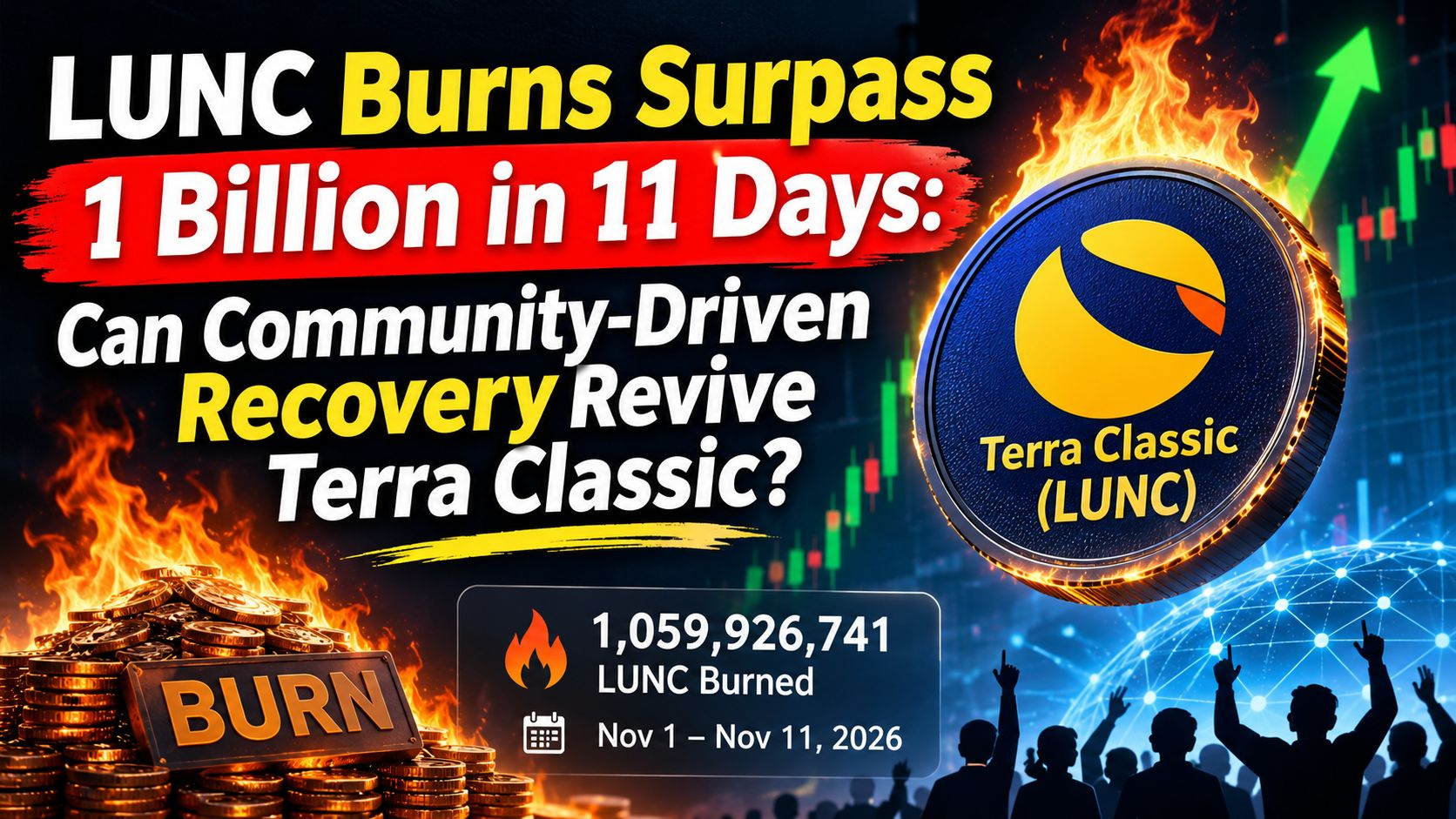

More than 1 billion LUNC tokens were burned in just 11 days. But even after removing so many tokens from circulation, is Terra Classic finally moving toward a genuine recovery, or does its future still depend largely on the expectation of continued burns?
Between November 1 and November 11, 2026, a total of 1,059,926,741 LUNC was burned on the Terra Classic network. According to the burn tracker published by $LUNC Daily on November 12, approximately 96.36 million tokens were removed from supply each day on average.
On November 4, around 155.89 million LUNC was burned, followed by another 162.37 million on November 5. These figures demonstrate that the community's efforts to reduce the circulating supply remain active.
However, investors need to understand one important distinction: token burns do not automatically translate into price appreciation. Alongside declining supply, actual market demand and network utility must also increase.
To understand LUNC's current position, it is important to revisit the collapse of May 2022. After $LUNA USD (UST) lost its dollar peg, the entire ecosystem entered a severe crisis. The supply of the original LUNA token expanded dramatically, causing its market value to collapse.
The network was subsequently split. The new Terra 2.0 launched with LUNA as its native token, while the original chain continued operating as Terra Classic, with LUNC as its token.
This distinction matters to investors. LUNC and LUNA now belong to two separate networks. Their development strategies, tokenomics, and long-term prospects must be evaluated independently.
Do Kwon's legal outcome has added another layer to the debate surrounding Terra's future. According to a December 11, 2025 announcement from the US Department of Justice, Terraform Labs co-founder Do Kwon received a 15-year prison sentence for fraud-related offenses. The court also ordered the forfeiture of more than $19 million in assets.
Later, on November 4, 2026, Singapore's International Commercial Court ordered Terraform Labs, Do Kwon, and the Luna Foundation Guard to pay approximately $1.3 million in compensation to 31 investors.
These developments have further damaged confidence in the original Terra project. However, Do Kwon's legal situation alone cannot determine LUNC's future market price.
Terra Classic is no longer dependent on a single founder in the way it once was. Its operations increasingly rely on validators, developers, token holders, and community governance.
This creates both an opportunity and a weakness for LUNC. Community participation can help keep the network operational. But long-term sustainability requires skilled developers, adequate funding, secure infrastructure, and genuine user adoption. Governance votes and token burns alone cannot make a blockchain competitive.
LUNC's burning mechanism primarily relies on three sources.
First, a portion of transaction taxes collected on the network is allocated to burns. Second, exchanges such as Binance burn LUNC using their designated trading fee contributions. Third, community members and individual wallets directly send tokens to the burn wallet.
According to LUNC Metrics data dated November 17, approximately 464.23 billion LUNC had been burned since May 2022. Of this amount, around 113.09 billion came from on-chain burns, while approximately 351.15 billion had been sent to the burn wallet.
This shows that direct community participation has played a substantial role in reducing supply. However, the effectiveness of this process depends not only on the number of tokens burned but also on the level of economic activity taking place on the network.
Terra Classic governance proposal #12223 has also attracted attention. Passed in August 2026, the proposal increased the network tax rate from 0.5% to 1.5%.
Under the proposal, the collected tax is allocated as follows: 80% to burns, 10% to the Community Pool, and the remaining 10% to the Oracle Pool.
This adjustment could increase the burn rate if network transaction activity remains stable. However, higher transaction taxes also introduce a potential downside.
If transaction costs become too expensive, users may reduce their activity on the network. In that case, even a higher tax rate might generate less total burn volume than expected.
Therefore, investors should not focus exclusively on the tax rate. Daily transactions, active wallets, and actual network usage must also be monitored to determine whether the policy is producing the intended results.
Binance's role is particularly important in this process. Historically, its monthly LUNC burns have represented one of the most significant contributions to reducing the token's supply.
According to the Binance Burn Tracker maintained by the $LUNC Community, as of November 17, the latest November burn had not yet been confirmed. The most recent confirmed monthly burn was approximately 334.87 million LUNC on October 1.
Although the community expects another Binance contribution in November, unconfirmed amounts should not be included in total burn calculations. Investors should verify Binance announcements against the actual transactions recorded on the burn wallet.
Current supply figures also provide important context. According to LUNC Metrics data dated November 17, the total supply stood at approximately 6.44 trillion LUNC, while the circulating supply was around 5.54 trillion. During the previous 30 days, approximately 2.96 billion tokens had been burned.
Even if this pace continues, significantly reducing a supply measured in trillions will take considerable time. A few days of substantial burns should not be interpreted as evidence of an immediate supply shortage in the market.
From an investment perspective, evaluating LUNC requires more than tracking burn activity. Market structure is equally important.
According to LUNC Metrics market data dated November 17, the token was trading at approximately $0.00003783, with a market capitalization of around $209 million and 24-hour trading volume of approximately $19.2 million.
Investors need to distinguish between genuine spot demand and short-term speculative trading. Exchange netflows, spot volume, Open Interest, and Funding Rates can help determine whether fresh buyers are entering the market or leveraged trading is driving activity.
A bullish scenario for LUNC would require several developments to occur together. Consistent token burns, increasing network utility, new developer activity, and sustained spot-market demand would all contribute to a stronger recovery.
On the other hand, if burns continue but network usage remains weak, liquidity deteriorates, and new investor demand fails to emerge, a meaningful price recovery will remain difficult.
A lower token supply does not automatically create a higher market price. Without sufficient buyers, the impact of burns will remain limited.
There is also an important uncertainty to consider. Projections for LUNC's future supply reduction depend on the current burn rate and the continuity of network activity. If transaction volumes decline, tax policies change, or Binance reduces its burn contributions, the expected rate of supply reduction could change significantly.
Similarly, if major holders begin selling aggressively, the positive impact of token burns may not translate into visible price appreciation.
In my assessment, LUNC's biggest challenge is no longer simply increasing the number of tokens burned. It is building a functional ecosystem alongside those burns.
Can the community attract new users? Are developers building useful applications and protocols? Will major exchanges continue supporting the burn mechanism?
The answers to these questions will be more important than short-term burn announcements.
What do you think will contribute more to LUNC's long-term price recovery: consistent burns by Binance and the community, or increased real-world utility and the development of new projects within the Terra Classic ecosystem? Share your analysis in the comments.
This article is for informational and market-analysis purposes only, not financial advice. Always conduct your own research (DYOR) before making investment decisions.