I've seen "trust me" turn into "verify me" a few times now, and it usually ends the same way: the verification part gets quietly outsourced back to trust.
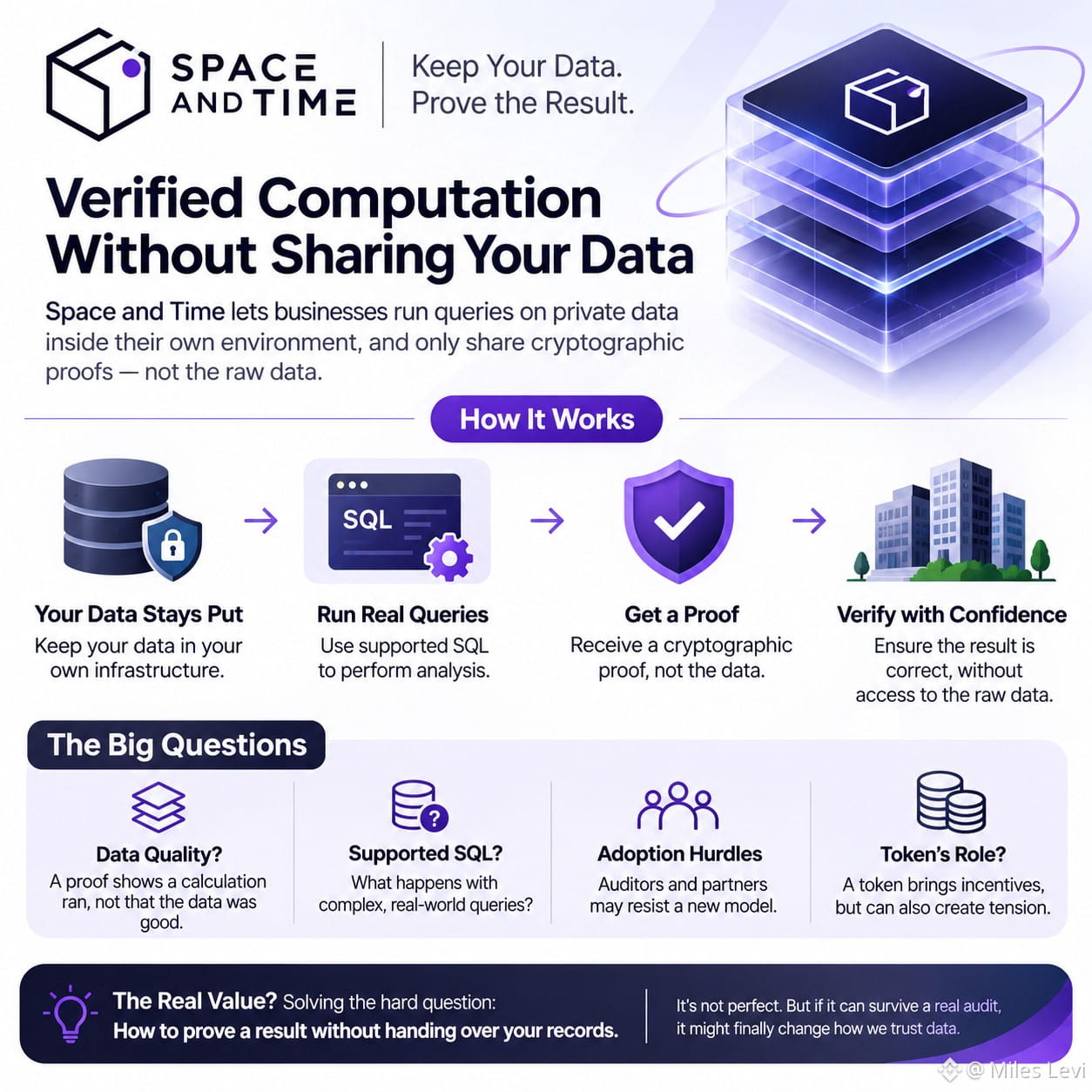
So when I read about Space and Time keeping records inside the company and only shipping out proofs, I didn't feel excited. I felt that old tiredness. But something about it caught me anyway. It doesn't ask anyone to move their data, and that's the part that usually kills these things.
Here's where I stall, though. A proof tells you a calculation ran correctly against a commitment. It says nothing about whether the data under that commitment was any good. Garbage in, cryptographically certified garbage out. I keep noticing how easy it is for people to hear "verified" and quietly translate it to "true."
And "supported SQL" is doing a lot of work in that pitch. Real businesses run ugly queries nobody planned for. What happens at the edge of what's supported? I don't know, and I don't think the post wants me to ask.
Then there's the awkward human part. Auditors have their own habits. Partners rarely want to learn a new way of trusting someone. I've watched good tech lose to a spreadsheet and a phone call more than once.
I'm also not sure what the token actually does here. Enterprises paying for software is one story. A token with its own incentives is another. I've watched those two stories fight each other before.
I don't fully trust it. But the question it raises, how to prove a result without handing over the records, is a real one. Most projects never get that far. I'd just like to see it survive one boring audit before I decide anything.
#sxt $SXT @SpaceandTime
So when I read about Space and Time keeping records inside the company and only shipping out proofs, I didn't feel excited. I felt that old tiredness. But something about it caught me anyway. It doesn't ask anyone to move their data, and that's the part that usually kills these things.
Here's where I stall, though. A proof tells you a calculation ran correctly against a commitment. It says nothing about whether the data under that commitment was any good. Garbage in, cryptographically certified garbage out. I keep noticing how easy it is for people to hear "verified" and quietly translate it to "true."
And "supported SQL" is doing a lot of work in that pitch. Real businesses run ugly queries nobody planned for. What happens at the edge of what's supported? I don't know, and I don't think the post wants me to ask.
Then there's the awkward human part. Auditors have their own habits. Partners rarely want to learn a new way of trusting someone. I've watched good tech lose to a spreadsheet and a phone call more than once.
I'm also not sure what the token actually does here. Enterprises paying for software is one story. A token with its own incentives is another. I've watched those two stories fight each other before.
I don't fully trust it. But the question it raises, how to prove a result without handing over the records, is a real one. Most projects never get that far. I'd just like to see it survive one boring audit before I decide anything.
#sxt $SXT @SpaceandTime