
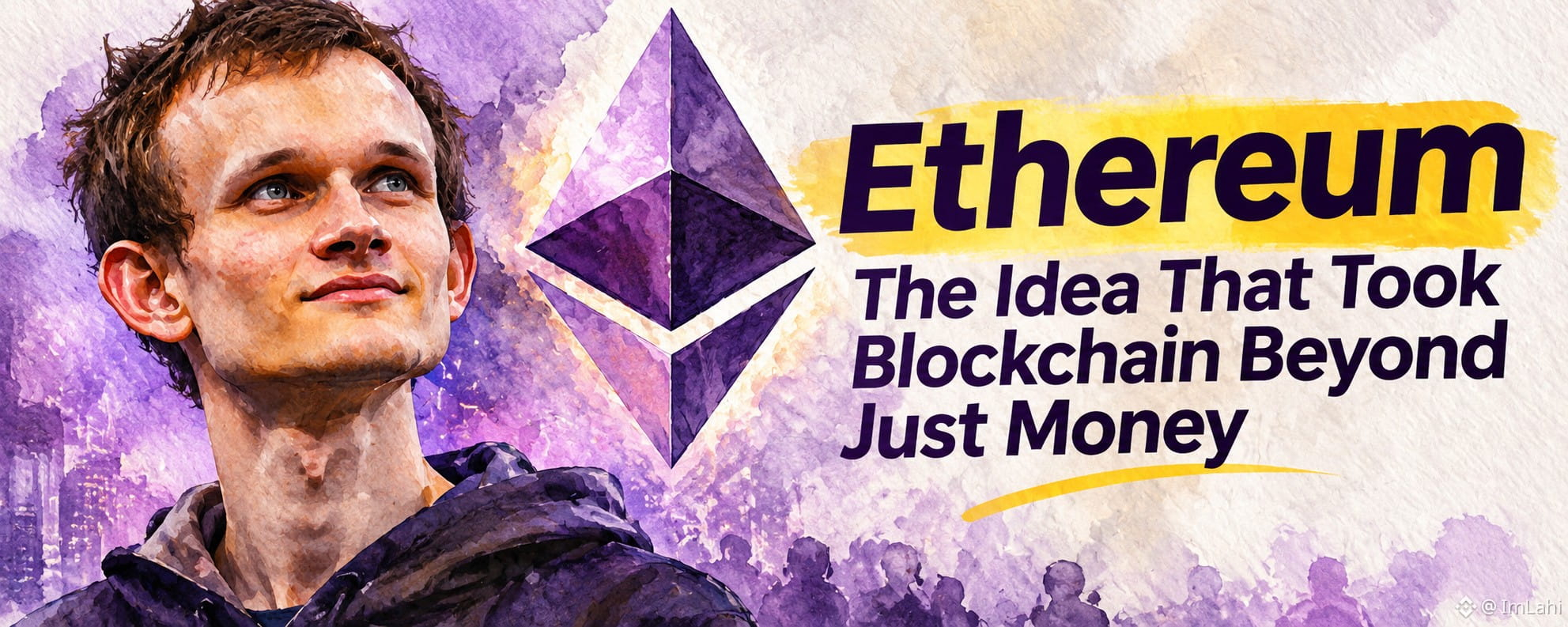

When people talk about Ethereum today, the conversation usually revolves around ETH prices, gas fees, staking, or whether it can outperform Bitcoin.
But I think the story of how Ethereum actually started is far more interesting than its price chart.
Because Ethereum wasn't originally about creating another digital currency. It was about taking the technology behind Bitcoin and asking a much bigger question.
What if blockchain could do more than just move money?
It started with a teenager who saw something missing
Back in 2011, Vitalik Buterin became interested in Bitcoin. He eventually co-founded Bitcoin Magazine and spent considerable time learning about the technology and the growing cryptocurrency community.
But there was something about Bitcoin's design that caught his attention.
Bitcoin was revolutionary because it allowed people to transfer value without depending on a central authority. However, its scripting capabilities were intentionally limited.
Vitalik imagined a blockchain that developers could use to build many different kinds of applications.
In late 2013, when he was just 19, he proposed Ethereum in a whitepaper.
And that idea would eventually become one of the most influential developments in cryptocurrency history.
Ethereum wasn't built by Vitalik alone
This is something I think deserves more attention.
Although Vitalik is the person most closely associated with Ethereum, the project was developed by a group of co-founders and early contributors.
People like Gavin Wood, Joseph Lubin, Charles Hoskinson, Anthony Di Iorio, and others played important roles in Ethereum's early development.
Gavin Wood, for example, helped define the Ethereum Virtual Machine and wrote the Ethereum Yellow Paper.
After development and fundraising in 2014, the Ethereum network officially launched on July 30, 2015.
What began as an ambitious idea had become a functioning blockchain.
The real breakthrough was smart contracts
Here's where Ethereum gets particularly interesting to me.
Instead of only recording cryptocurrency transactions, Ethereum allows developers to deploy programs called smart contracts.
These programs run on the blockchain and execute according to predefined rules.
Think about a financial application that allows people to borrow or lend crypto without a traditional bank operating the system.
Or a digital collectible whose ownership can be verified publicly.
Ethereum helped make these kinds of applications possible.
And over time, that opened the door to decentralized finance (DeFi), NFTs, DAOs, stablecoins, and thousands of blockchain applications.
Of course, smart contracts aren't automatically safe. Bugs, exploits, and poor design have caused enormous losses across crypto.
But the underlying innovation is still remarkable.
Ethereum has changed significantly since 2015
One of the things I find fascinating about Ethereum is how much the network has evolved.
In September 2022, Ethereum completed The Merge, moving from proof-of-work mining to proof-of-stake consensus.
That was a massive technical transition for an established blockchain.
Ethereum has also continued working on scalability, including upgrades designed to make layer-2 networks more efficient.
And while Ethereum still faces serious challenges involving fees, usability, competition, and decentralization, its development hasn't stood still.
So what makes ETH valuable?
ETH isn't simply a token people trade hoping its price increases.
It's the native asset of the Ethereum network.
ETH is used to pay transaction fees, and validators stake ETH to help secure the blockchain.
That creates a relationship between the asset and the network's activity.
But I think it's important to distinguish technological importance from investment performance.
A blockchain can be influential without its token necessarily delivering strong returns at every point in time.
My perspective
What interests me most about Ethereum isn't whether ETH will reach some particular price target.
It's the fact that an idea proposed by a 19-year-old helped change how people think about what blockchains can actually do.
Bitcoin demonstrated that decentralized digital money was possible.
Ethereum expanded that conversation into programmable applications and financial infrastructure.
And whether someone prefers Bitcoin, Ethereum, Solana, or another ecosystem, it's difficult to ignore Ethereum's influence on the industry.
For me, that's what makes the history worth understanding.
Here's something I'm curious about:
Do you think Ethereum will remain the leading smart-contract ecosystem over the next decade, or will another blockchain eventually take its place?