$FET: FET: When Fast Rallies Trigger an Informational Cascade
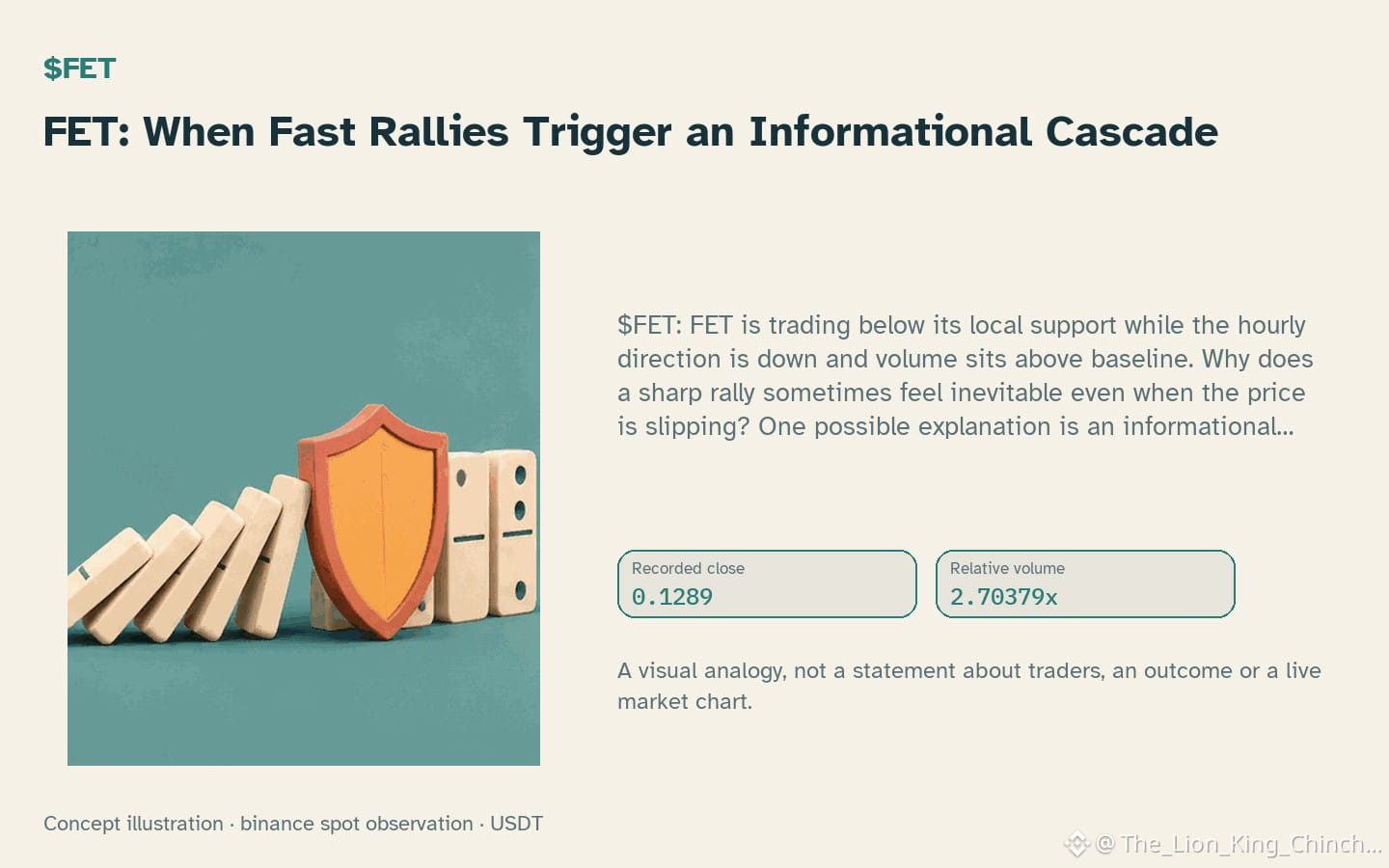
$FET: FET is trading below its local support while the hourly direction is down and volume sits above baseline. Why does a sharp rally sometimes feel inevitable even when the price is slipping? One possible explanation is an informational cascade, a form of anchoring bias where traders imitate the most recent visible action, assuming the earlier participants had better information.
In this scenario the observation shows a downtrend and strong buying volume 2.70x baseline. A trader noticing the volume spike may anchor on the idea of a sudden buying surge, overlooking the price's position relative to support 0.1296. The cascade can amplify attention on the volume signal and suppress contrary cues such as the downside direction.
A competing view treats the volume as a temporary liquidity event unrelated to future price moves. If the next closed hourly candle shows a neutral or positive change -1.15031% and RSI 32.9 near neutral, the cascade hypothesis would lose weight.
Practical self‑check: before reacting to the volume, ask whether the price action confirms the implied demand. Compare the current support level to the recent low and note if RSI remains low. If both metrics stay bearish, the cascade is likely a bias rather than a genuine reversal.
Future evidence that could weaken this interpretation includes a sustained down move despite continued high volume or a sudden drop in RSI below the oversold region. In such cases the observed volume would be better explained as a short‑term order flow anomaly rather than a collective belief shift.
Probabilistic market research, not a recommendation or guaranteed return.
A useful cross-check: $ETH has hourly direction down and volume not above its baseline; $GLMR has hourly direction down and volume not above its baseline. This alone does not establish correlation.
#FET #ETH #GLMR