
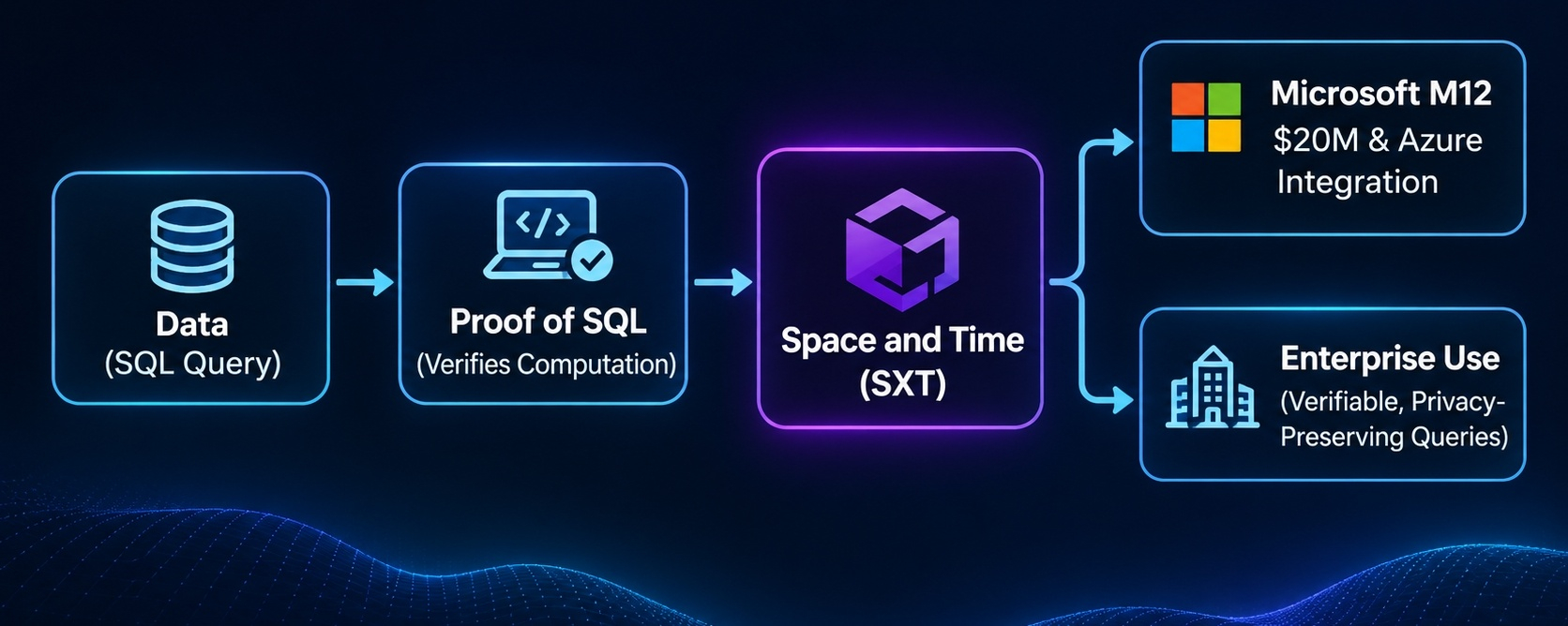


I've seen plenty of crypto projects build impressive technology, attract serious investors and still struggle to make their tokens worth holding. That's why Space and Time caught my attention. Not because of another big funding announcement, but because it's trying to solve a problem that actually matters: how do you prove that a computation was performed correctly without simply trusting whoever produced the result?
Its Proof of SQL technology is built around that question. And there's a difference here that people shouldn't overlook.
Verifying computation isn't the same as verifying reality.
A system might prove that a database query was executed correctly against a particular dataset. That doesn't automatically prove the underlying data was accurate, complete or honestly collected. If someone feeds incorrect information into a system, a perfectly verified computation can still produce a perfectly verified wrong answer. That's the part I think deserves more attention than the usual technology headlines.
The idea becomes more interesting when you consider where this could be used. Financial applications, enterprise reporting, AI systems and blockchain protocols all depend on data they often can't independently inspect. Businesses don't necessarily want to publish sensitive information just to demonstrate that a calculation is legitimate. Proof of SQL aims to address that friction by making query results verifiable without requiring users to blindly trust the database operator.
Microsoft's M12 investment adds another dimension. The reported $20 million funding round and integration with Azure suggest that serious technology investors see potential in the infrastructure. That's worth noting. But let's not confuse Microsoft's interest in the technology with an endorsement of the SXT token. Those are two entirely different things.
Enterprise adoption is where the economics get interesting. Businesses generally care about reliability, predictable costs, integration and support. They aren't sitting around waiting for a token to double in price. They want systems that work, produce accurate results and fit into existing operations without creating another expensive problem.
And that's where SXT faces a difficult question.
The technology may have a genuine commercial use, but the token still needs a reason to capture value from that activity. Enterprise billing and token speculation don't naturally operate on the same timetable. A company paying for infrastructure wants stable, predictable expenses. A crypto investor holding SXT is exposed to market volatility, liquidity conditions and changing sentiment.
Those incentives can clash.
There's also the supply question. SXT has a maximum supply of 5 billion tokens, and scheduled unlocks deserve attention. A useful network doesn't automatically create buying pressure strong enough to absorb additional circulating supply. If token distribution grows faster than actual demand, even a technically successful project can face persistent market pressure.
I've learned to be careful with projects that have impressive partnerships but haven't yet demonstrated sustained economic demand. Funding provides runway. Azure integration provides an opportunity. Neither guarantees customers will build long-term dependence on the product.
And that's the uncomfortable possibility here: Space and Time could succeed as infrastructure while SXT struggles as an investment.
Those two outcomes aren't mutually exclusive. The technology might become useful, enterprises might pay for its services, and the token could still disappoint holders.
The real test isn't another announcement or funding headline. It's whether people keep paying to use the system when the excitement fades.
Because a working product and a valuable token are two very different businesses.