@SpaceandTime Smart contracts are excellent at enforcing rules without trust. But ask one a simple data question, like “which wallets have interacted with this pool since launch?”, and it can’t answer. That gap is why I spent time studying @SpaceandTime ($SXT ).
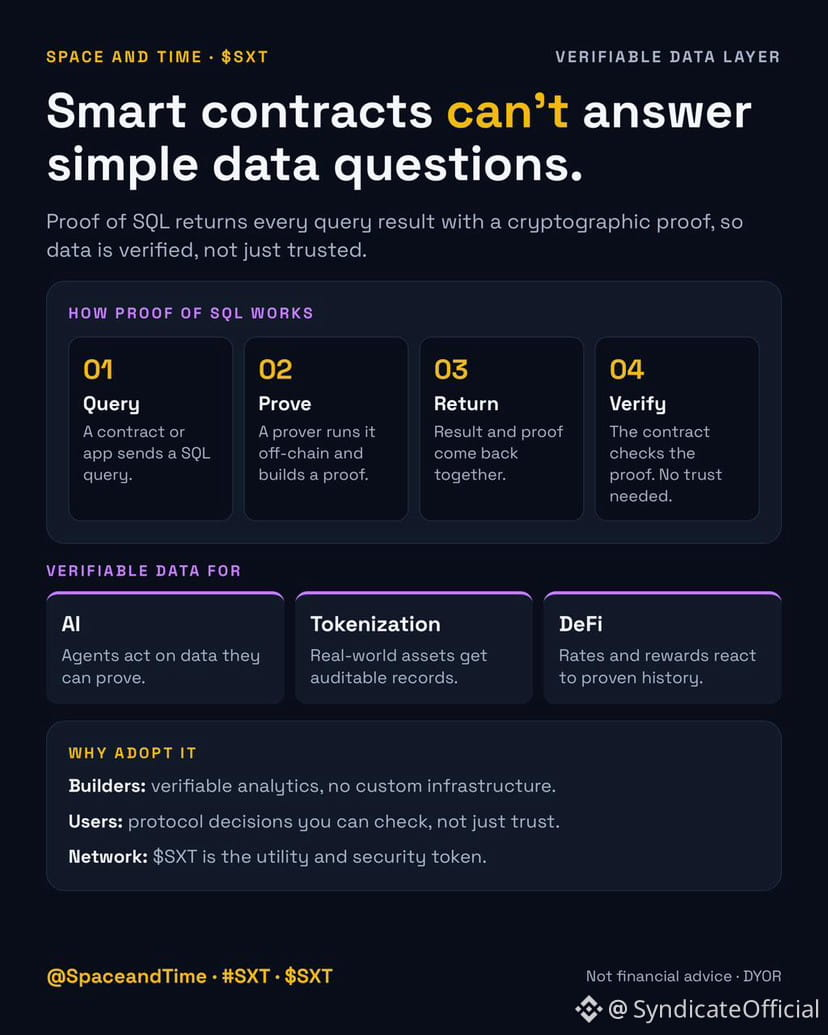
What it does: Space and Time’s Proof of SQL runs a query off-chain, then returns the result together with a cryptographic proof. The proof shows that the underlying data wasn’t tampered with and that the computation was done correctly. A contract can verify it without trusting any server, so heavy analytics stay off-chain while trust stays on-chain.
Why it fits the big narratives:
🤖 AI: agents acting on-chain need data they can prove, not data they hope is right.
🏦 Tokenization: real-world assets need records that can be audited, not just displayed.
📊 DeFi: lending parameters, rewards and risk checks can react to proven history instead of guesswork.
My experience: After going through the whitepaper and docs, what changed my view was the focus. Instead of trying to prove everything, the team built a prover specifically for SQL and reports sub-second proofs on 100k-row tables. Many projects talk about “decentralized data”. This one makes data checkable. I’ve seen how a single bad data feed can hurt a protocol, so this felt like a practical fix rather than a slogan.
Why adopt it: Builders get verifiable analytics without building their own infrastructure. Users get protocols whose decisions can be checked, not just trusted. $SXT is the network’s utility and security token.
I’m watching SXT as infrastructure, not hype. The real test is how many builders put verifiable data into production.
Not financial advice. Always DYOR.
#sxt $SXT @SpaceandTime