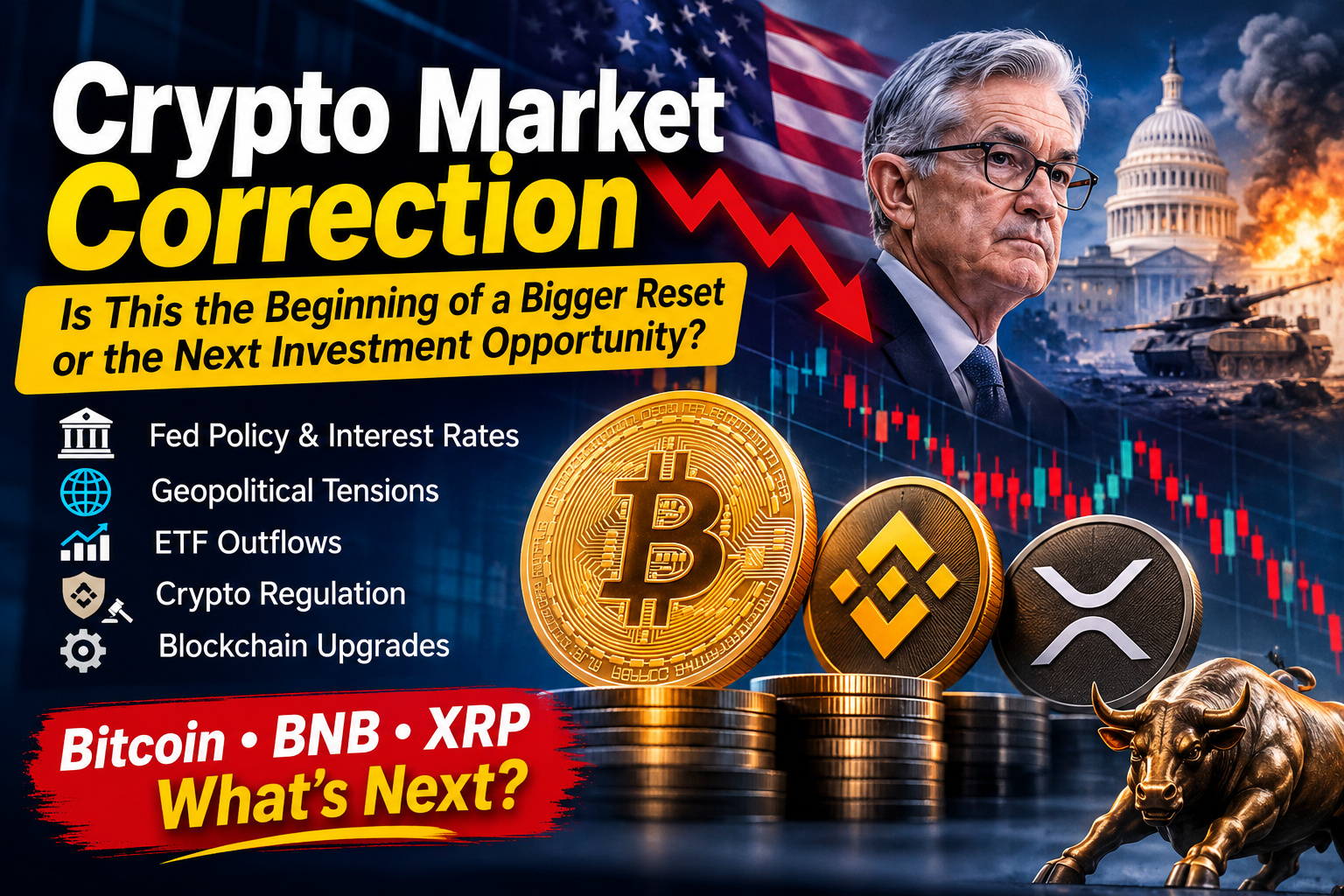

Bitcoin, BNB and XRP Under Pressure: How Fed Policy, ETF Outflows and Geopolitical Tensions Are Reshaping the Crypto Market
What if the biggest risk in today's crypto market isn't falling prices, but misunderstanding why they're falling?
Bitcoin and altcoins are facing renewed selling pressure. Institutional investors are pulling capital from crypto ETFs, uncertainty around Federal Reserve policy is weighing on risk appetite, and geopolitical tensions are adding another layer of uncertainty to global financial markets.
But price declines alone don't tell the whole story.
Behind this correction, a much bigger shift is taking place: global capital is becoming more selective about where it goes, how much risk it takes and which digital assets deserve long-term investment.
For investors, understanding these forces could be more valuable than trying to predict the next short-term price movement.
1. Crypto's Historical Shift: From an Alternative Asset to an Institutional Market
Bitcoin emerged after the 2008 global financial crisis. Its original appeal was built around financial independence, limited supply and an alternative to traditional monetary systems.
But the market has changed considerably.
Institutional investors, regulated investment products and major financial intermediaries now play a much larger role in crypto.
The launch of US spot Bitcoin ETFs in 2024 accelerated that transition. Traditional investors could gain Bitcoin exposure without directly managing wallets or private keys.
That brought new capital into the market. It also introduced a new source of selling pressure.
When institutions reduce exposure to risky assets, Bitcoin can face selling alongside technology stocks and other growth investments.
This is an important lesson: Bitcoin has its own monetary design, but its market price is increasingly influenced by global liquidity and institutional risk appetite.
2. Federal Reserve Policy: Why Interest Rates Matter for Crypto
The Federal Reserve remains one of the most important external forces influencing digital asset valuations.
On October 28, 2026, the Fed maintained its benchmark interest-rate range at 3.75%–4.00%. Two policymakers preferred a 25-basis-point increase, highlighting continuing disagreement over inflation risks.
Why should crypto investors care?
Because interest rates influence where institutional capital goes.
When interest rates remain high, government bonds and other yield-generating assets become more attractive. That can reduce demand for speculative investments.
A stronger US dollar can add further pressure to Bitcoin and altcoins.
There is another important point: a rate pause does not automatically mean easier monetary conditions.
Investors should watch inflation data, Treasury yields, dollar strength and the Fed's policy guidance rather than treating every pause as a bullish signal.
3. ETF Outflows: Institutional Investors Are Becoming More Cautious
ETF flows offer a useful window into institutional sentiment.
US spot Bitcoin ETFs recorded approximately $1.07 billion in net outflows during the week ending November 13. This followed another period of substantial withdrawals.
Across seven consecutive trading sessions, Bitcoin ETFs experienced approximately $1.91 billion in outflows.
Ethereum ETFs also faced pressure, recording nearly $399 million in weekly withdrawals.
These numbers suggest that institutional demand has weakened.
However, investors should avoid jumping to conclusions. ETF outflows do not necessarily mean institutions have abandoned Bitcoin.
They may reflect profit-taking, portfolio rebalancing or a temporary reduction in risk exposure.
The more important question is whether the outflows continue.
A sustained return of ETF inflows, supported by stronger spot-market demand, would provide a more convincing recovery signal than a short-lived price bounce.
4. Geopolitics: How Global Political Decisions Affect Crypto Prices
Crypto investors often focus on charts, technical indicators and exchange activity.
But some of the biggest market movements begin far away from the crypto industry.
Consider the relationship between geopolitical tensions and financial markets.
Geopolitical escalation → Higher energy prices → Inflation concerns → Higher bond yields → Tighter financial conditions → Reduced appetite for risky assets → Pressure on Bitcoin and altcoins.
For example, disruptions to major energy supply routes can push oil prices higher.
That can complicate inflation management and make central banks more cautious about cutting interest rates.
The opposite can also happen.
Diplomatic progress, lower energy prices and improved trade relations may reduce inflationary pressure and support risk assets.
There is also a longer-term strategic battle underway.
The United States, China and other major economies are competing over financial infrastructure, semiconductor technology, payment systems and digital asset regulation.
Stablecoins, tokenized assets and blockchain-based settlement networks are becoming part of this competition.
For investors, this means crypto is increasingly connected to the broader financial and geopolitical system.
5. US Crypto Regulation: Could Policy Clarity Attract More Capital?
Regulation remains a major factor in determining how much institutional capital enters the crypto industry.
The proposed CLARITY Act aims to establish clearer responsibilities for the SEC and CFTC in overseeing digital asset markets.
The SEC's proposed Regulation Crypto Assets framework could also influence disclosure and offering requirements for certain crypto-related activities.
Why does this matter?
Large investors generally need clear rules, reliable custody arrangements and predictable compliance requirements before committing significant capital.
Political developments are equally important.
On November 12, the White House submitted nominees for SEC and CFTC positions to the Senate. The changing political balance following the midterm elections could also influence the future direction of crypto legislation.
But investors need to separate political expectations from actual regulatory outcomes.
A nomination is not an appointment. A proposal is not an enacted law.
Markets may react to expectations, but long-term investment decisions should be based on confirmed policy changes.
6. BNB and XRP: Two Different Investment Opportunities
Not every cryptocurrency should be evaluated using the same investment framework.
BNB and XRP have different use cases, market drivers and risk factors.
BNB (BNB): The Exchange and Blockchain Ecosystem
BNB's investment case is closely connected to Binance and the BNB Chain ecosystem.
Its utility includes transaction fees, decentralized applications and participation in the broader network.
During a market correction, investors should look beyond the token price.
Network transactions, active addresses, decentralized exchange activity, developer participation and token supply changes can help assess whether the ecosystem remains healthy.
A falling price does not automatically mean the underlying network is weakening.
But strong network activity alone does not guarantee an immediate price recovery either.
XRP (XRP): Payments and Institutional Infrastructure
XRP follows a different investment narrative.
Its long-term potential is linked to payment infrastructure, liquidity and the development of the XRP Ledger ecosystem.
Investors should monitor actual network usage, payment-related adoption, institutional participation and regulatory developments.
Positive headlines can generate short-term buying pressure.
However, sustainable growth requires more than announcements. It needs measurable economic activity and consistent demand.
For both assets, the current correction is an opportunity to reassess fundamentals and valuation—not a reason to buy blindly.
7. Blockchain Upgrades: Why Technology Still Matters During a Sell-Off
One interesting feature of crypto markets is that development does not stop when prices fall.
Blockchain networks continue upgrading their infrastructure, improving transaction efficiency and attracting developers.
Solana's Alpenglow upgrade and ecosystem developments have drawn attention to network performance and transaction finality.
Its Breakpoint conference in London, scheduled for November 15–17, also brings developers, investors and financial institutions together.
These developments matter because long-term crypto valuations cannot depend entirely on market sentiment.
Investors should ask three questions:
Is the network becoming more useful?
Are developers and users actively participating?
Is real economic activity growing?
A conference announcement or new project launch can create excitement. But actual adoption is what deserves closer attention.
8. Meme Coins and Emerging Altcoins: Opportunity Comes With Higher Risk
Meme coins and newly launched tokens can attract enormous attention during bullish market conditions.
But they are also among the most vulnerable assets when liquidity disappears.
Their prices often depend on social sentiment, speculative demand, concentrated ownership and leveraged trading.
Before investing, examine token distribution, circulating supply, upcoming unlocks and actual market liquidity.
Funding rates and open interest can also reveal whether excessive leverage is building up.
A large online community does not necessarily indicate a sustainable project.
BNB and XRP have identifiable ecosystem and payment-related narratives. Smaller altcoins and meme coins often carry significantly higher uncertainty.
Investors should allocate capital accordingly rather than treating every trending token as a long-term investment.
9. How Investors Can Navigate the Current Correction
The biggest mistake during a market correction is assuming that every price decline represents a buying opportunity.
Some corrections recover quickly. Others develop into prolonged downtrends.
A disciplined strategy should focus on three things.
First: Protect Your Capital
Reduce excessive leverage. Avoid chasing falling prices with large positions.
Watch funding rates, open interest and liquidation activity. If leverage remains elevated while prices continue falling, another wave of forced selling may follow.
Keeping some capital in reserve provides flexibility.
Second: Wait for Confirmation
Look for signs that selling pressure is weakening.
Important indicators include:
Bitcoin holding important support levels.
Higher lows forming on the daily chart.
ETF outflows slowing or reversing.
Stronger spot-market buying.
Excessive leverage declining.
Altcoin strength improving relative to Bitcoin.
No single indicator confirms a market bottom. Several signals should support the same direction.
Third: Accumulate Selectively
Instead of deploying all available capital at once, consider staggered entries.
Bitcoin may serve as the core allocation for investors seeking greater liquidity and market depth.
$BNB and $XRP can provide additional exposure to specific blockchain and payment-related narratives.
Smaller altcoins and meme coins should generally receive much smaller speculative allocations.
The goal is not to buy the exact bottom. It is to build positions at prices where the potential return justifies the risk.
10. The Global Political-to-Portfolio Map
For investors, the real advantage comes from understanding how political and economic decisions affect their holdings.
Global development Market impact Possible crypto reaction
Fed rate increase Tighter liquidity BTC and altcoin pressure
Lower inflation Improved easing expectations Potential bullish sentiment
Geopolitical escalation Higher energy and supply risks Increased volatility
Stronger US dollar Tighter global financial conditions Pressure on crypto
Bitcoin ETF inflows Institutional demand increases Potential BTC support
ETF outflows Institutional exposure declines Selling pressure
Clearer crypto regulation Lower compliance uncertainty Potential long-term investment growth
Blockchain adoption Greater network utility Selective altcoin opportunities
These relationships are not automatic.
Markets often react before a decision becomes official because investors price in expectations.
That is why understanding the difference between political headlines, actual policy changes and measurable economic effects is essential.
11. What Could Trigger the Next Crypto Recovery?
Three developments deserve particular attention.
1. A shift in Federal Reserve expectations
Softer inflation and a less restrictive monetary outlook could improve liquidity expectations. However, a rate cut is never guaranteed.
2. A reversal in ETF flows
Consistent Bitcoin and Ethereum ETF inflows would suggest that institutional investors are becoming more comfortable with current valuations.
3. Stronger blockchain fundamentals
Growing network usage, sustainable DeFi activity, institutional settlement and real-world asset adoption could help distinguish fundamentally stronger projects from speculative tokens.
The December 8–9 FOMC meeting will be another important event to watch. Investors will be looking beyond the rate decision to understand how the Fed views inflation and future monetary policy.
Final Investment Perspective: Follow Capital, Not Just Headlines
The current correction is a reminder that crypto markets do not operate in isolation.
Federal Reserve policy influences the cost of capital. Geopolitical tensions affect energy prices and inflation. Institutional flows determine how much money enters or leaves the market. Regulation influences which projects can attract long-term investment.
For Bitcoin, the immediate challenge is stabilizing market structure and restoring institutional demand.
For BNB and XRP, the key question is whether ecosystem utility and adoption can translate into sustainable token demand.
For smaller altcoins and meme coins, liquidity, token distribution and speculative positioning remain major risks.
My approach is straightforward: don't rush to call the bottom.
Watch where institutional capital is moving, monitor macroeconomic signals and focus on assets with measurable utility.
The next major opportunity may not come from buying the biggest dip. It may come from recognizing which projects can survive the correction and attract capital when market conditions improve.
What is your strategy in this correction? Are you accumulating $BTC , BNB and XRP at lower levels, keeping cash on the sidelines, or looking for opportunities in emerging altcoins? Share your analysis in the comments.
Disclaimer: This article is for educational and informational purposes only. It is not financial or investment advice. Cryptocurrency investments involve substantial risks, including the possibility of losing your entire investment. Always conduct independent research (DYOR) and manage your risk carefully.



#USSpotXRPETFsSeeLargestWeeklyOutflowIn8Months #CryptoSelloffTriggersMultipleWhaleLiquidations #BitcoinActiveSupplyInProfitDropsBelow45% #Geopolitics #CryptoAnalysis