
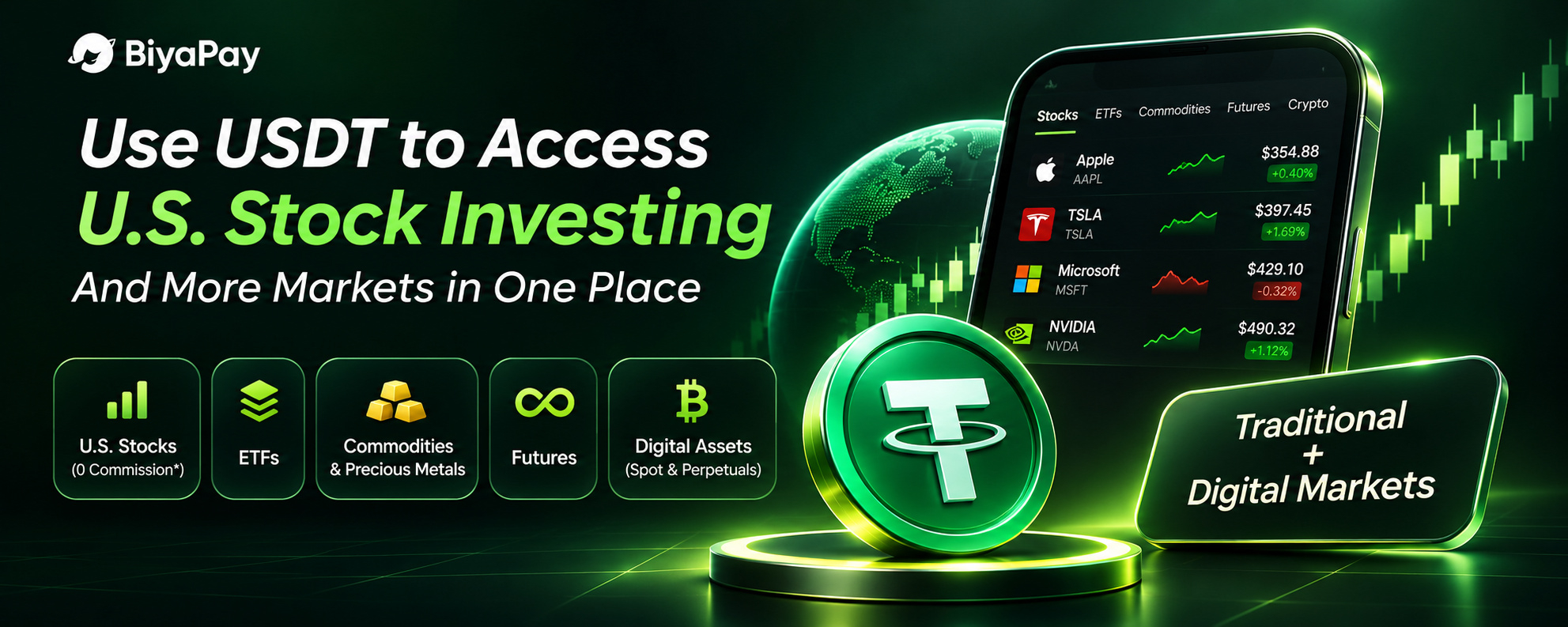

A person holding USDT may have more than one financial goal.
They might want exposure to established U.S. companies, explore ETFs, follow commodity markets or trade digital assets. The challenge is finding a practical way to access these different markets without constantly moving between separate platforms and funding systems.
This raises an interesting question: can someone use their existing USDT balance to access traditional financial markets while still having access to cryptocurrency trading?
BiyaPay is one platform exploring this combination. Its services bring together U.S. and Hong Kong stocks, ETFs, commodities, forex and digital asset markets.
But before looking at the features, it's worth understanding what this combination actually means for someone managing their money.
The problem with managing different markets separately
Traditional investing and digital asset trading often operate through different financial systems.
Someone interested in U.S. stocks may need a brokerage account, an accepted funding method and a way to convert their money into the required currency.
Meanwhile, someone trading cryptocurrencies may already have USDT in a digital asset account.
Moving between these systems can introduce extra steps. There may be currency conversion costs, transfer charges, account requirements and different settlement arrangements.
This becomes particularly relevant for people outside the United States who want to explore U.S. markets while holding digital assets.
Having USDT available doesn't automatically give someone access to every traditional investment product. The funding route, account eligibility and supported instruments still matter.
Using USDT to access U.S. stocks
One of the features advertised by BiyaPay is the ability to fund its investment services using digital assets.
According to its official stock service information, the general process involves:
1. Registering for an account.
2. Completing identity verification.
3. Depositing fiat currency or supported digital assets.
4. Converting USDT into USD or HKD where required.
5. Transferring funds into the relevant investment account and trading.
The platform advertises zero commission for U.S. stock trading and describes its stock service as providing access to real stocks, ownership and dividends.
This can be relevant to investors who already hold USDT and want another funding route for accessing U.S. equities.
However, zero commission should be understood as a specific fee category. Other charges may still apply, including platform fees, external institution fees, regulatory charges, currency conversion costs or transfer fees.
The actual costs should be checked against the current fee schedule and order confirmation before trading.
Traditional markets extend beyond individual stocks
Another interesting part of the platform is the range of traditional market categories displayed on its investment interface.
These include:
ETFs: Exchange-traded funds provide exposure to baskets of securities or specific market segments. Depending on the fund, this could include broad market indexes, fixed income or particular sectors.
Commodities: Commodity-linked markets provide exposure to assets such as gold, silver and crude oil. These instruments can behave differently from individual company shares.
Precious metals: Gold and silver are commonly followed by investors interested in commodity markets and alternative asset exposure. Before trading, it's important to understand whether the product represents a fund, a commodity-linked instrument or another type of contract.
Futures: Futures markets allow traders to take positions based on the expected future price of an underlying asset. They involve additional risks and may require margin.
The availability of these categories gives users a wider range of markets to explore. However, the specific instruments, trading conditions and access requirements should always be checked inside the platform.
Digital asset trading remains part of the picture
Traditional financial products are only one side of this combination.
BiyaPay also displays cryptocurrency spot and perpetual markets.
Spot trading involves buying or selling an asset at the prevailing market price, with the transaction settled according to the platform's rules.
Perpetual contracts are different. They allow traders to speculate on price movements without holding the underlying asset in the same way as a spot purchase. They can also involve leverage and funding payments.
The distinction matters because the risks are not the same.
BiyaPay's published spot fee information currently lists a zero maker fee and a 0.08% taker fee. Some individual perpetual contract pages advertise zero maker fees. These figures should not be treated as a universal zero-fee guarantee across every trading pair or product. Check the applicable fee schedule before placing an order.
Leveraged perpetual trading can lead to rapid losses, including liquidation of a position. It requires a clear understanding of margin, funding rates and position risk.
What about regulation and settlement?
This is an area where investors should take their time.
A platform offering access to financial products does not automatically mean every product is covered by the same regulatory framework.
BiyaPay's published regulatory disclosure identifies BIYA GLOBAL LIMITED as a New Zealand-registered Financial Service Provider and BIYA GLOBAL LLC as registered with FinCEN as a Money Services Business.
The same disclosure describes the U.S. Broker-Dealer licence application as being pursued. That wording should not be confused with confirmation that the entity already holds a Broker-Dealer licence.
Investors should verify the legal entity providing the service, its current regulatory status, the applicable custody arrangements and the protections available for the specific product they intend to use.
Settlement also deserves attention. A platform may advertise fast or instant settlement, but the actual process depends on the instrument, order execution, market arrangements and any third-party institutions involved.
A zero-commission headline or a fast-settlement description should never replace a review of the actual trading and transfer terms.
Why this combination matters
The interesting development here is the possibility of managing exposure to traditional financial markets and digital assets through a connected platform.
For someone holding USDT, that could mean having a route to explore eligible U.S. stocks and ETFs while also accessing supported cryptocurrency markets.
BiyaPay is positioning its platform around this combination of traditional finance and digital asset trading.
Still, having multiple markets available does not mean every product is suitable for every investor. Stocks, ETFs, commodities, futures and perpetual contracts have different structures, costs and risk profiles.
The sensible approach is to understand the instrument first, confirm that it's available to your account, review its fees and check how deposits, withdrawals and settlement work.
Final thoughts
The relationship between traditional finance and digital assets continues to evolve.
For people who already hold USDT, platforms connecting these markets offer another route to explore. BiyaPay is one example, bringing together access to U.S. and Hong Kong stocks, ETFs, commodities, forex and cryptocurrency trading.
The real value of this kind of setup depends on the products available to you, the total cost of using them and the protections attached to each service.
Before moving funds, read the relevant terms and verify the details for the specific market you plan to access.
Disclaimer: This article is for educational purposes only and does not constitute investment, legal or financial advice. It is not a recommendation to buy, sell or hold any asset. All financial products involve risk, including the possible loss of capital. Futures and leveraged perpetual contracts carry additional risks. Product availability, fees, regulatory status and settlement arrangements may vary. Verify current information through official sources before making any financial decision.
#BiyaPay #USDT #USStocks #TradFi #DeFi #ETFInvesting #CommodityTrading #PreciousMetals #CryptoTrading #DigitalAssets #PerpetualTrading #BinanceSquare