Ten dollars. That's what it cost to rob a DeFi protocol this week.
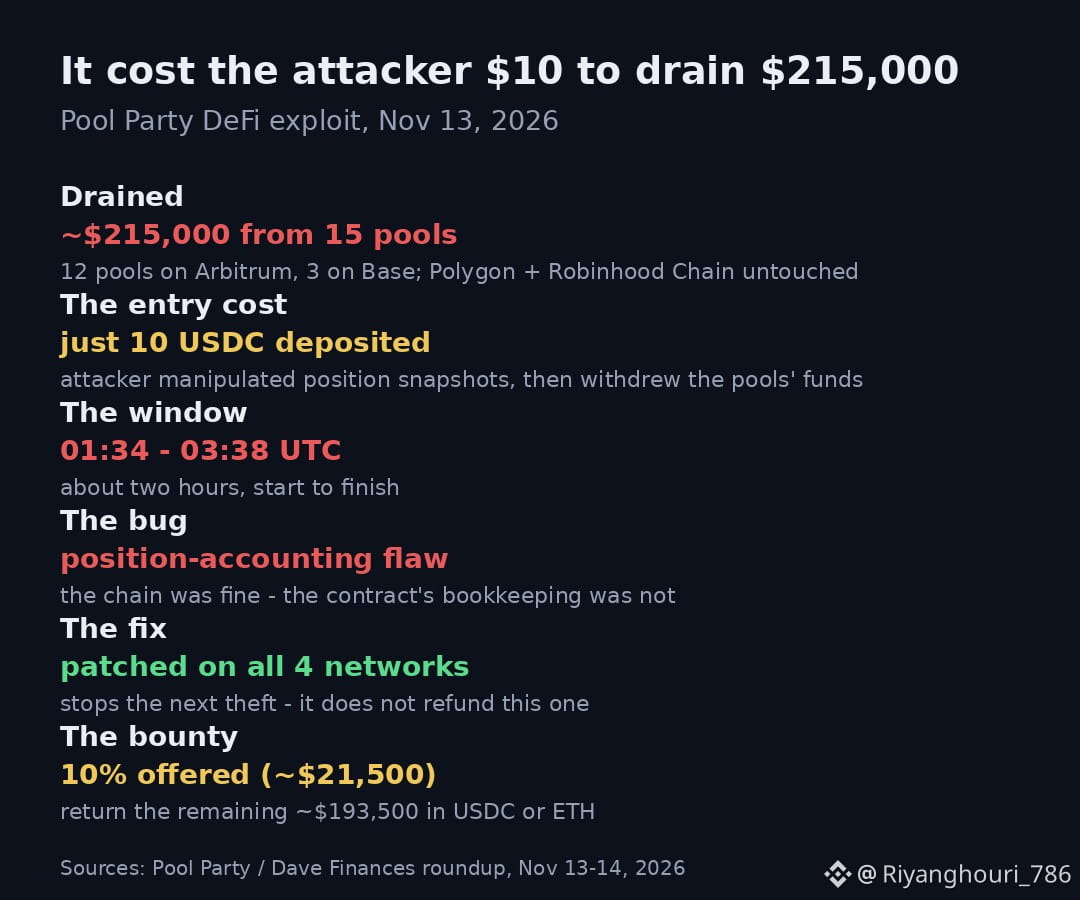
Pool Party confirmed an attacker drained about $215,000 from 15 of its liquidity pools on Thursday — 12 on Arbitrum, 3 on Base — by exploiting a flaw in the smart contracts that record user positions. The attacker deposited just 10 $USDC, manipulated the position snapshots, and walked out with the pools' funds. Two hours, start to finish.
The protocol has patched the vulnerability across all four of its networks, and it's now offering the attacker a 10% bounty — roughly $21,500 — to return the rest. But here's the part that should bother you: the patch is live and the money is still gone. A fix stops the next theft. It doesn't refund this one.
My take: this is the same class of bug that keeps draining DeFi — position-accounting errors, not broken blockchains. The chain did nothing wrong; the contract's bookkeeping did. And that's exactly why I don't park serious money in small, new pools no matter how good the yield looks. If you can't find a real audit and a track record, the APY is not worth it — because the attacker only needed $10 to find out what you didn't.
Do you check audits before you put money into a new pool, or do you just look at the yield?
Pool Party confirmed an attacker drained about $215,000 from 15 of its liquidity pools on Thursday — 12 on Arbitrum, 3 on Base — by exploiting a flaw in the smart contracts that record user positions. The attacker deposited just 10 $USDC, manipulated the position snapshots, and walked out with the pools' funds. Two hours, start to finish.
The protocol has patched the vulnerability across all four of its networks, and it's now offering the attacker a 10% bounty — roughly $21,500 — to return the rest. But here's the part that should bother you: the patch is live and the money is still gone. A fix stops the next theft. It doesn't refund this one.
My take: this is the same class of bug that keeps draining DeFi — position-accounting errors, not broken blockchains. The chain did nothing wrong; the contract's bookkeeping did. And that's exactly why I don't park serious money in small, new pools no matter how good the yield looks. If you can't find a real audit and a track record, the APY is not worth it — because the attacker only needed $10 to find out what you didn't.
Do you check audits before you put money into a new pool, or do you just look at the yield?