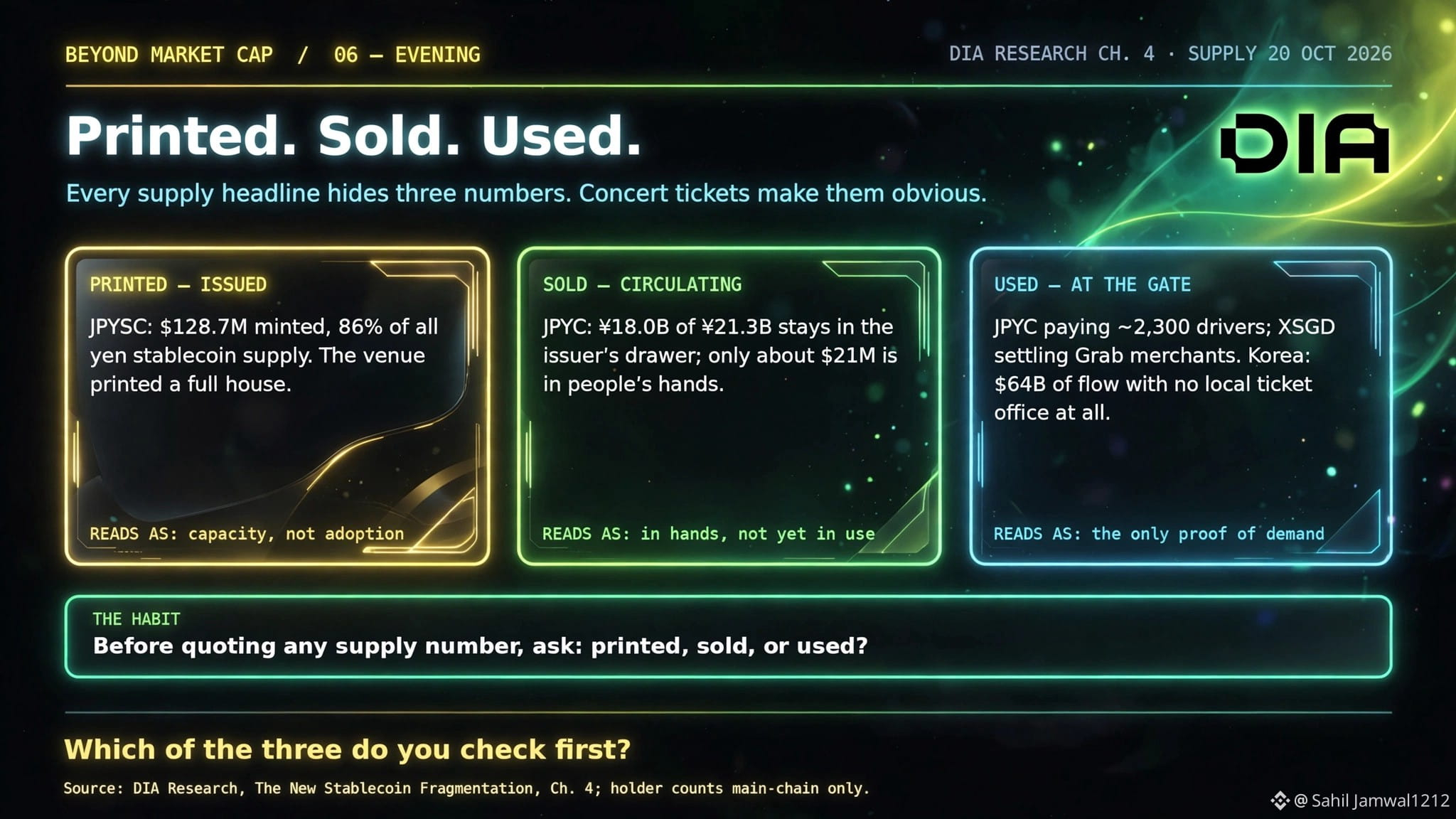
One habit can prevent bad stablecoin analysis: separate three numbers.
ISSUED. CIRCULATING. USED.
Think of concert tickets. A venue prints 10,000 tickets but keeps 9,000 in its own drawer. Only 1,000 are released. If 600 are scanned at the entrance, that is evidence of actual use.
Stablecoins need the same distinction.
Japan’s JPYSC had around $128.7M issued in $DIA ’s 20 October 2026 snapshot, representing 86% of tracked yen stablecoin supply. But two addresses associated with one exchange held roughly $64M each.
That shows concentrated custody, not two individual holders or broad retail adoption.
JPYC had around ¥21.3B in contract supply. After excluding approximately ¥18B held in issuer treasury, about $21M remained in circulation.
It also had around 3,000 holder addresses across four chains and a planned payment rollout involving approximately 2,300 logistics drivers and contractors. Planned does not mean completed.
South Korea offers another contrast: no regulated won stablecoin was live in the report’s snapshot, yet buyers purchased approximately $64B in stablecoins over 12 months.
That $64B is a purchase flow, not outstanding supply.
My checklist:
• Issued: How much was created?
• Circulating: How much remains after issuer treasury is excluded?
• Used: Is there evidence of actual distribution and payment activity?
Addresses are not people. Exchange custody is not automatically retail adoption.
Before quoting a stablecoin supply figure, ask: issued, circulating or used?