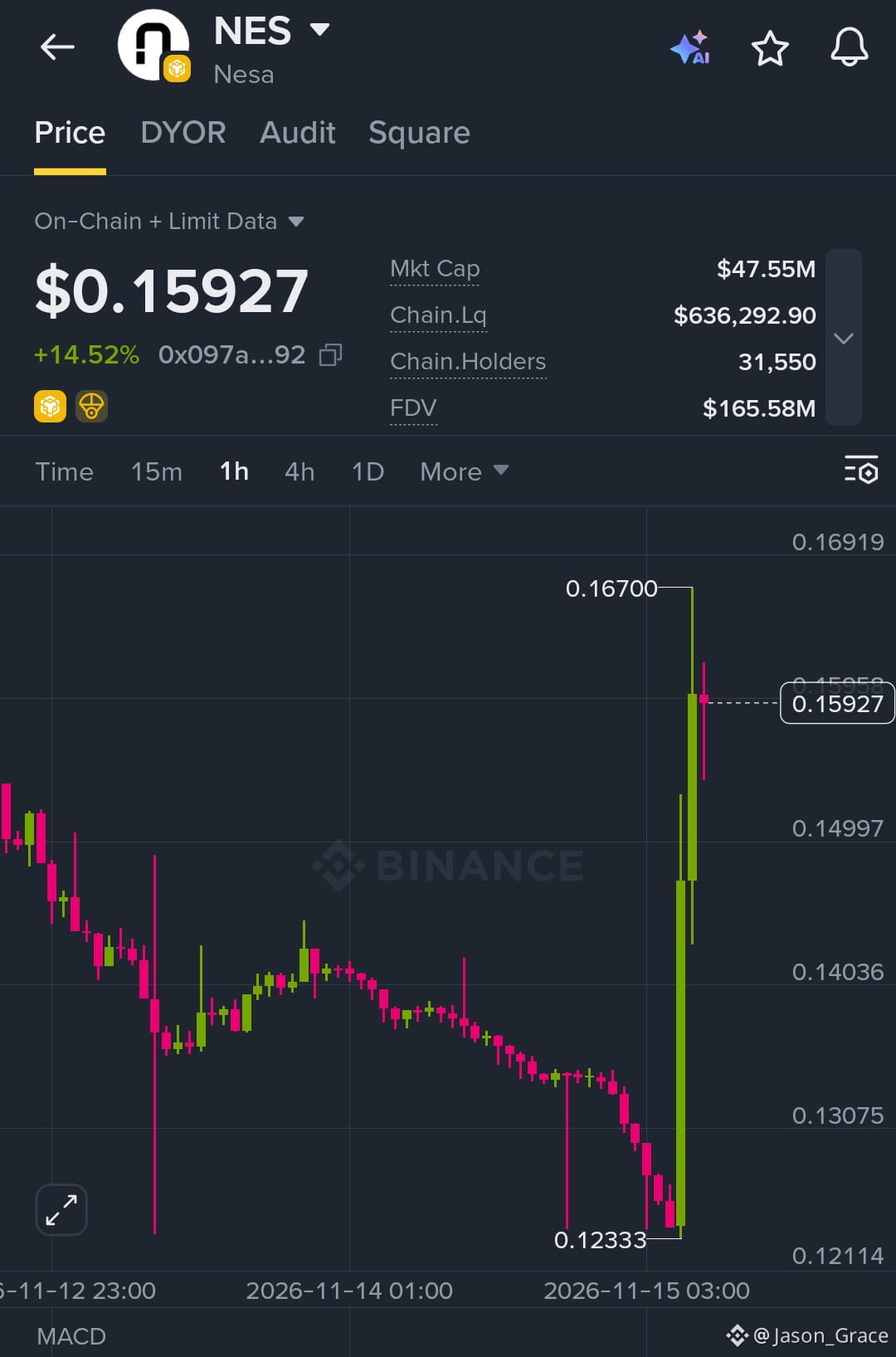

Nesa ($NES ) caught my attention after a sharp move to $0.15927, up 14.52% on the chart I reviewed. Its market capitalization is around $47.55 million, while FDV stands at $165.58 million. That valuation gap made me stop scrolling, because the project’s underlying technology deserves a closer look.
From what I can tell, Nesa is building a decentralized AI infrastructure designed to make AI execution more private, transparent, and verifiable. Instead of relying entirely on centralized AI providers, it distributes model inference across independent network participants. Its approach combines cryptography, distributed computing, and verification mechanisms to make AI outputs more trustworthy.
One strength I find interesting is how NES connects the network's actual operations to its token. NES is used for transaction fees, staking, validator participation, minor rewards, and payments to model owners. This creates a direct relationship between network activity and token utility, rather than depending entirely on speculative demand.
However, the supply structure deserves attention. Nesa launched with 1 billion genesis tokens, and its tokenomics also include an inflation mechanism that gradually declines toward a 1.8% annual floor. According to published vesting data, approximately 20.8 million NES tokens are scheduled to unlock on December 24, 2026. That represents roughly 2.1% of the genesis supply, creating another factor worth monitoring.
The interesting part is the difference between Nesa's technological ambitions and NES's current market valuation. The infrastructure has a clear purpose, but sustained adoption and demand for inference services still need to translate into measurable token demand.
Will real AI usage become Nesa's next major catalyst, or will growing token supply remain the bigger challenge?
#USPPIMissMayEaseBTCPressure
#USSpotXRPETFsSeeLargestWeeklyOutflowIn8Months
#WhoWillSucceedJensenHuangatNvidia?
#WhatWillDriveCryptoandStocks’NextRebound?