

Disclosure: It is not financial advice
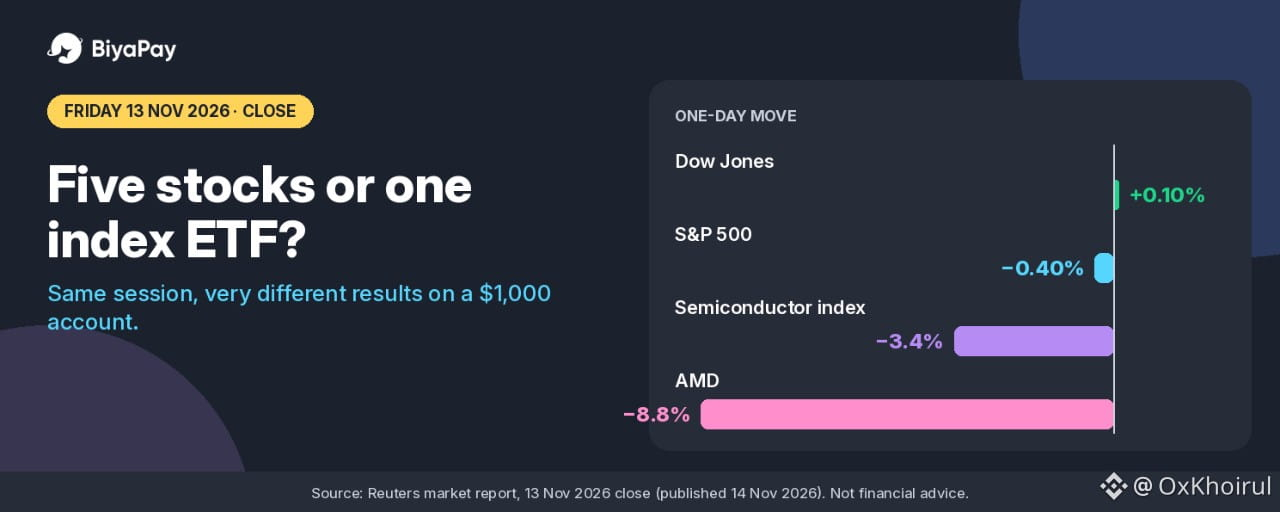
On Friday, 13 November 2026, the S&P 500 closed down 0.40 percent. On the same day, Advanced Micro Devices fell 8.8 percent, Broadcom fell 4.8 percent, and the Philadelphia Semiconductor Index fell 3.4 percent, according to Reuters. The Dow Jones Industrial Average actually closed 0.10 percent higher.
Same market, same session, very different results. The gap between those numbers is the whole argument of this article.
A common piece of advice for small accounts is "just split your money across five stocks and you are diversified." A second one is "buy one index ETF, it is always the cheaper choice." Friday's numbers, and BiyaPay's published US stock fee rules, suggest both claims are only half true.
This is not a recommendation to buy or sell any stock or fund. It is a worked comparison using official and reputable figures, with a 1,000 dollar example that is an illustration, not a suggested order size.
What one session did to 1,000 dollars
Take 1,000 dollars and put it to work three different ways, using Friday's actual closing moves.
All of it in one chip stock that fell 8.8 percent: the position loses 88 dollars in one session.
Split into five equal 200 dollar positions, where one of them is that same stock and the other four are unchanged: the account loses 17.60 dollars, or 1.76 percent. The one bad position still hurts, but it is one fifth of the damage.
All of it tracking the S&P 500, which fell 0.40 percent: the account loses about 4 dollars, before any tracking difference or fund costs.
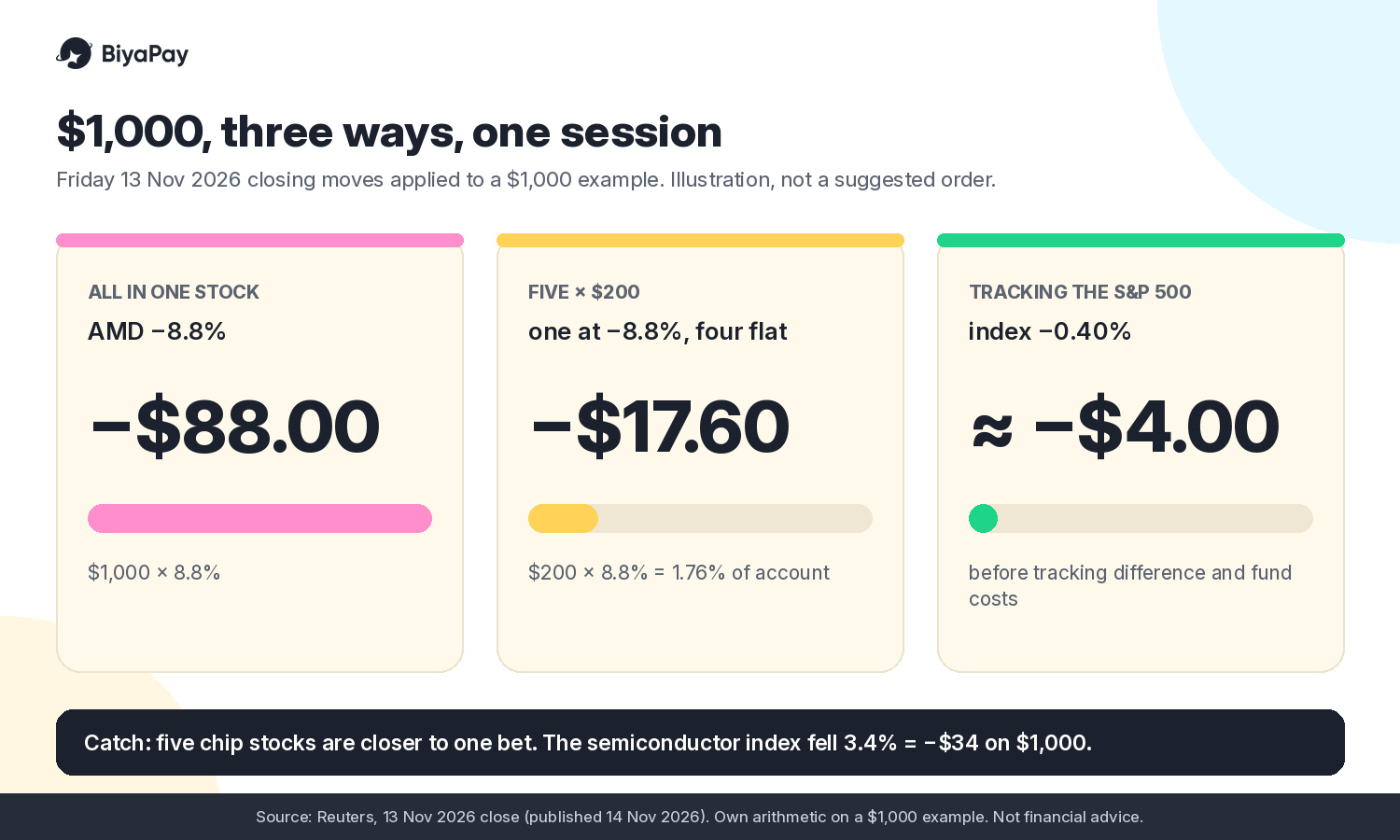
That middle case comes with a catch that is easy to miss. "Five stocks" only spreads risk if the five stocks do not all react to the same news. Five chip names are closer to one bet with five tickers. On Friday the semiconductor index as a whole fell 3.4 percent, which on 1,000 dollars is 34 dollars, more than eight times the S&P 500's move.
The index does not avoid chip stocks either
The opposite mistake is to think an index fund simply sidesteps a sector sell-off. It does not. It holds the sector at whatever weight the index gives it.
State Street's official page for the SPDR S&P 500 ETF Trust (SPY), with holdings as of 12 November 2026, lists the index weight of Nvidia at 6.15 percent and Broadcom at 2.65 percent. Information Technology is 36.15 percent of the index.
A rough contribution check: Nvidia fell 2 percent on Friday and Broadcom fell 4.8 percent, according to Reuters. At those weights, Nvidia's move takes about 0.12 percentage points off the index, and Broadcom's takes about 0.13 points. Together that is roughly 0.25 points of the index's 0.40 percent decline, from just two companies. Weights shift during the day, so treat this as an approximation, not an official attribution.
So the index ETF did not dodge Friday. It diluted it. That is a real difference, but it is not immunity. In a broad market decline the index falls too, and with 36 percent in technology, a tech-led sell-off reaches an index holder more than the word "diversified" suggests.
What the order fees add on BiyaPay
Here is where the "five stocks" approach has a cost that a 1,000 dollar account feels more than a large one.
BiyaPay's official article on US stock fees, published on 2 June 2026 and still showing the same schedule when I checked it on 15 November 2026, says commission is 0 dollars, while the platform fee is 0.005 dollars per share, with a minimum of 0.99 dollars per order and a maximum of 1 percent of the transaction value. External institution fees, trading activity fees, and sell-related items can also apply.
On small orders the per-share calculation is usually below the minimum, so the 0.99 dollar minimum is what applies. On a 200 dollar order, 1 percent is 2 dollars, so the cap does not bring it lower. Using only that platform-fee minimum:
One order of 1,000 dollars: 0.99 dollars to buy, 1.98 dollars to buy and later sell. That is about 0.2 percent of the account for the round trip.
Five orders of 200 dollars: 4.95 dollars to buy, 9.90 dollars to buy and later sell. That is about 0.99 percent of the account, five times as much, before any external fees.
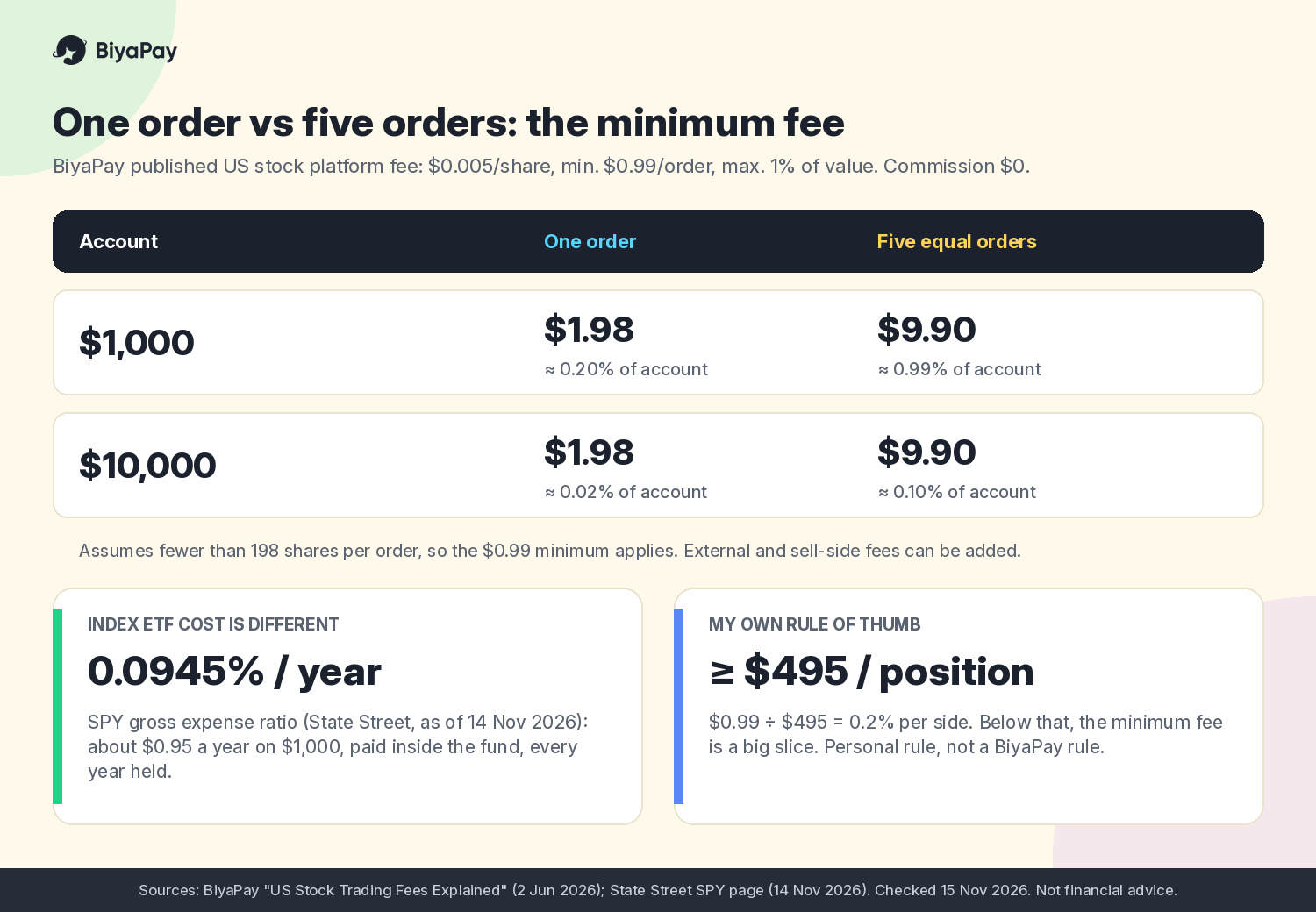
Now scale the same split to 10,000 dollars. If each order is still under 198 shares, so the per-share calculation stays below the minimum, five orders of 2,000 dollars still cost 9.90 dollars for a round trip, which is about 0.1 percent of the account. The fee did not change. The account size did.
The index ETF has its own cost, and it is a different kind. State Street lists SPY's gross expense ratio at 0.0945 percent a year, as of 14 November 2026. On 1,000 dollars that is about 0.95 dollars a year, taken inside the fund rather than charged per order. It is small, but it repeats every year you hold, while an order fee is paid once per trade.
There is one more practical detail. SPY closed at 757.12 dollars on 12 November 2026, according to State Street. A 1,000 dollar account can buy one whole share and has about 243 dollars left over. BiyaPay's Help Center says some US stocks support fractional trading, and its fee article says an order below one share is charged a 1 percent platform fee capped at 1 dollar, with no commission or third-party fees. I would check in the app whether a specific ETF supports fractional orders before planning around that. I have not assumed it does.
BiyaPay's Help Center also says it can currently trade all US stocks, including ETFs. So the choice between one fund and several single names is available on the same account. The question is which one fits the account size.
When five single stocks make sense, and when they do not
Five single stocks can make sense when:
The account is large enough that the minimum fee is a small slice of each position. At 0.99 dollars per order, a 495 dollar position keeps the minimum at about 0.2 percent per side.
The five companies are genuinely different businesses that do not move on the same headline. A bank, a retailer, a drug maker, an energy company, and a software company spread risk. Five chip makers do not.
You actually want to avoid what the index is heavy in. With 36 percent of the S&P 500 in technology, someone who wants less tech exposure cannot get that from the index alone.
They make less sense when:
The account is small and every position is under a few hundred dollars. The minimum fee then becomes a meaningful percentage before the stock has moved at all.
The five picks are really one theme. That is concentration with extra fees.
You plan to rebalance or trade often. Each trade on each name pays the minimum again.
And the index ETF is not automatically right either. It cannot outperform the market it tracks, it charges an annual expense ratio, and it fell on Friday along with everything it holds.
My view
In my view, the first 1,000 dollars of a US stock account is not the place to build a five-stock portfolio. The numbers say the five-order version costs about five times as much in platform-fee minimums, and the protection it buys depends entirely on whether the five stocks are truly different. Friday showed what happens when they are not.
I would rather start with one broad position, accept that it holds tech at the index weight, and add single names only when each new position is large enough that the 0.99 dollar minimum stays near 0.2 percent per side. That works out to roughly 500 dollars per position or more. That is a rule I would set for myself, not a rule from BiyaPay.
A short checklist I would use before splitting money across stocks:
Divide 0.99 by the planned position size. If the result is above about 0.2 percent per side, the position is small relative to the minimum fee.
Ask whether the stocks would all fall on the same headline. If yes, count them as one bet.
If using an index ETF, read its official holdings and sector weights, so you know what it already contains.
Check the order preview on BiyaPay for the actual fee, including external and sell-side items, before sending the order.
Fees, fund expenses, and index weights change. I would re-read the official fee article, the fund's own page, and the order preview before acting.
Sources: Reuters market report on 13 November 2026 trading, published 14 November 2026; State Street Investment Management, SPDR S&P 500 ETF Trust (SPY) page: top holdings and sector weights as of 12 November 2026, closing price as of 12 November 2026, gross expense ratio as of 14 November 2026; BiyaPay article "Biya U.S. Stock Trading Fees Explained" (published 2 June 2026); BiyaPay Help Center, "What types of US stocks can BiyaPay trade?" and "What is the minimum number of shares I can buy for US stocks?" (both 10 February 2026). All checked on 15 November 2026 (Asia/Jakarta, UTC+7).