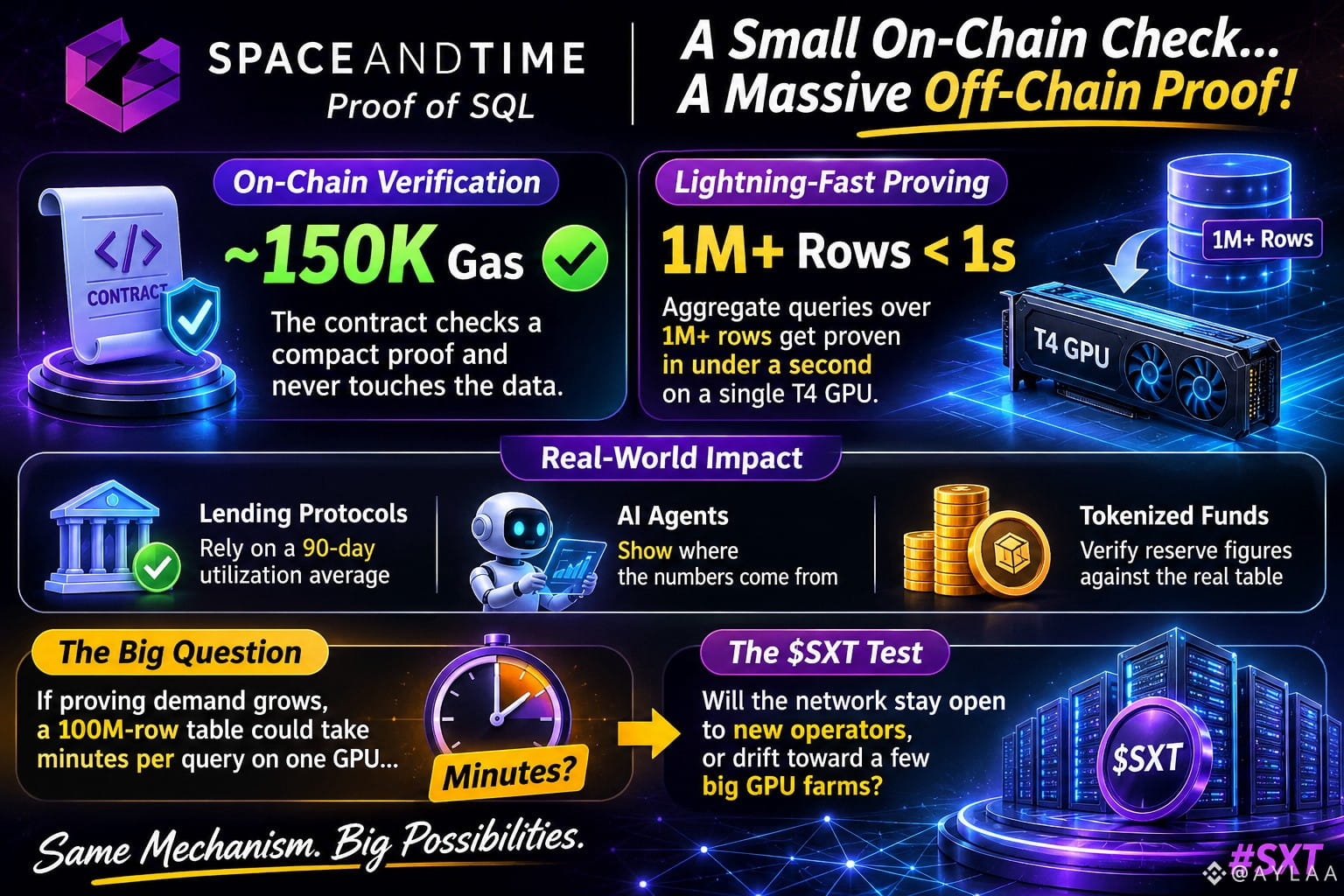

#sxt $SXT @SpaceandTime Something odd stood out while I was reading through the Proof of SQL docs... the proof gets verified on-chain for about 150k gas, and it doesn't really care how big the table was.
Verification can cost as little as roughly 150k gas, while aggregate queries over 1M+ rows get proven in under a second on a single T4 GPU. The earlier benchmark was 3.2 seconds on a million rows, so the prover has gotten a lot faster. The contract's job stays small either way. It checks a compact proof and never touches the data.
I think that split is the whole story. A lending protocol could rely on a 90-day utilization average without trusting whoever calculated it. An AI agent could show where its numbers came from. A tokenized fund's reserve figure could be checked against the table behind it. Same mechanism each time, which is why @SpaceandTime is more interesting to me than the "verifiable data" label suggests.
My hesitation is on the proving side. Checking is cheap, but proving time grows with table size. If it scaled linearly (my own rough assumption, not a published benchmark), a 100M-row table turns seconds into minutes per query on one GPU. Demand like that would make GPU access the bottleneck, and then the question is who ends up running the provers.
That's probably where $SXT gets tested, since it's what's meant to line up who proves and who pays. #SXT
If proving demand ever gets heavy, does the network stay open to new operators, or does it drift toward a few big GPU farms?