
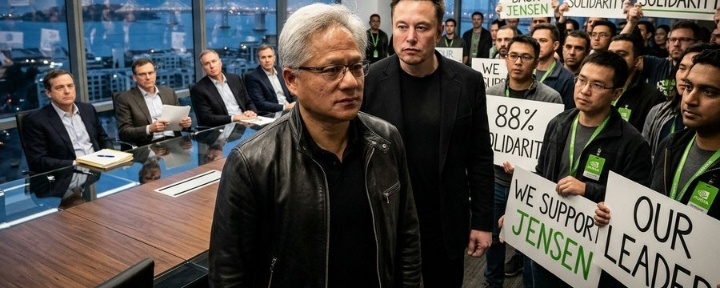



After Nvidia’s board forced Jensen Huang out, Silicon Valley and Wall Street began fighting back.
Wall Street funds fire the first shot
First, look at what the money side is doing. Two prominent tech funds with heavy Nvidia holdings, Altimeter and Atreides, together manage more than $25 billion in assets. They were the first to jointly publish an open letter demanding that Nvidia’s board reinstate Jensen Huang as CEO.
These two funds actually hold very small stakes in Nvidia, together less than 0.1%, but they carry enormous clout on Wall Street and in Silicon Valley. In 2022, when Mark Zuckerberg stubbornly doubled down on the metaverse, burning tens of billions of dollars in a single year and sending Meta’s stock price plunging, it was Altimeter that sent an open letter forcing Zuckerberg to lay off large numbers of employees, slash metaverse spending, and pivot entirely to AI.
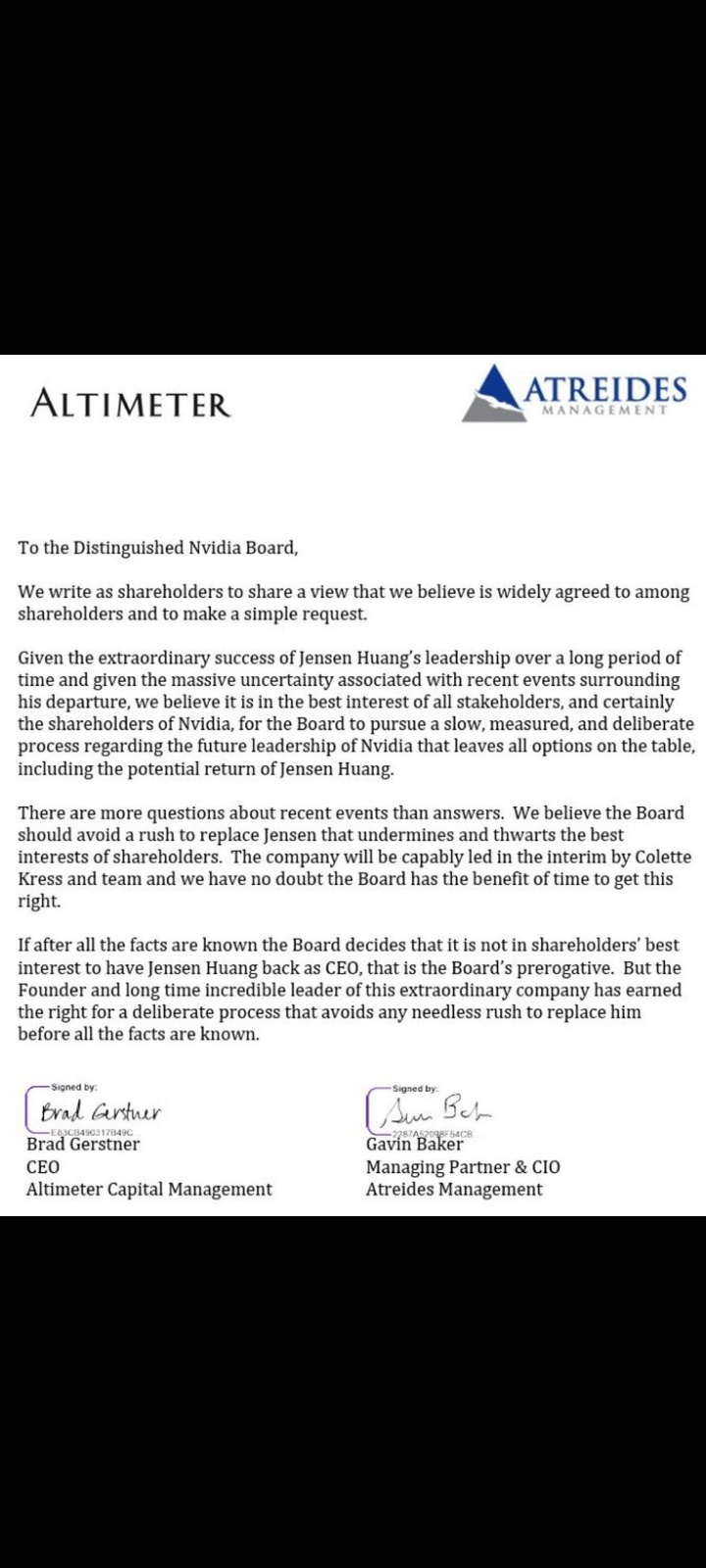
Of course, the ones who can really settle the matter are Nvidia’s three largest shareholders on Wall Street: Vanguard, BlackRock, and Fidelity, which together hold roughly 20% of Nvidia’s shares. These financial giants rarely publicly trade insults the way Silicon Valley investment funds do, but now that their more aggressive, influential junior partners have fired the first shot, it is very much worth watching whether these three giants will come out in support of Jensen Huang’s return.
Musk leads the charge, Silicon Valley heavyweights rally behind him
A group of Silicon Valley founders has also begun rallying behind him. Musk, along with the founders of Uber, Shopify, Replit, and Vercel, have all publicly posted in support of Jensen Huang’s reinstatement. Prominent Silicon Valley investor Naval put it bluntly: Jensen Huang is Nvidia’s Steve Jobs, and no one can replace him.
Musk went even further yesterday, making five public statements in a single day. That morning, he was still just replying with a Hmm as an onlooker. By noon, he replied Indeed in agreement. By the afternoon, he had announced that he would sign the reinstatement petition himself. That evening, he reposted the major shareholders’ open letter and endorsed the comparison of Jensen Huang to Steve Jobs. In just one day, he had gone from agreeing to leading the charge in pressuring the board.
90% of employees back the boss coming home
The same is true inside Nvidia. When a longtime employee posted a protest on the company’s internal network, more than 1,600 comments poured in, all calling on the board to bring the boss back. In a poll of Nvidia employees on an anonymous Silicon Valley community, nearly 90% backed Jensen Huang, while only 1% supported the board’s decision to oust him. These employees have worked under him for so many years, and their fortunes were all built on Nvidia stock. In their hearts, there is only one boss.
This is only just beginning. From here on, the people on Nvidia’s board who oppose Jensen Huang will face mounting pressure from employees, shareholders, partners, and customers until they compromise and give in.
A product of partisan political warfare in the US, with Wall Street having the final say
Over the past couple of days, a racist narrative has been circulating widely in X’s Chinese-language community, claiming that Jensen Huang was ousted because he is Chinese. In reality, this is a narrative being pushed by people with a mission to conduct external propaganda. The real reason for what happened to Jensen Huang has nothing to do with race. It is the result of partisan political warfare in the US.
Before this, Jensen Huang had been actively lobbying Washington to get the US government to ease restrictions on chip exports to China. His confidence in taking such a high-profile stance came mainly from two sides: on one side was Trump, who cared more about doing business and making money and took a pragmatic approach, largely turning a blind eye to the issue; on the other were forces within Washington that supported easing chip restrictions on China, such as Commerce Secretary Howard. Treasury Secretary Bessent had publicly complained that Trump was getting too close to Jensen Huang.
But after the midterm elections, the political winds in Washington shifted completely. As Democrats regained control of both the Senate and the House, the hawks who took a hard line on the chip embargo against China began to dominate the debate, and many Democrats had already been openly calling for action against Big Tech. Among the many tech and Wall Street heavyweights, Jensen Huang, who had been on the front lines lobbying to sell chips to China, naturally became their first target.
So, to put it plainly, Jensen Huang’s ouster this time is fundamentally a product of partisan political warfare in the US. But the ultimate outcome will still depend on how Wall Street lines up and makes the final call. No matter how bitterly the two US parties fight, capital still has the final say.