
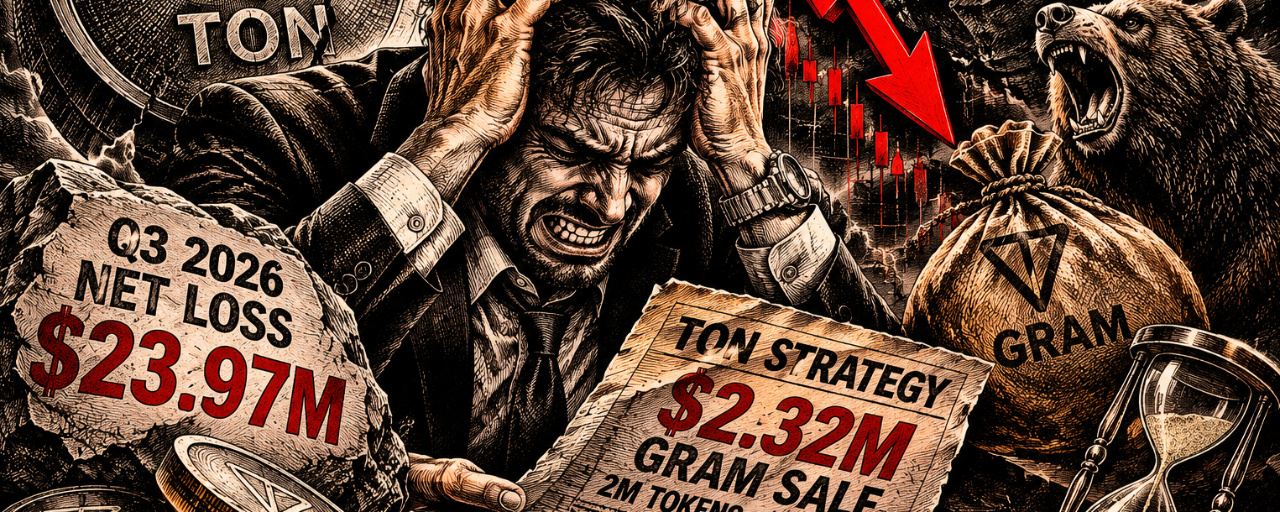

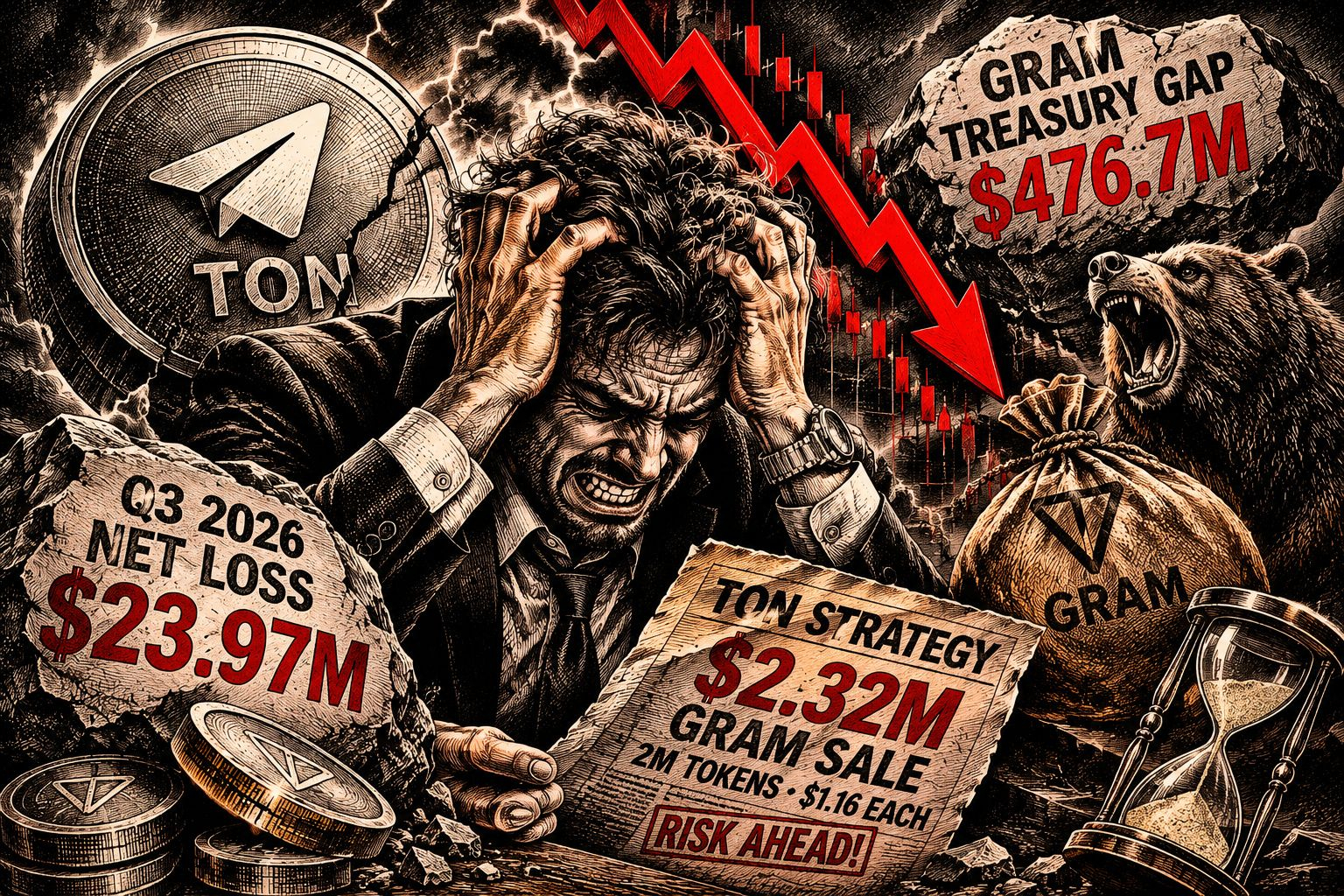
#TONStrategyReports$23.97MQ3NetLoss
🚨 TON STRATEGY Q3 2026: THE $23.97M LOSS IS NOT THE BIGGEST WARNING — THE $476.7M GRAM TREASURY GAP IS
TON Strategy Company (NASDAQ: TONX) | Q3 2026 Financial & Treasury Analysis
📅 November 14, 2026
🎯 Prepared for: Crypto traders, investors and exchange readers
🔍 EXECUTIVE SUMMARY
TON Strategy Company reported a $23.97 million consolidated net loss for Q3 2026.
At first glance, the headline looks alarming. But the composition of that loss tells a more complicated story.
The company generated $13.065 million in staking revenue and approximately $3.977 million in operating income from continuing operations. Nevertheless, a $27.228 million unrealized fair-value loss on digital assets pushed its quarterly financial result into negative territory.
However, there is a bigger development investors should not ignore.
🪙 TON Strategy held approximately 235.13 million GRAM, with a reported cost basis of $744.75 million.
The treasury's reported valuation changed significantly:
September 30: $348.46 million.
November 11: $268.04 million.
That represents an approximately $80.41 million decline in reported treasury value after quarter-end.
Additionally, the company disclosed that it sold 2 million GRAM for $2.32 million between October 1 and November 12.
⚠️ The central investment question is no longer simply why TONX reported a quarterly loss. It is whether the company can preserve shareholder value while its underlying GRAM treasury remains substantially below its acquisition cost.
1. 💰 DECODING THE $23.97M NET LOSS
The Q3 financial results reveal an important distinction between operating performance and treasury valuation.
📈 Total revenue: $13.065 million.
🏢 Operating income from continuing operations: $3.977 million.
📉 Unrealized digital-asset fair-value loss: $27.228 million.
🔴 Consolidated net loss attributable to common shareholders: $23.968 million.
📊 Loss per share: $0.42.
What actually happened?
The primary pressure came from the decline in the fair value of the company's GRAM treasury.
Under fair-value accounting, digital assets are revalued as market prices change. When GRAM declines, the company must recognize the resulting valuation loss.
But investors should understand three things:
✅ An unrealized loss does not automatically mean cash has left the company.
⚠️ Staking revenue is not necessarily equivalent to cash received.
📉 If tokens are eventually sold below their cost basis, the economic loss becomes realized on those disposals.
The company earned approximately 9.43 million GRAM through staking during the quarter, recognizing approximately $13.065 million in revenue based on their accounting value when earned.
The business is generating staking income, but its treasury remains exposed to token-price depreciation.
2. 🪙 THE TREASURY PROBLEM: $744.75M COST VS. $268.04M VALUE
This is arguably the most important part of the entire report.
TON Strategy reported approximately:
🪙 Total GRAM holdings: 235.13 million tokens.
💰 Total acquisition cost basis: $744.75 million.
📊 September 30 fair value: $348.46 million.
📉 November 11 indicative fair value: $268.04 million.
At September 30, the treasury was approximately 53.2% below its reported cost basis.
By November 11, the indicative valuation gap had widened to approximately $476.71 million.
That represents a valuation decline of approximately 64% relative to the historical cost basis.
🧠 What should investors understand?
The company's historical acquisition cost is not a guaranteed recovery target.
GRAM does not need to return to the company's average acquisition price for the token to remain economically viable.
However, the difference between acquisition cost and current market value highlights the scale of treasury concentration risk.
The real challenge is preserving future economic value, not defending historical purchase prices.
3. 🚨 THE SIGNAL THE HEADLINE HIDES: TONX HAS STARTED SELLING GRAM
One of the most important post-quarter developments appeared in the company's SEC filing.
Between October 1 and November 12:
GRAM sold: 2 million tokens.
💵 Cash proceeds: $2.32 million.
Average implied sale price: approximately $1.16 per token.
The quantity represents less than 1% of the September 30 treasury holdings.
Therefore, this should not be interpreted as evidence of a major treasury liquidation.
But the development deserves attention.
Why does this matter to GRAM traders?
There are two possible interpretations.
🟢 Positive interpretation
The company has converted part of its treasury into dollar liquidity.
Cash can support operations and capital allocation.
A relatively small sale does not necessarily indicate financial distress.
🔴 Negative interpretation
Further sales could introduce additional token supply.
Repeated treasury monetization could weaken investor confidence.
Continued GRAM price depreciation could increase pressure to preserve cash.
Importantly, the filing confirms token sales and proceeds, but does not establish that all transactions were executed directly through public exchange order books.
Trading signal: Watch subsequent treasury disclosures and verified GRAM transfers. Do not automatically interpret corporate sales as immediate exchange-market selling pressure.
4. 📈 STAKING REVENUE: THE BUSINESS IS STILL GENERATING INCOME
TON Strategy's staking operation remains an important part of its treasury strategy.
The company reported approximately:
🪙 235.13 million GRAM in total holdings.
🔒 232.87 million GRAM deployed in staking.
📊 Approximately 99.04% of holdings staked.
🎁 9.43 million GRAM earned as staking rewards.
💰 $13.065 million in recognized staking revenue.
📈 Approximately 16% annualized gross staking yield.
This is a meaningful positive.
The company continues generating additional GRAM through its staking strategy.
But there is a major distinction between earning more tokens and increasing dollar-denominated wealth.
For example, if staking generates additional GRAM while the token's market price declines, the treasury can still lose substantial dollar value.
Furthermore, approximately 119.10 million GRAM remained subject to transfer restrictions at September 30.
Those tokens cannot be treated as freely available liquidity until their restrictions expire.
⚠️ A 16% annualized gross token yield is not a guaranteed 16% dollar return.
Staking income is productive treasury activity, not protection against market depreciation.
5. 🏦 CASH RESERVES, DEBT AND SHAREHOLDER CAPITAL
The balance sheet offers another important perspective.
At September 30, 2026:
💵 Cash and cash equivalents: $25.30 million.
🏦 Total assets: $379.08 million.
📋 Total liabilities: $6.77 million.
📊 Total shareholders' equity: $372.31 million.
✅ No debt reported at quarter-end.
🔻 Nine-month cash used in continuing operations: $15.42 million.
There is also an important capital-allocation development.
TON Strategy repurchased approximately 1.79 million shares for $5.74 million during Q3.
This indicates management's willingness to allocate capital toward share repurchases.
However, a buyback is not automatic proof of undervaluation.
Investors should also monitor outstanding warrants, restricted stock units and any future share issuance.
🧠 The key question is whether the company can maintain sufficient dollar liquidity while preserving its GRAM treasury and shareholder value.
6. 🌐 TELEGRAM AND TON ECOSYSTEM: THE LONG-TERM CATALYST
The investment thesis is not based exclusively on token prices.
TON Strategy's treasury is connected to the broader TON ecosystem.
Two developments deserve attention:
📱 Telegram's Gram Wallet rollout: A potential distribution channel for GRAM-related services and ecosystem activity.
⚙️ TON protocol upgrades: Improvements in smart-contract architecture and network throughput could support greater ecosystem utility.
These developments may contribute to long-term demand through payments, applications and network participation.
However, announcements alone do not establish sustainable token demand.
Investors should monitor:
Active wallet adoption.
Actual network transactions.
Staking participation.
Network fees and activity.
Token liquidity and market depth.
Potential ecosystem growth is a catalyst, not a guarantee of token-price recovery.
7. 🎯 WHAT THIS MEANS FOR CRYPTO TRADERS
🪙 GRAM spot traders
Monitor treasury sales, token transfers, market depth and liquidity.
The important signal is whether additional supply enters the market and whether buyers can absorb it.
⚡ GRAM derivatives traders
Do not assume that treasury stress automatically creates forced liquidations.
The company has no reported debt at quarter-end, and its staked holdings are not equivalent to leveraged margin collateral.
Watch volatility, funding rates, open interest and liquidation levels independently.
📊 TONX shareholders
The company's stock represents exposure to its treasury strategy, operating business and capital-allocation decisions.
Monitor the discount or premium to net asset value, outstanding share count and the realizable value of restricted holdings.
🏦 Long-term investors
Evaluate whether staking rewards, ecosystem development and treasury management can generate sustainable dollar-denominated returns.
₿ Bitcoin and Ethereum traders
TON Strategy's accounting loss is primarily a company-specific treasury event.
It should not independently determine BTC or ETH positioning.
Broader crypto exposure should be evaluated through macroeconomic conditions, ETF flows, institutional liquidity and market-wide risk appetite.
8. 🔮 THREE SCENARIOS INVESTORS SHOULD MONITOR
🟢 BULLISH SCENARIO — GRAM STABILIZES
Treasury valuation improves.
Staking rewards continue accumulating.
Ecosystem adoption translates into real network activity.
Investor confidence strengthens.
TONX's NAV discount could narrow.
🟡 NEUTRAL SCENARIO — GRAM CONSOLIDATES
Staking operations continue.
Treasury value remains volatile.
The company maintains liquidity through disciplined capital allocation.
Investors remain cautious about the gap between historical cost and current market value.
🔴 BEARISH SCENARIO — GRAM DECLINES FURTHER
Treasury valuation deteriorates.
Additional unrealized losses become possible.
Repeated token sales could increase market concerns.
Shareholders face greater uncertainty over NAV and future dilution.
These are analytical scenarios, not price targets or predictions.
9. 👀 FIVE INDICATORS THAT MATTER NEXT
🪙 GRAM price action: Is the market stabilizing or continuing to decline?
🔍 Treasury transactions: Are additional GRAM sales disclosed, and how large are they relative to holdings?
📈 Staking economics: Can token rewards compensate for declining dollar valuations?
💵 Liquidity: Are cash reserves sufficient to support operations without excessive token sales?
📊 TONX NAV discount: Is the market valuing the company below the realizable value of its net assets?
10. 🧠 FINAL VERDICT: A PRODUCTIVE TREASURY, BUT A DAMAGED VALUATION
TON Strategy's Q3 financial results should not automatically be interpreted as a failed operating business.
The company generated positive operating income from continuing operations, earned substantial staking rewards and reported zero debt at quarter-end.
But the treasury picture is considerably more complicated.
Its $744.75 million GRAM cost basis stood against a September valuation of $348.46 million, which declined to approximately $268.04 million by November 11.
The additional sale of 2 million GRAM for $2.32 million is another development investors should monitor.
The message for different market participants:
🪙 GRAM HOLDERS: The biggest risk is continued token-price deterioration and potential additional treasury sales, not the accounting loss alone.
📊 TONX SHAREHOLDERS: The buyback demonstrates management's capital-allocation decision, but the NAV discount cannot be expected to close without improving confidence in the underlying treasury.
📈 CRYPTO TRADERS: Watch GRAM liquidity, actual token transfers, treasury disclosures and network demand. Do not confuse accounting losses with forced market liquidations.
₿ BTC/ETH INVESTORS: TON Strategy is primarily a company-specific treasury story. Broader crypto positioning should be assessed using macroeconomic conditions, ETF flows and market liquidity.
🚨 THE BIGGEST TAKEAWAY
A company can generate staking income while simultaneously losing substantial treasury value.
TON Strategy's next challenge is not simply to earn more GRAM.
It is to preserve the dollar value of its treasury, manage liquidity and demonstrate that its digital-asset strategy can create sustainable shareholder value.
For investors, the decisive variable is no longer how many tokens TONX owns. It is how much economic value those tokens can ultimately deliver.
📚 SOURCES & VERIFICATION
TON Strategy Company Q3 2026 Form 10-Q, filed November 13, 2026.
TON Strategy Q3 2026 official earnings release, November 10, 2026.
Subsequent-event disclosures through November 12, 2026.
Company treasury and staking disclosures.
Figures are reported or derived from company disclosures. November 11 valuations are indicative fair values of the September 30 holdings, not a live valuation of the remaining treasury after subsequent sales.



#WhoWillSucceedJensenHuangatNvidia? #WhatWillDriveCryptoandStocks’NextRebound? #Binance #BTC