I’ve watched crypto turn “data” into a narrative more than once. The pitch is usually that better infrastructure will unlock everything; then the hard questions arrive: who supplies the data, who checks it, who pays, and why change what already works?
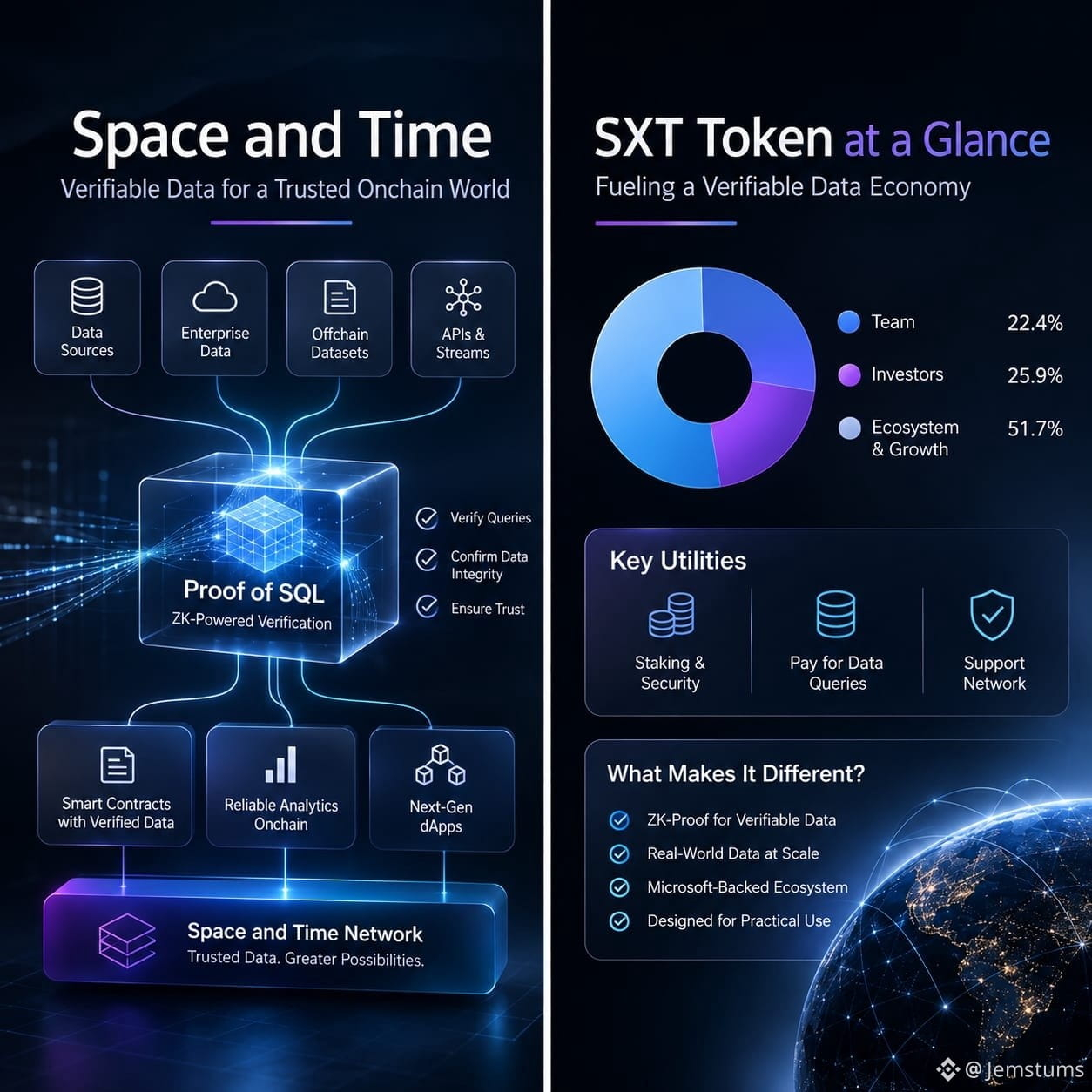
Space and Time is tackling a specific problem. Its Proof of SQL lets smart contracts query large datasets and verify both the computation and the integrity of committed data. That is more concrete than another promise about bringing the world onchain. SXT also has a defined role: staking, network security, and paying for data inserts and queries.
But I keep coming back to the limits of the proof. It can show that a query ran correctly against committed data; it cannot make a bad source truthful. Ingestion, availability, cost, and developer experience still matter. A technically elegant system can lose to a simpler database if the extra guarantees aren't worth the friction.
The Microsoft connection and ecosystem announcements are interesting, but they aren't durable demand. I’d rather watch repeat workloads, independent usage, and fees than count logos. Token distribution matters too: 22.4% is allocated to the team and 25.9% to investors, with vesting schedules worth keeping in view.
I’m not writing Space and Time off. I’m waiting to see whether real users keep paying for verifiable data when the market stops paying attention.
#sxt $SXT @SpaceandTime