
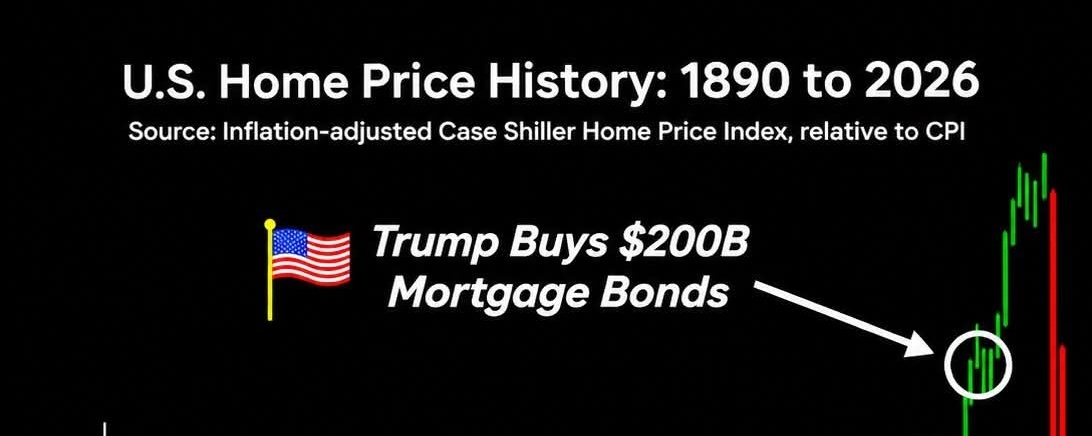

THE $200 BILLION HOUSING MOVE HAS A MUCH BIGGER STORY BEHIND IT.
Let's look at what is actually happening in America's housing market.
Back in January 2026, President Trump directed Fannie Mae and Freddie Mac to purchase $200 billion in mortgage-backed securities.
The objective was straightforward.
Increase demand for mortgage bonds.
Push their prices higher.
Bring mortgage yields lower.
And hopefully reduce the interest rates Americans pay when buying a home.
But here's where things get complicated.
Mortgage rates are not determined by the Federal Reserve alone.
They are influenced by Treasury yields, mortgage-bond prices, investor demand, inflation expectations, and the spread between Treasury securities and mortgage-backed securities.
When large buyers step into the mortgage-bond market, they can influence that equation.
But they cannot control every part of it.
And the latest housing numbers show why this matters.
As of November 12, the average 30-year fixed mortgage rate was still 7.11%.
That's lower than the previous week's 7.18%, but considerably higher than the 6.24% recorded one year earlier.
Meanwhile, existing-home sales in October fell 8.8% compared with the same month last year.
The annual sales pace dropped to approximately 3.75 million homes.
That's the lowest level since August 2010.
Think about what these numbers are telling us.
Millions of potential buyers are dealing with expensive financing.
Many existing homeowners are reluctant to sell because they don't want to give up the much lower mortgage rates they secured years ago.
And buyers are still facing expensive homes.
This creates a difficult situation.
Lower mortgage rates could bring more buyers back into the market.
But if housing supply doesn't increase alongside demand, more purchasing power can also put upward pressure on home prices.
In other words, making mortgages cheaper doesn't automatically make houses affordable.
There's another side of this $200 billion strategy that deserves attention.
Fannie Mae and Freddie Mac are not the Federal Reserve.
They are government-sponsored enterprises with their own balance sheets, investment limits, and financial risks.
Their purchases are not the same as the Fed creating money and launching a new quantitative-easing program.
And the entire $200 billion should not be confused with money already spent.
Implementation has been gradual, rather than an immediate $200 billion injection.
So why should investors pay attention?
Because mortgage-backed securities connect the housing market to the wider financial system.
Their prices and yields influence mortgage financing.
Changes in interest rates can affect banks, mortgage lenders, homebuilders, and housing-related companies.
Treasury markets also matter because mortgage rates are closely linked to longer-term borrowing costs.
But don't assume that one housing policy automatically determines what happens next in stocks, gold, or Bitcoin.
Those markets respond to different forces, even when interest rates and liquidity connect them.
And here's the biggest issue I see in this entire debate.
America doesn't have a housing affordability problem that can be solved by cheaper financing alone.
It also has a problem involving home prices, available housing, construction costs, and the gap between household incomes and the cost of owning a home.
If policymakers reduce borrowing costs without addressing those deeper problems, they could improve monthly payments while leaving the underlying affordability challenge largely untouched.
That's the difference between making mortgages cheaper and making housing genuinely affordable.
LOWER RATES CAN HELP BUYERS. THEY CANNOT BUILD MORE HOMES.