Asia’s stablecoin story is not one story.
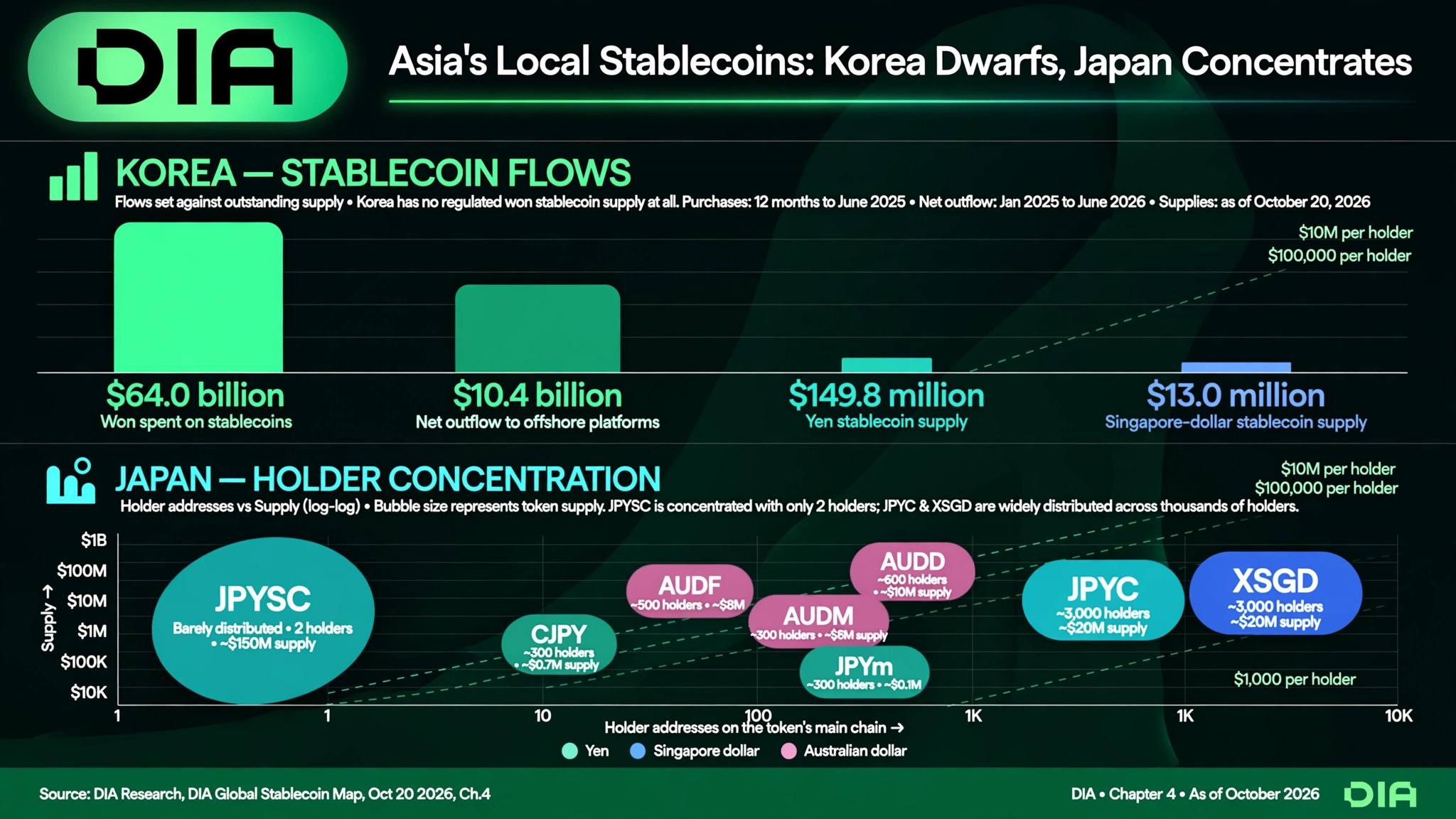
South Korea shows demand for access. Chainalysis recorded $64B in won-based stablecoin purchases in the 12 months to June 2025. FSS data then showed $10.4B in net outflows from five major exchanges between Jan 2025 and Jun 2026, across 18 consecutive months.
That points to users seeking products and markets unavailable at home not necessarily demand for a won stablecoin.
Japan is different. At DIA’s 20 Oct 2026 snapshot, JPYSC held $128.7M, around 86% of tracked yen stablecoin supply. But that balance sat in just two onchain addresses, roughly $64M each, associated with one exchange. That is concentrated custody, not broad circulation.
JPYC was smaller at about $21M after excluding issuer treasury, but it has a clearer payment story: a logistics group plans to use it to pay around 2,300 business partners. That is a planned rollout, not proof of mass adoption.
Singapore and Hong Kong show the same gap between frameworks and usage: regulated markets, but modest circulation and institutional access.
My takeaway: dollar stablecoins in developed Asia often serve access to global markets. Local-currency tokens need practical utility, such as merchant payments or business settlement.
Korea’s National Assembly Budget Office modeled about ₩1.23T in annual merchant savings if 10% of card payments shifted to a won stablecoin. That is a scenario, not a realized saving.
Important: $64B is a 12-month purchase flow; $128.7M is a point-in-time supply snapshot. They are not directly comparable.
Which arrives first: a won stablecoin on payment cards, or a yen stablecoin used by major banks for corporate settlement? $DIA
South Korea shows demand for access. Chainalysis recorded $64B in won-based stablecoin purchases in the 12 months to June 2025. FSS data then showed $10.4B in net outflows from five major exchanges between Jan 2025 and Jun 2026, across 18 consecutive months.
That points to users seeking products and markets unavailable at home not necessarily demand for a won stablecoin.
Japan is different. At DIA’s 20 Oct 2026 snapshot, JPYSC held $128.7M, around 86% of tracked yen stablecoin supply. But that balance sat in just two onchain addresses, roughly $64M each, associated with one exchange. That is concentrated custody, not broad circulation.
JPYC was smaller at about $21M after excluding issuer treasury, but it has a clearer payment story: a logistics group plans to use it to pay around 2,300 business partners. That is a planned rollout, not proof of mass adoption.
Singapore and Hong Kong show the same gap between frameworks and usage: regulated markets, but modest circulation and institutional access.
My takeaway: dollar stablecoins in developed Asia often serve access to global markets. Local-currency tokens need practical utility, such as merchant payments or business settlement.
Korea’s National Assembly Budget Office modeled about ₩1.23T in annual merchant savings if 10% of card payments shifted to a won stablecoin. That is a scenario, not a realized saving.
Important: $64B is a 12-month purchase flow; $128.7M is a point-in-time supply snapshot. They are not directly comparable.
Which arrives first: a won stablecoin on payment cards, or a yen stablecoin used by major banks for corporate settlement? $DIA