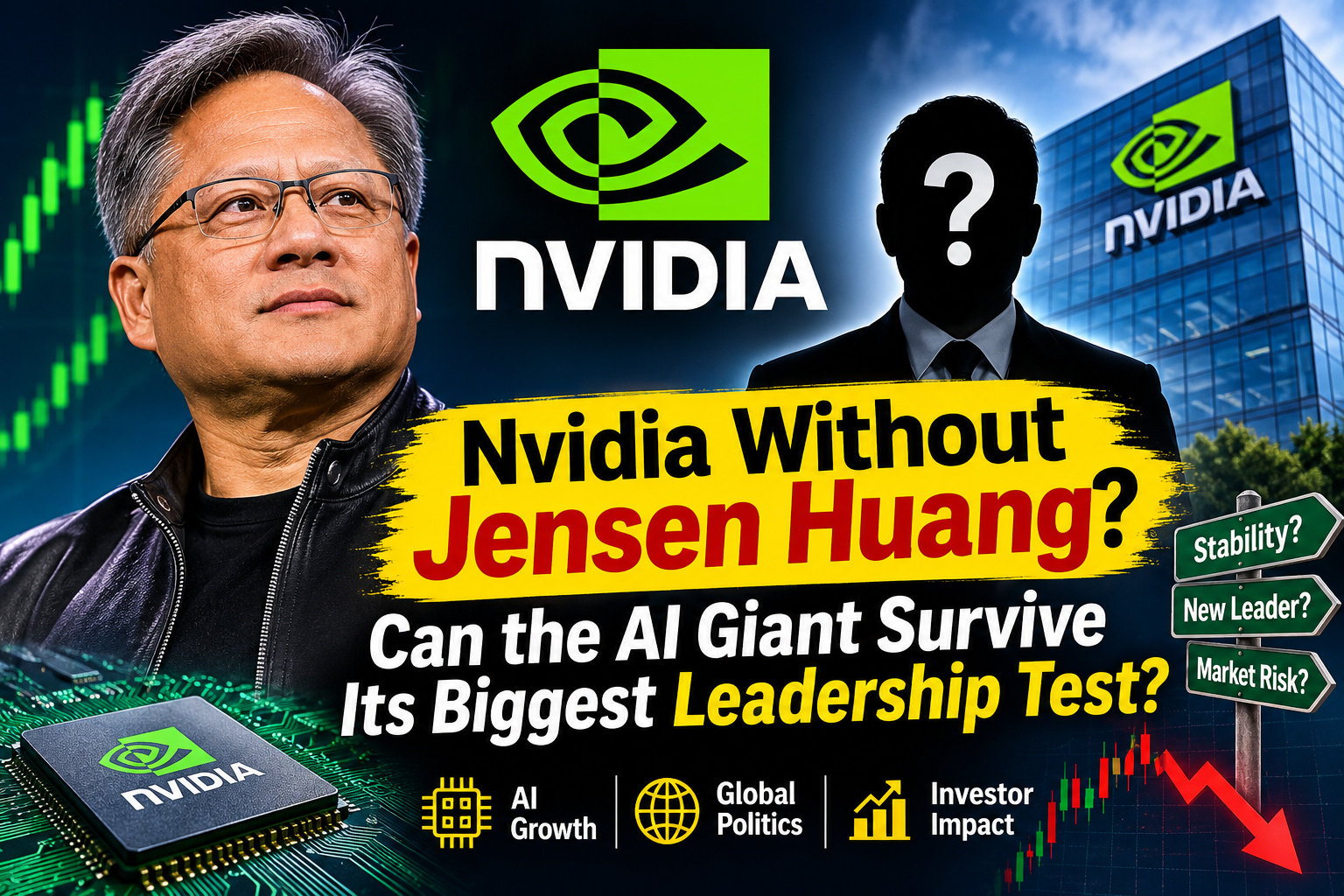

One of the world's most valuable technology companies is facing a question investors cannot ignore: Is Nvidia's success built on its technology, or on the leadership of one man?
Nvidia's leadership transition has put the AI industry on alert. With Jensen Huang out of the CEO position, investors are now watching closely to see who will take control of the company and whether its growth story can continue without its long-time leader.
The stakes are enormous. Nvidia is not just another chipmaker. It sits at the center of the global AI infrastructure boom.
Rene Haas: A Possible Successor, Not a Confirmed Choice
Speculation about Nvidia's next CEO intensified after the Financial Times reported that the company's board had approached Arm Holdings CEO Rene Haas.
Haas has a history with Nvidia. He spent seven years at the company before joining Arm in 2013. He became Arm's CEO in 2022.
But Nvidia has pushed back against the speculation.
The company says it is still selecting an executive search firm and has not formally engaged with any potential candidates. It has described speculation about individual names as premature.
That is an important distinction. A reported approach does not mean a candidate has been selected or that negotiations are underway.
For investors, the bigger question is whether Nvidia can find someone capable of managing its technology leadership, global business and growing political challenges.
Why This CEO Search Matters to the Global AI Market
Nvidia's influence goes far beyond semiconductor manufacturing.
Its GPUs power AI systems used by major technology companies, cloud providers and research institutions. Its business is also closely tied to global supply chains and US technology policy.
Washington's export restrictions are particularly important.
Limits on advanced AI chip exports can affect Nvidia's access to international markets, especially China. At the same time, geopolitical tensions create uncertainty for suppliers, customers and long-term investment plans.
The next CEO will need more than technical knowledge. Managing government relationships, regulatory pressure and international competition will be just as important.
This is also a test of corporate governance.
In simple terms, corporate governance means how a company is managed, how major decisions are made and how executives are held accountable.
A strong company should be able to operate even when its most influential leader leaves.
What Investors Should Watch in NVDA
Nvidia's financial performance remains a major part of the investment story.
In its second quarter of fiscal 2027, the company reported:
Revenue: $96.2 billion, up 106% year over year.
Data Center revenue: $89 billion, up 117%.
Non-GAAP gross margin: 75%.
Nvidia had also projected third-quarter revenue of approximately $108 billion, plus or minus 2%.
These numbers show why investors should not judge the company solely by its leadership headlines.
However, the market has already shown signs of nervousness.
Nvidia shares finished November 12 down approximately 4.3%, followed by another decline of around 2% on November 13. Arm shares also weakened after the succession report.
Broader technology-market weakness may have contributed to these moves, so it would be misleading to blame the entire decline on CEO uncertainty.
The next major catalyst is Nvidia's November 17 third-quarter earnings report. Investors will be looking for evidence that AI demand remains strong and that the leadership transition has not disrupted operations.
Bullish vs Bearish Outlook
The bullish case
If Nvidia maintains operational stability under interim CEO Colette Kress and appoints a credible permanent successor, investor confidence could recover.
Continued AI infrastructure spending, strong GPU demand and better-than-expected earnings could support $NVDA shares.
A smooth transition would also prove that Nvidia's competitive advantage is built into the business, not dependent on one individual.
The bearish case
A prolonged succession process could create uncertainty around strategic decisions.
If AI spending slows, export restrictions become tougher or earnings disappoint, the pressure on Nvidia shares could increase.
There is also a question investors cannot ignore: How much of Nvidia's success is connected to Huang's personal leadership and vision?
That question will take time to answer.
The Bigger Political and Economic Picture
Nvidia's leadership change also matters to policymakers.
The United States wants to maintain its advantage in advanced AI and semiconductor technology. But unpredictable regulations and escalating trade restrictions can make long-term business planning harder.
For investors, policy stability matters almost as much as technological innovation.
For ordinary people, the stakes are broader. AI infrastructure affects employment, productivity, business costs and access to new economic opportunities.
A competitive and well-regulated technology industry can create jobs and lower costs. But excessive market concentration can also limit competition and give a handful of companies enormous influence over the economy.
That is why transparent corporate oversight and fair competition matter.
My Investment Takeaway
I would not rush to buy $NVDA simply because its shares have fallen following the leadership news.
But I would not assume that Jensen Huang's departure means Nvidia's AI dominance is over, either.
Three developments deserve close attention:
CEO appointment: Does Nvidia select a leader with the experience to maintain its competitive position?
Earnings performance: Does the November 17 report confirm that AI demand remains strong?
Business fundamentals: Can Nvidia protect its margins, revenue growth and market position?
The distinction is simple: Leadership uncertainty creates risk, but the company's financial performance will ultimately determine its long-term investment value.
Nvidia's next chapter will reveal whether it has built a lasting institution or a business too closely tied to one extraordinary leader.
What do you think? Can Nvidia maintain its dominance in the AI market without Jensen Huang, or will competitors such as AMD and Broadcom benefit from this leadership transition? Share your analysis below.
Disclaimer: This article is for informational and educational purposes only. It is not financial advice. Always conduct your own research (DYOR) and manage your investment risk.

#WhoWillSucceedJensenHuangatNvidia? #NVDA #CryptoAnalysis #Geopolitics #cryptouniverseofficial