



A Macro Breakdown of Capital Rotation, Inflation, Interest Rates and the Future Direction of Digital Assets
The relationship between Bitcoin and gold is becoming increasingly important in understanding the current financial market environment.
Both assets are often discussed as alternatives to traditional financial systems. However, their market behaviour is very different, especially during periods of economic uncertainty.
Gold has traditionally attracted investors seeking capital preservation, while Bitcoin has increasingly become a macro-sensitive asset that responds to global liquidity, institutional positioning and investor risk appetite.
The current market is providing an interesting example of this difference.
As of November 14, Bitcoin has fallen below the $70,000 psychological level, with reports placing it around $69,342. Ethereum has also weakened towards $1,951. At the same time, gold has experienced significant selling pressure, with higher inflation expectations, a stronger US dollar and rising interest-rate expectations affecting demand.
This raises an important question:
If gold is supposed to be a safe-haven asset and Bitcoin is often described as digital gold, why are both markets facing pressure?
Let's break down what is happening and what it could mean for the next phase of the crypto market.
---
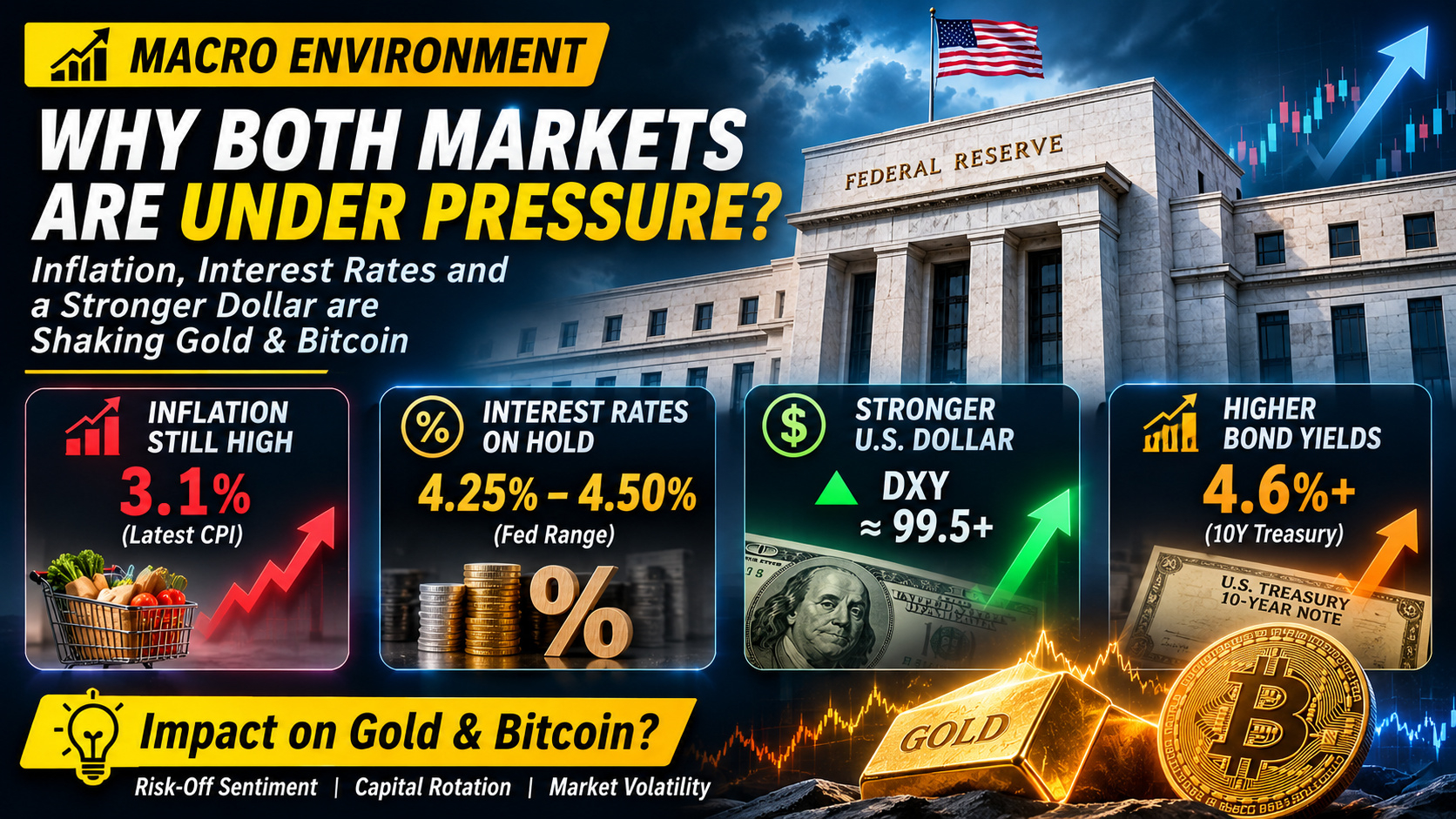
1. THE MACRO ENVIRONMENT: WHY BOTH MARKETS ARE UNDER PRESSURE
The biggest factor influencing the current market is the changing expectation around US monetary policy.
Recent inflation data has complicated the outlook for interest rates. Instead of expecting easier monetary conditions, investors are increasingly considering the possibility that interest rates could remain elevated for longer.
This creates three important consequences:
First: A stronger US dollar.
When the dollar strengthens, dollar-denominated assets such as gold can become less attractive to international buyers.
Second: Higher bond yields.
Gold does not generate interest income. When government bonds offer relatively attractive yields, investors face a higher opportunity cost when holding gold.
Third: Tighter financial conditions.
Bitcoin and other cryptocurrencies are particularly sensitive to changes in liquidity and risk appetite. When investors become defensive, speculative assets often experience selling pressure.
This is why the current weakness should not be analysed as an isolated crypto-market event. It is part of a broader repricing of financial risk.
2. GOLD'S CURRENT POSITION: A CORRECTION OR A BIGGER TREND CHANGE?
Gold's recent movement deserves attention.
The metal previously benefited from geopolitical uncertainty, central-bank buying and concerns surrounding long-term currency stability.
However, the latest inflation-driven repricing has introduced a different challenge.
Gold has faced pressure as markets reassess the possibility of higher interest rates and a stronger dollar.
There are two competing forces here:
Bearish factors:
- Higher real interest rates.
- Continued dollar strength.
- Reduced expectations of monetary easing.
- Profit-taking following the previous rally.
Bullish factors:
- Continued central-bank demand.
- Long-term diversification away from concentrated dollar exposure.
- Geopolitical uncertainty.
- Fiscal concerns and persistent inflation risks.
The World Gold Council's November outlook also highlights this conflict. It expects investment demand and central-bank purchases to remain important sources of support, while higher rates and stronger yields could limit further upside.
My interpretation is that gold's longer-term investment case has not necessarily disappeared, but its short-term direction remains vulnerable to monetary-policy expectations.
3. BITCOIN: WHY THE CRYPTO MARKET IS REACTING DIFFERENTLY
Bitcoin's recent weakness is more concerning than an ordinary daily correction because several factors are occurring simultaneously.
A. Institutional capital flows
Institutional participation has become an important part of Bitcoin's market structure.
When institutional investors reduce exposure, the impact can extend beyond Bitcoin itself because market participants often use BTC as their primary indicator of crypto-market risk.
Recent reporting has highlighted substantial Bitcoin ETF outflows, adding another layer of selling pressure.
B. Risk-off sentiment
Bitcoin is still treated by many investors as a higher-risk asset.
During periods of uncertainty, investors may reduce exposure to cryptocurrencies before considering an increase in defensive assets.
This explains why Bitcoin does not always behave like gold during market stress.
C. Weakness across the broader crypto market
Ethereum's decline towards $1,951 is another important signal.
When BTC and ETH weaken together, it suggests that selling pressure is not restricted to a single cryptocurrency.
If this continues, smaller altcoins could experience even greater volatility because they generally carry higher market risk.
4. THE MOST IMPORTANT QUESTION: IS CAPITAL MOVING FROM BITCOIN INTO GOLD?
This is where the analysis becomes particularly interesting.
Bitcoin and gold are competing for some overlapping investment narratives, but they do not necessarily compete for exactly the same capital.
Gold is generally preferred for defensive allocation and wealth preservation.
Bitcoin attracts investors looking for exposure to digital scarcity, monetary innovation and potentially higher returns.
During periods of financial stress, capital may favour gold over Bitcoin.
However, we should not automatically assume that every dollar leaving Bitcoin is entering gold.
Investors may also be moving into:
- US Treasury securities.
- Cash and money-market funds.
- Other defensive assets.
- Reduced overall portfolio exposure.
Therefore, a direct BTC-to-gold capital rotation should be confirmed through actual fund flows and relative-performance data rather than price movements alone.
5. THREE POSSIBLE SCENARIOS FOR THE NEXT CRYPTO MARKET PHASE
Instead of predicting one direction, it is more useful to evaluate three possible outcomes.
Scenario 1: Continued bearish pressure
This scenario becomes more likely if inflation remains persistent and the Federal Reserve maintains a restrictive policy outlook.
Possible market consequences:
- The dollar remains strong.
- Bond yields remain elevated.
- Gold struggles to recover.
- Bitcoin remains under pressure.
- Altcoins continue to underperform.
In this environment, temporary BTC recoveries could become selling opportunities rather than the beginning of a sustainable bullish trend.
Scenario 2: A macro-driven recovery
This scenario could develop if upcoming inflation and economic data show signs of cooling.
Lower inflation pressure could reduce expectations of further monetary tightening.
Potential consequences:
- Bond yields begin to ease.
- The dollar loses momentum.
- Gold finds room to recover.
- Bitcoin attracts renewed risk capital.
- Ethereum and major altcoins begin stabilising.
However, one positive economic report would not be enough to confirm a new bullish cycle. Consistent improvement in liquidity conditions and institutional flows would matter more.
Scenario 3: Gold outperforms while Bitcoin consolidates
This is a scenario worth watching closely.
If uncertainty remains elevated but liquidity does not improve meaningfully, investors may continue favouring defensive assets.
Gold could maintain relative strength while Bitcoin struggles to recover its previous market structure.
This would challenge the assumption that Bitcoin automatically behaves like digital gold during periods of uncertainty.
---
6. WHAT I WOULD WATCH BEFORE TAKING A STRONG MARKET POSITION
For the next few weeks, I would focus on five indicators rather than relying on headlines.
1. US Dollar Index (DXY)
A sustained dollar rally could continue creating headwinds for both gold and cryptocurrencies.
2. US Treasury yields and real yields
These will help determine whether financial conditions are becoming more restrictive or starting to ease.
3. Bitcoin ETF net flows
Consistent inflows would indicate renewed institutional demand. Continued outflows would suggest that investors are still reducing exposure.
4. Gold's relative strength against Bitcoin
The BTC/Gold ratio is particularly useful.
If gold continues outperforming Bitcoin, it may indicate that investors are prioritising capital preservation over speculative growth.
A sustained reversal in this ratio could signal improving relative demand for Bitcoin.
5. Bitcoin's market structure
I would look for a recovery above important resistance levels, stronger spot demand and improving volume before treating a bounce as a genuine trend reversal.
---
7. THE BIGGER PICTURE: WHAT COULD HAPPEN IN 2027?
Looking beyond the immediate correction, the next major opportunity for cryptocurrencies could depend on a shift in global financial conditions.
If inflation gradually moderates, real yields decline and monetary conditions become more supportive, Bitcoin could benefit from renewed institutional and speculative demand.
Ethereum could also benefit if broader risk appetite returns and activity across its ecosystem strengthens.
However, if inflation remains persistent and global liquidity stays restrictive, the recovery could take longer than many investors expect.
The important distinction is between a temporary price recovery and a sustainable change in the macroeconomic environment.
Those are two very different things.
---
FINAL THOUGHTS
The current weakness in Bitcoin and gold is not necessarily a contradiction. It reflects a market environment in which interest rates, inflation expectations and dollar strength are influencing asset valuations.
Gold remains supported by long-term structural demand, while Bitcoin continues to face the challenge of proving that it can attract capital during periods of restrictive financial conditions.
For me, the most important metric to watch is not simply whether Bitcoin or gold rises next.
It is whether global capital starts moving back towards risk assets.
If liquidity improves, Bitcoin could regain momentum. If financial conditions remain restrictive, defensive assets may continue to attract greater attention.
The next major crypto move may not begin with a crypto-specific announcement. It may begin with a change in the global macroeconomic environment.