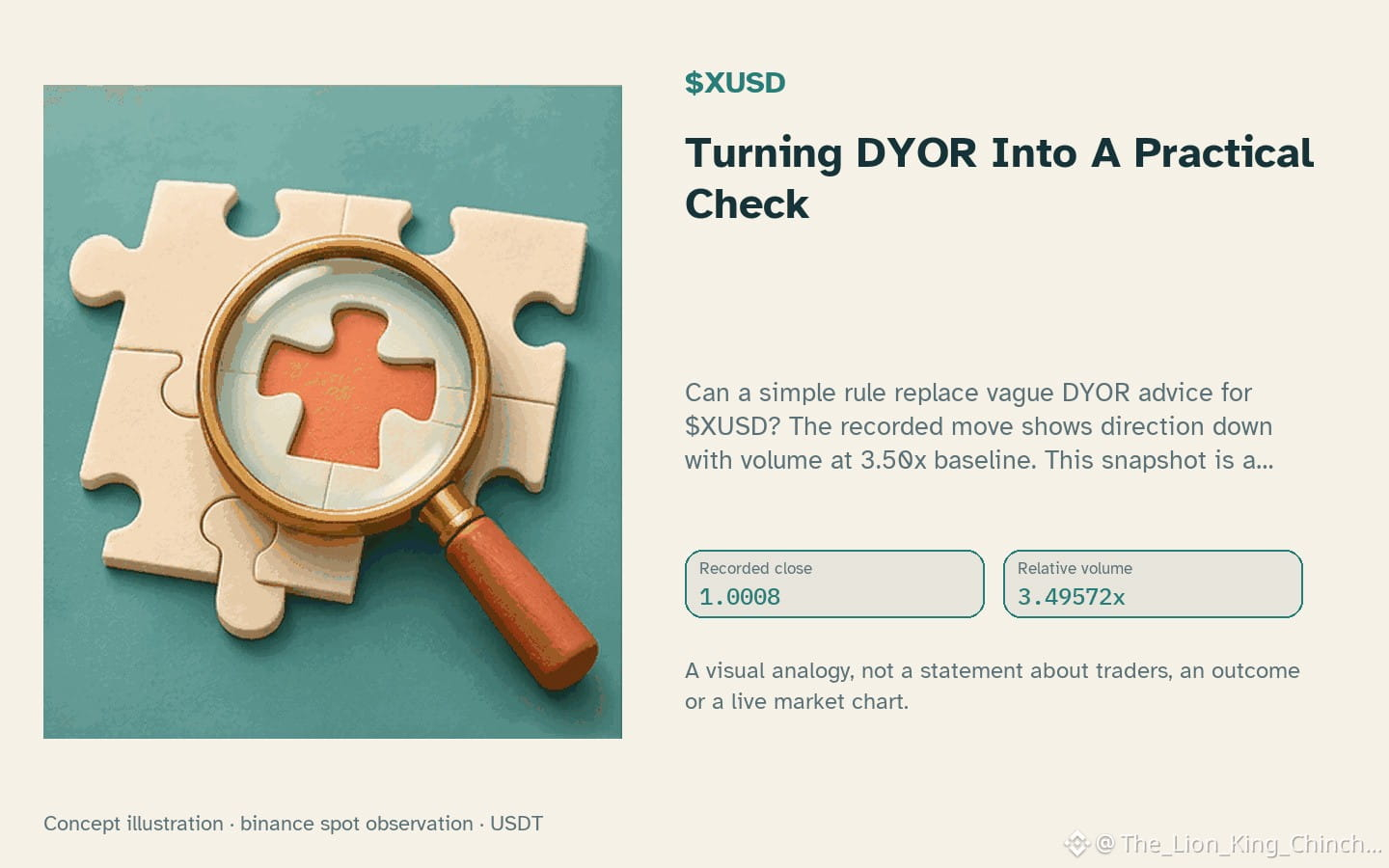
$XUSD: Turning DYOR Into A Practical Check
Can a simple rule replace vague DYOR advice for $XUSD? The recorded move shows direction down with volume at 3.50x baseline. This snapshot is a hypothetical decision point, not a forecast.
A useful mechanism asks if the price action matches your written expectation. If you expected weakness given the daily change -0.01998%, this observation supports that view. However, RSI reads 44.394, which stays within the typical neutral band. It is not an extreme that guarantees reversal. The dilemma is clear: volume confirms interest, but it does not prove motive.
Consider a counterexample. If the next hourly change reverses while volume drops, your initial interpretation weakens. Self-checking means asking if your thesis relied on social proof or just recorded data. Public analysis often blends evidence with persuasion, especially where incentives like Write to Earn reward content creation. This creates a tension: writers may frame uncertainty as opportunity. Using RSI 44.394 helps, but only if you define your exit conditions beforehand. A concrete reassessment condition is whether price respects the local support level 1.0008. If it breaks, the downside thesis strengthens. If it holds, wait for further evidence.
This approach separates observation from narrative. It treats data as a boundary, not a command. Readers gain a repeatable method to test their own logic without needing secret signals or crowd validation. The goal is clarity, not certainty.
Probabilistic market research, not a recommendation or guaranteed return.
#XUSD #CryptoCommunity #CryptoLearning