

Disclosure: It is not financial advice
The next Federal Reserve policy meeting is still weeks away. The 10-year US Treasury yield did not wait.
On Tuesday, 10 November 2026, the US Bureau of Labor Statistics reported that the consumer price index rose a seasonally adjusted 0.4 percent in October, above the 0.3 percent increase economists had expected, according to Reuters and CNBC. Core CPI, which excludes food and energy, rose 0.3 percent, also above the forecast. The BLS did not publish a year-over-year inflation rate, because a government shutdown in 2025 left no October comparison base.
The Federal Reserve's policy rate is still in a 3.75 percent to 4.00 percent range, after officials held that range at the October meeting. The next scheduled Federal Open Market Committee meeting is on 8 and 9 December 2026, according to the Federal Reserve's official calendar, last updated on 12 November 2026. It is a meeting associated with a Summary of Economic Projections.
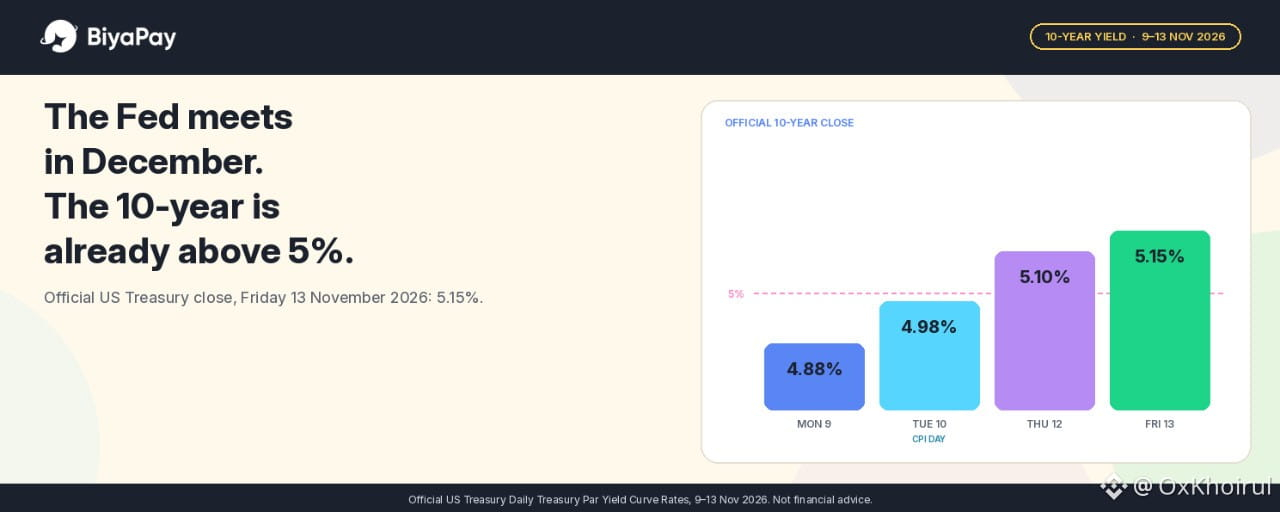
By Friday, 13 November, the official Daily Treasury Par Yield Curve Rate for the 10-year note had closed at 5.15 percent. On Monday, 9 November, that same official series closed at 4.88 percent. That is a rise of 27 basis points in four trading sessions. One basis point is 0.01 percent. From the previous Friday, 6 November, when the 10-year closed at 4.86 percent, the week's move was 29 basis points.
The 10-year crossed 5 percent between the Tuesday close of 4.98 percent, the day of the CPI report, and the Thursday close of 5.10 percent. There is no official daily close on that Treasury series for Wednesday, 11 November. I am using the official daily par yield curve, not an intra-day screen, so these are closing figures.
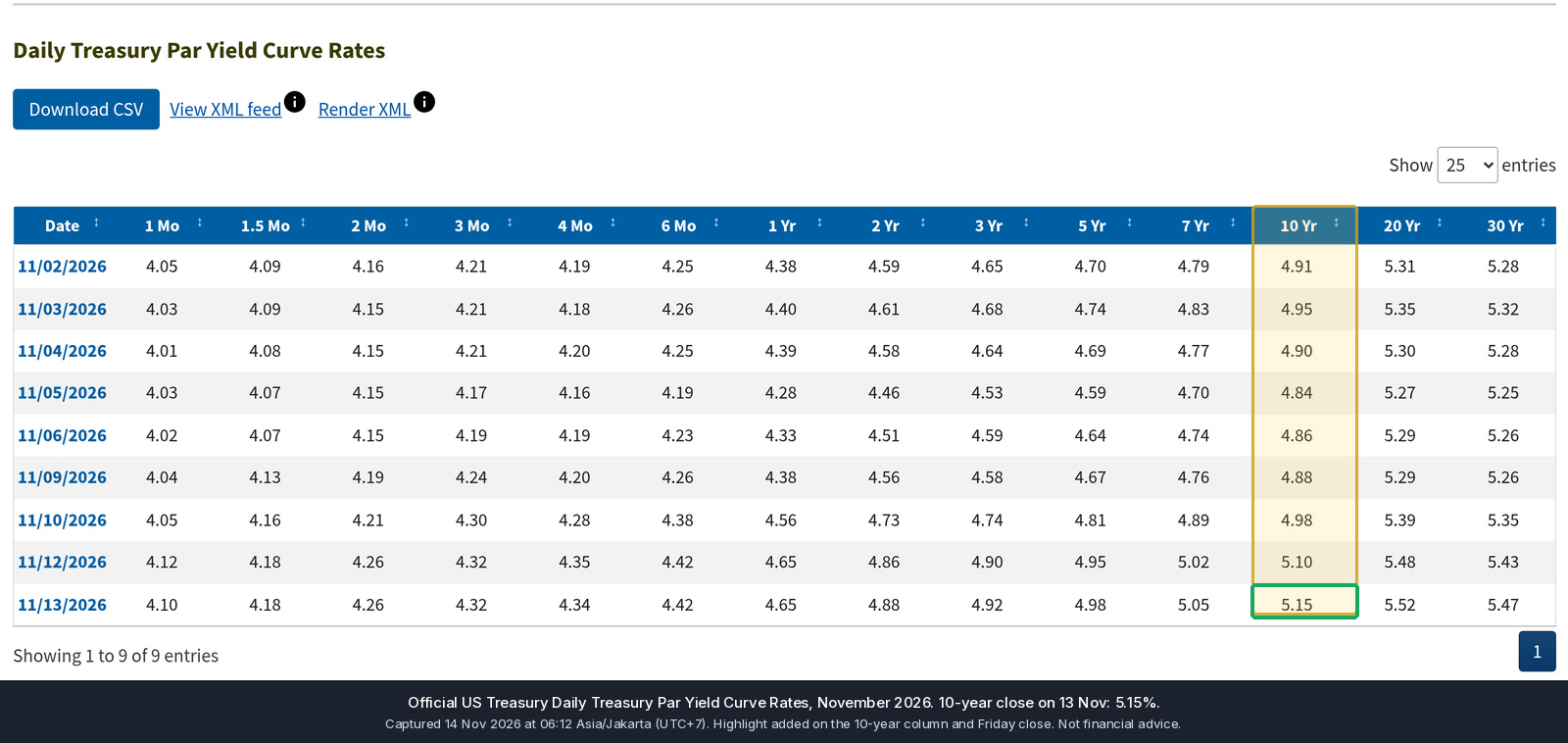
This is not a forecast of what the Fed will do in December, and it is not a recommendation to buy or sell any stock. It is a reading of a rate that is already on an official Treasury page, and of what I would put next to a US stock after a week like this.
The policy rate and the 10-year are not the same number
It is easy to treat "the Fed will hike" as the whole story. The policy rate is the overnight federal funds range. A widely discussed 25 basis point increase in December would take that range to 4.00 percent to 4.25 percent, if the Fed chooses that size. That decision has not been made.
The 10-year yield is a longer market rate. It already closed at 5.15 percent on Friday, which is above both the current policy range and the 4.00 to 4.25 percent range that a quarter-point hike would create. The two-year yield, which usually moves more closely with near-term policy expectations, closed at 4.88 percent on Friday, up 32 basis points from Monday's 4.56 percent, on the same official Treasury series.
In my view, that is why the useful number this week is not a December headline that has not arrived yet. The useful number is the 10-year yield that already moved.
Markets can still be surprised. Officials have discussed a larger 50 basis point option, and I would not treat Friday's close as a prediction of where the 10-year will be on 9 December. I would treat 5.15 percent as the market rate that is on the page today.
What 5.15 percent means on a 1,000 dollar example
Take 1,000 dollars as a worked example, not as a suggested order size.
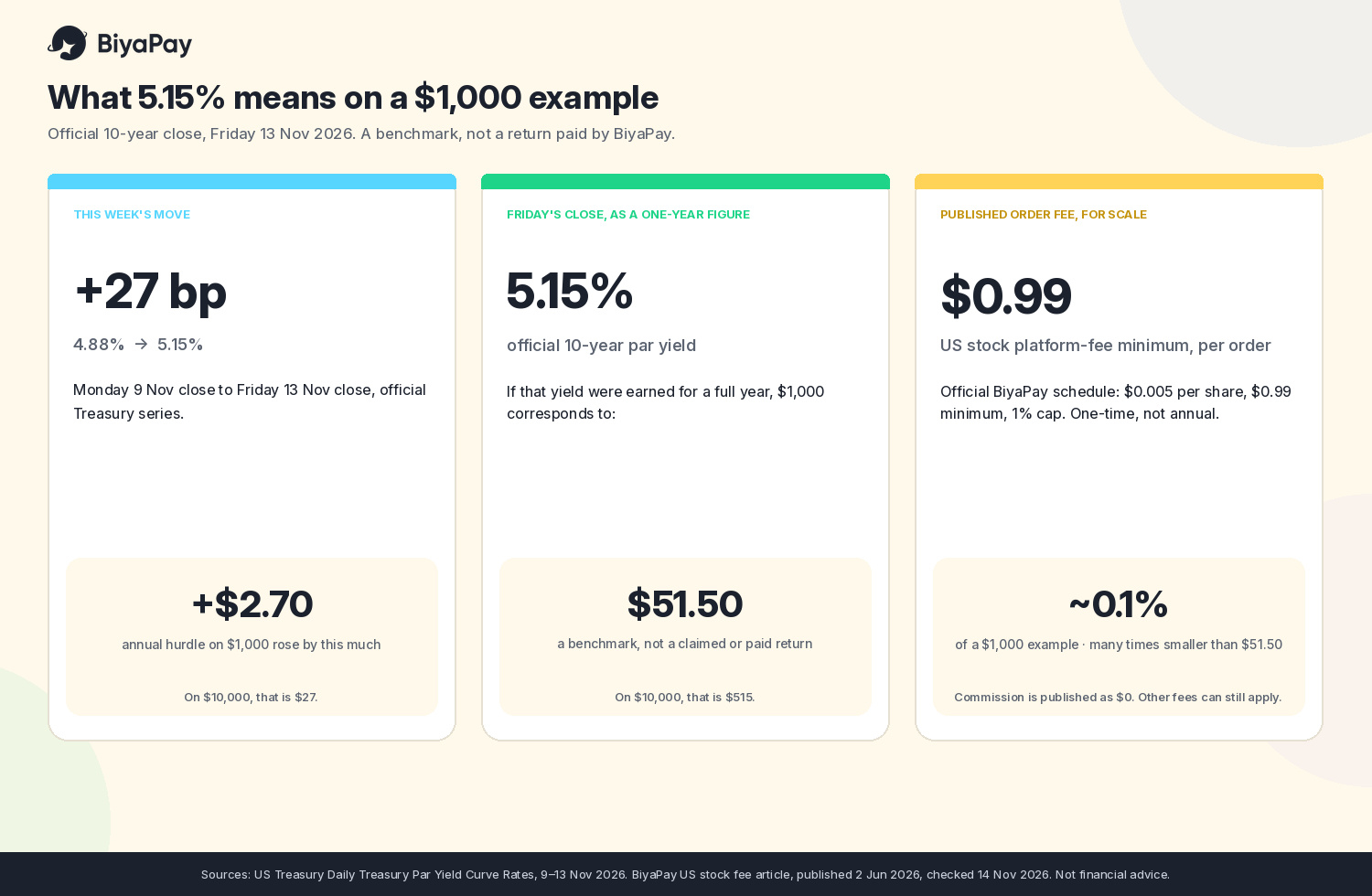
At Friday's official 10-year close of 5.15 percent, 1,000 dollars would correspond to 51.50 dollars over a year if that yield were earned for a full year. At Monday's close of 4.88 percent, the same example would have been 48.80 dollars. The week's 27 basis point rise lifted that annual figure by 2.70 dollars on 1,000 dollars, or by 27 dollars on 10,000 dollars.
That 51.50 dollar figure is a benchmark, not a return I can claim, and it is not a product on BiyaPay. To earn a Treasury yield, an investor would have to buy an actual Treasury security, elsewhere, at the then-prevailing price, and hold it through the relevant period. The 5.15 percent close is the market's own longer-term rate. I would use it as a hurdle: a US stock I am considering would have to offer a combination of dividends and price change that I believe can clear that bar, after costs, and after the risk that comes with equities.
Dividends are part of that comparison only when they are actually paid. A BiyaPay Help Center article, dated 10 February 2026 and checked on 14 November 2026, says that US and Hong Kong stocks purchased may receive dividends. Whether a dividend is paid depends on whether the company pays one and whether you meet that company's conditions. I would not plug in a made-up dividend and call it income.
The cost of placing a US stock order on BiyaPay sits in a different category. Official product language describes US stock trading with 0 commission. A BiyaPay article on US stock fees, published on 2 June 2026 and still describing the same schedule when checked on 14 November 2026, says the published US stock platform fee is 0.005 US dollars per share, with a minimum of 0.99 US dollars per order and a maximum of 1 percent of the transaction value. External institution fees, trading activity fees, and other items can also apply, and I would read the live fee schedule and the order preview before sending anything.
On a 1,000 dollar example, that 0.99 dollar minimum is about 0.1 percent of the position, and it is a one-time order cost. Friday's 5.15 percent yield is an annual benchmark. Those two numbers are not the same kind of cost, and I would not pretend they are. The comparison I would still make is one of scale. If I hold for a year, the hurdle I am measuring against is 51.50 dollars on 1,000 dollars, which is many times the published minimum platform fee on a single order. This week, the market rate moved by 2.70 dollars on that same 1,000 dollar example, which is already larger than the 0.99 dollar minimum.
When this hurdle matters, and when it does not
This comparison is useful if I am considering a US stock as a longer holding, and I want a clear market rate to put next to whatever return I expect. In a week when the 10-year has just moved through 5 percent, that rate is easier to ignore than it should be, because the conversation is about the December meeting rather than about the yield that already changed.
It is less useful if I am trading around the announcement itself. A short holding is dominated by the next price move, which can be several percent in either direction, not by a 5.15 percent annual benchmark. A 1 percent move on a 1,000 dollar position is 10 dollars, which is already larger than the week's 2.70 dollar change in the annual hurdle.
It also does not apply as a guaranteed alternative. BiyaPay's US stock product is a way to buy actual shares. It is not a Treasury auction, and I would not write as if a 5.15 percent yield is sitting in a wallet and can be clicked. Cash, USDT, and a 10-year Treasury are different assets. This article is about the hurdle, not about a substitute trade.
A December decision that surprises the path already priced into the market could move the 10-year again, up or down. Friday's close is a starting point I would update, not a number I would freeze until December.
What I would actually do
In my view, the question worth asking after this CPI week is not "will the Fed hike in December?" That outcome is widely expected, and the 10-year has already moved. The question I would ask is whether a US stock I am looking at can reasonably be expected to earn more than the 5.15 percent the 10-year already offers, after the costs I would actually pay, and after the risk of holding equities instead of a government note.
I would rather start with that hurdle than start with the commission line. The commission is published as zero, and the remaining order fees are real, but they are not what changed this week.
A short list I would use:
Read the latest official 10-year close, not only the Fed-meeting headline.
Write down what return I actually expect from the stock, including only dividends the company itself has declared or paid, not a round number I assumed.
Check the BiyaPay order preview for the fee on that ticket, including the 0.99 dollar platform-fee minimum where it applies.
If I cannot explain why the stock should clear a 5.15 percent hurdle after those costs, I would wait, rather than treat a December headline as a reason to click.
None of this is financial advice, and it is not a recommendation to buy or sell. Official yields, fees, and meeting calendars can change. I would re-read the Treasury daily par yield curve, the Federal Reserve calendar, and the current BiyaPay fee schedule and order preview before acting.
Source: US Bureau of Labor Statistics CPI report for October 2026, as reported by Reuters and CNBC on 10 November 2026; US Treasury Daily Treasury Par Yield Curve Rates for 6 to 13 November 2026, captured on 14 November 2026 at 06:12 Asia/Jakarta (UTC+7); Federal Reserve FOMC calendar, last updated 12 November 2026; BiyaPay Help Center article on dividends, dated 10 February 2026, and BiyaPay US stock fee explanation published 2 June 2026, both checked on 14 November 2026 (Asia/Jakarta, UTC+7).