WINkLink’s Buyback & Burn: Turning Real Revenue Into Long-Term Token Value
A sustainable token economy needs more than market attention. It needs a mechanism that connects actual business activity with token economics.
That is the thinking behind WINkLink’s $WIN Buyback & Burn Program.
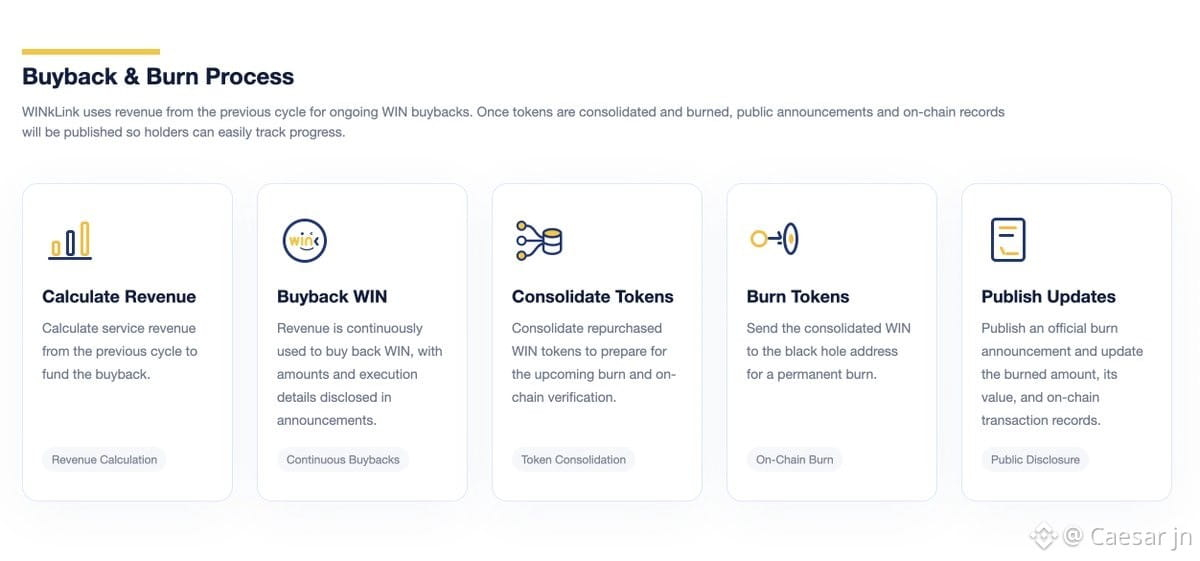
The model is built around five important steps:
1. Revenue-Driven Funding
WINkLink calculates service revenue generated during the previous cycle to determine the funds available for the buyback process.
2. Continuous $WIN Buybacks
100% of WINkLink’s service revenue is allocated to buying back $WIN. The buyback amount is dynamically determined based on market performance during the period.
3. Token Consolidation
Repurchased $WIN tokens are consolidated in preparation for the next stage.
4. Permanent On-Chain Burn
The consolidated tokens are permanently burned through the token contract's burn function, removing them from circulation.
5. Transparent Public Disclosure
Each round comes with public details, including the amount of $WIN burned, its value, and the corresponding on-chain transaction record.
What makes this model interesting is the connection between protocol revenue, market activity, and token supply.
Instead of relying entirely on speculative demand or temporary incentives, WINkLink is establishing a recurring mechanism funded by its own service revenue.
Round 1 is already complete, with the program designed for long-term execution and updates disclosed for each round.
However, the bigger picture goes beyond individual burn transactions.
The real metric to watch over time is how consistently the oracle business generates revenue, how much $WIN is repurchased, and how transparently each burn is executed.
A buyback announcement creates attention. Consistent execution and verifiable on-chain records create something more meaningful: accountability.
This is an important development to follow as WINkLink continues building within the TRON ecosystem.
@Justin Sun孙宇晨 @WINkLink_Official
#TRONEcoStar