$AVGOB : AVGOB: How Fast Rallies Can Trigger Informational Cascades
$AVGOB : AVGOB shows an hourly direction down while volume sits above baseline. Why might a rapid rally still lead to a cascade of buying despite the negative price move?
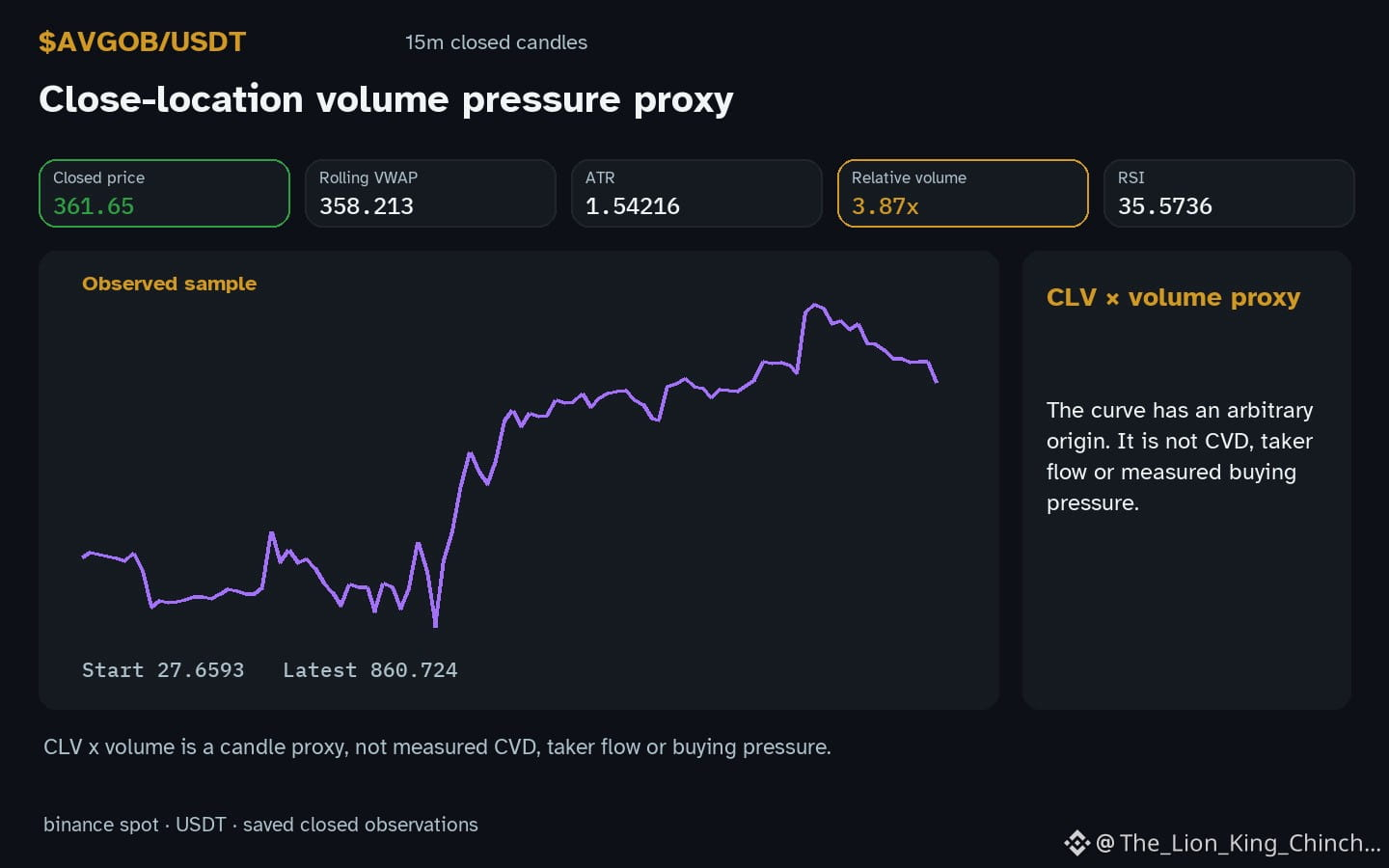
A common assumption is that price momentum alone drives trader attention. When a candle rises quickly, observers may anchor on the upward move and ignore the broader downtrend. This anchoring bias can create an informational cascade: each participant assumes the prior trader had a reason to buy, so they follow without independent analysis. The observation of relative volume 3.87x baseline supports the idea that many eyes are on the market, yet the direction remains down.
A counterexample to consider is a scenario where the same volume surge occurs during a clear downtrend and price continues falling. In that case, the cascade may be broken by loss aversion, as traders become reluctant to add to a losing position. The RSI 35.6 can serve as a signal of overextension, but it does not prove a cascade.
What could change the reading? A future closed hourly candle showing a sustained upward move with RSI moving into neutral territory would weaken the cascade hypothesis. Conversely, a sharp reversal back down with volume returning to baseline would suggest the rally was a brief attention spike rather than a true cascade.
Practical self‑check: before assuming a cascade, pause and ask whether you are reacting to the price move itself or to the perceived actions of others. Compare the current volume level to the baseline and note if the RSI is extreme. If both are high, consider stepping back and gathering independent evidence before adding to the position.
Probabilistic market research, not a recommendation or guaranteed return.
The comparison to keep in mind: $BTC has hourly direction down and volume not above its baseline; $BARD has hourly direction up and volume not above its baseline. This alone does not establish correlation.
#AVGOB #BTC