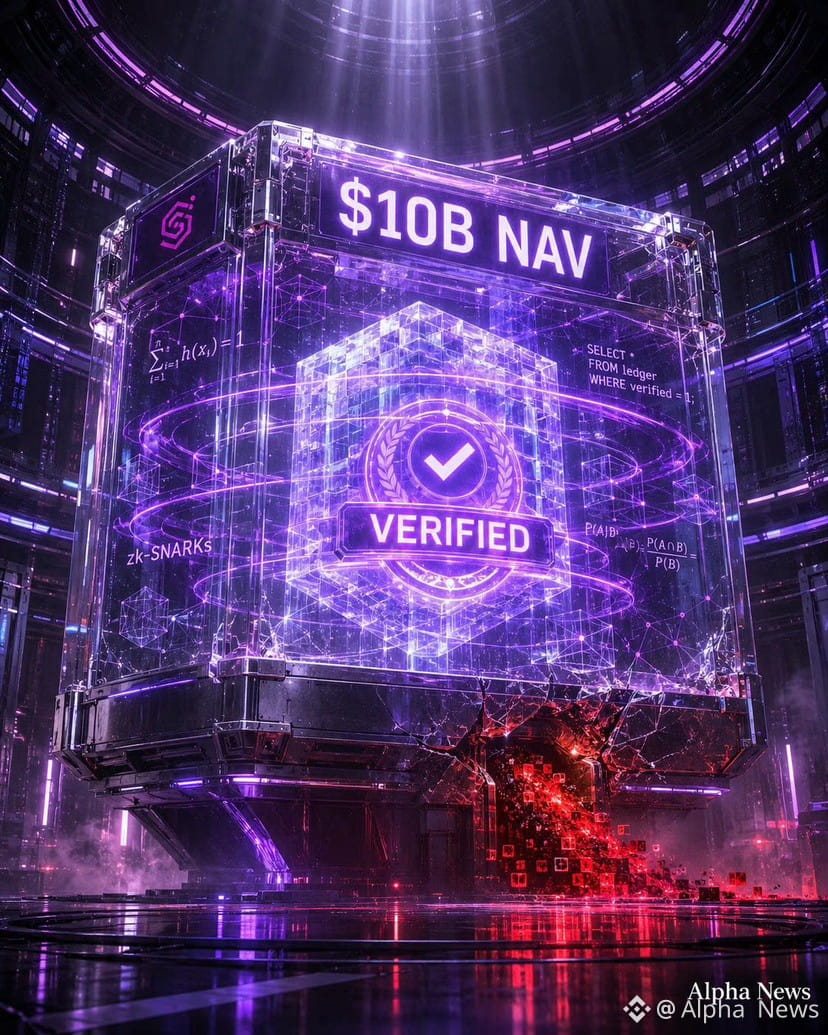
I used to assume that “verifiable data” meant every number passing through the system could be trusted.
I read Space and Time’s v2.0 whitepaper and an interview with the team to revisit that assumption. Proof of SQL proves two things simultaneously: that a query was executed correctly, and that the underlying data table has not been altered from the commitment signed by validators. The prover does not need to be trusted, because the verifier simply checks the result against the commitment.
But a commitment only reflects the data from the moment it enters the system. The team also makes this clear: if the data was manipulated beforehand, the proof cannot detect it.
That made me rethink the NAV of tokenized funds. On each business day, at around 4 PM Eastern Time, the fund administrator finalizes a figure, and billions of dollars in subscriptions and redemptions are priced against it the following morning. With Space and Time, the calculation producing that figure can come with proof. But whether the inputs themselves are genuine comes down to the ingestion gate, where validators reach consensus before the data is recorded (the whitepaper uses the example of a stock price sourced from 12 data providers).
Looking back, trust has not disappeared. It has simply been narrowed down to a single point. The same applies to AI agents and Uniswap v4 hooks: query results can come with proofs, but the ingestion gate still needs to be scrutinized.
The question I still cannot answer is: as more applications rely on provable data, who will be responsible for checking what comes in?
This content is a paid promotion.
Purchasing SXT is risky. You are encouraged to DYOR and to consult professional advice before buying SXT or any other cryptocurrency.
#sxt $SXT @SpaceandTime
I read Space and Time’s v2.0 whitepaper and an interview with the team to revisit that assumption. Proof of SQL proves two things simultaneously: that a query was executed correctly, and that the underlying data table has not been altered from the commitment signed by validators. The prover does not need to be trusted, because the verifier simply checks the result against the commitment.
But a commitment only reflects the data from the moment it enters the system. The team also makes this clear: if the data was manipulated beforehand, the proof cannot detect it.
That made me rethink the NAV of tokenized funds. On each business day, at around 4 PM Eastern Time, the fund administrator finalizes a figure, and billions of dollars in subscriptions and redemptions are priced against it the following morning. With Space and Time, the calculation producing that figure can come with proof. But whether the inputs themselves are genuine comes down to the ingestion gate, where validators reach consensus before the data is recorded (the whitepaper uses the example of a stock price sourced from 12 data providers).
Looking back, trust has not disappeared. It has simply been narrowed down to a single point. The same applies to AI agents and Uniswap v4 hooks: query results can come with proofs, but the ingestion gate still needs to be scrutinized.
The question I still cannot answer is: as more applications rely on provable data, who will be responsible for checking what comes in?
This content is a paid promotion.
Purchasing SXT is risky. You are encouraged to DYOR and to consult professional advice before buying SXT or any other cryptocurrency.
#sxt $SXT @SpaceandTime