
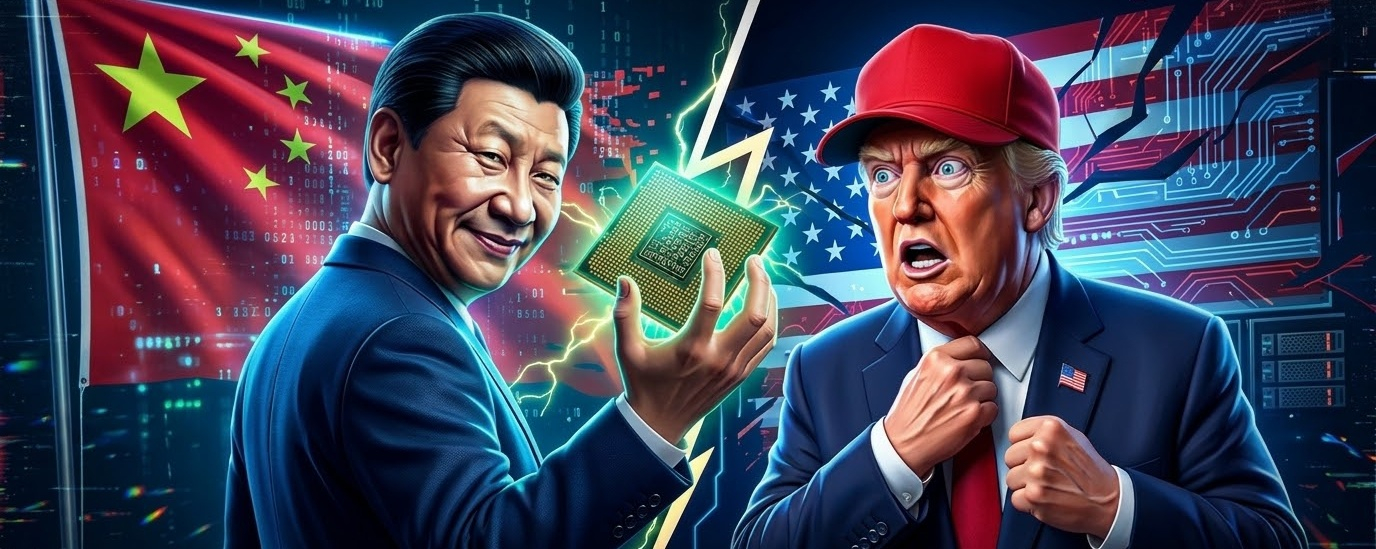

November 12, 2026 | Global Technology & Financial Markets
The competition between the United States and China is entering a new phase.
This time, the focus is on something that could shape the future of the global economy: Artificial Intelligence and semiconductor technology.
From advanced NVIDIA processors to China's growing domestic chip industry, both countries are competing for technological leadership.
Recent developments involving NVIDIA, US export restrictions and Chinese AI companies have brought this competition back into the spotlight.
But what is really happening, and how could it affect global markets?
🇺🇸 1. Why Is the United States Restricting AI Chip Exports?
The United States considers advanced semiconductor technology strategically important.
Companies such as NVIDIA manufacture powerful processors used to develop AI models, operate data centers and perform advanced computing tasks.
Washington is concerned that unrestricted access to these technologies could strengthen China's military and technological capabilities.
As a result, the US has introduced export restrictions on certain advanced AI chips.
However, these restrictions also create challenges for American technology companies because China represents an important potential market.
The central question is how the US can protect its national security while maintaining its position in the global semiconductor industry.
🇨🇳 2. China Is Accelerating Its Domestic Chip Industry
China is working to reduce its dependence on American semiconductor technology.
Several Chinese companies are investing in domestic alternatives.
Important players include:
Huawei
SMIC
Cambricon
China's broader strategy includes expanding domestic chip manufacturing, developing AI processors and building its own computing infrastructure.
However, producing advanced semiconductors at the highest technological levels remains a significant challenge.
The competition is not only about manufacturing chips. It is also about software, research, manufacturing equipment and access to advanced technology.
🚨 3. NVIDIA Is Facing Increasing Pressure Over China
NVIDIA has become one of the most important companies in the global AI industry.
However, its business relationship with China is facing increased scrutiny.
On November 11, Reuters reported that Northwestern Polytechnical University, a Chinese university on the US export blacklist, purchased two NVIDIA H200 processors through a Chinese supplier.
The development raised further questions about how restricted AI chips reach organizations in China.
US lawmakers are increasingly demanding stronger export controls and better monitoring of semiconductor shipments.
This issue could influence future regulations affecting NVIDIA and other American chip manufacturers.
Source: Reuters, November 11, 2026.
⚡ 4. Chinese AI Companies Are Looking Overseas for Computing Power
One of the most interesting developments is happening outside mainland China.
According to a November 12 Reuters report, Chinese AI companies are exploring access to NVIDIA-powered computing capacity through overseas data centers.
Why?
Because direct access to certain advanced AI processors is restricted.
Overseas cloud computing infrastructure provides another possible way to access powerful processors without importing them directly.
However, Washington is considering stronger oversight of remote access to restricted AI technology.
The proposed Remote Access Security Act could give US authorities additional powers to regulate such access.
If these restrictions expand, Chinese AI developers could face additional challenges in obtaining advanced computing resources.
Source: Reuters, November 12, 2026.
📉 5. What Does This Mean for the Stock Market?
The growing competition between the US and China could influence several major semiconductor companies.
Here are some important stocks to watch.
NVIDIA (NVDA)
Further restrictions on Chinese sales could limit some business opportunities. However, international AI infrastructure demand remains an important growth factor.
AMD (AMD)
AMD could benefit if customers diversify their semiconductor suppliers. Its own exposure to export restrictions also remains important.
Broadcom (AVGO)
Demand for AI networking infrastructure and custom semiconductor solutions could support its business.
TSMC (TSM)
As a major semiconductor manufacturer, TSMC is exposed to both growing AI demand and geopolitical tensions involving Taiwan.
Chinese Semiconductor Companies
Domestic chip manufacturers could benefit from China's efforts to develop local alternatives to foreign technology.
However, manufacturing capabilities and technological limitations remain important challenges.
These are potential business implications, not guaranteed stock-price movements.
🔮 6. Three Possible Scenarios for the Future
Scenario 1: Improved US-China Technology Relations
If both countries find common ground on semiconductor trade, uncertainty could decrease.
This could improve sentiment toward international technology companies.
Scenario 2: Stricter Export Restrictions
Additional restrictions could make it more difficult for Chinese companies to access advanced American AI processors.
This could accelerate China's investment in domestic semiconductor technology.
Scenario 3: Two Separate AI Ecosystems
The United States and China could increasingly develop independent AI infrastructure and semiconductor supply chains.
This could reshape global technology investment over the coming years.
None of these scenarios is guaranteed. Government policy and technological developments will determine how the situation evolves.
🎯 Final Thoughts: The Next Big Battle Is About Technology
The competition between China and the United States is becoming one of the most important developments in the global technology industry.
Artificial intelligence is no longer just a software business.
It depends on advanced processors, semiconductor manufacturing, data centers, energy infrastructure and international supply chains.
NVIDIA remains a major player in this ecosystem, but the competition involves hundreds of companies across multiple countries.
For investors, understanding these developments is becoming increasingly important.
The next major developments to watch include US export policy, China's domestic semiconductor progress and the global demand for AI computing power.
One question remains:
Will the United States maintain its leadership in advanced AI chips, or will China eventually build a competitive semiconductor ecosystem of its own?
💬 What is your opinion?
Can China become independent of American AI chip technology, or will NVIDIA and other US companies maintain their technological advantage?
Share your thoughts in the comments!
#HuangExitNvidiaStrategyInFocus #AnthropicRejectsIPODelayValuationinQuestion #BitMineReports$6.3BNetLossForFiscal2026 #ChipStocksExtendLossesAfterNvidiaCEOChange #ThailandProposes$148KDailyStablecoinDepositWithdrawalCaps