DeFi Utility and Smart Contract Evolution
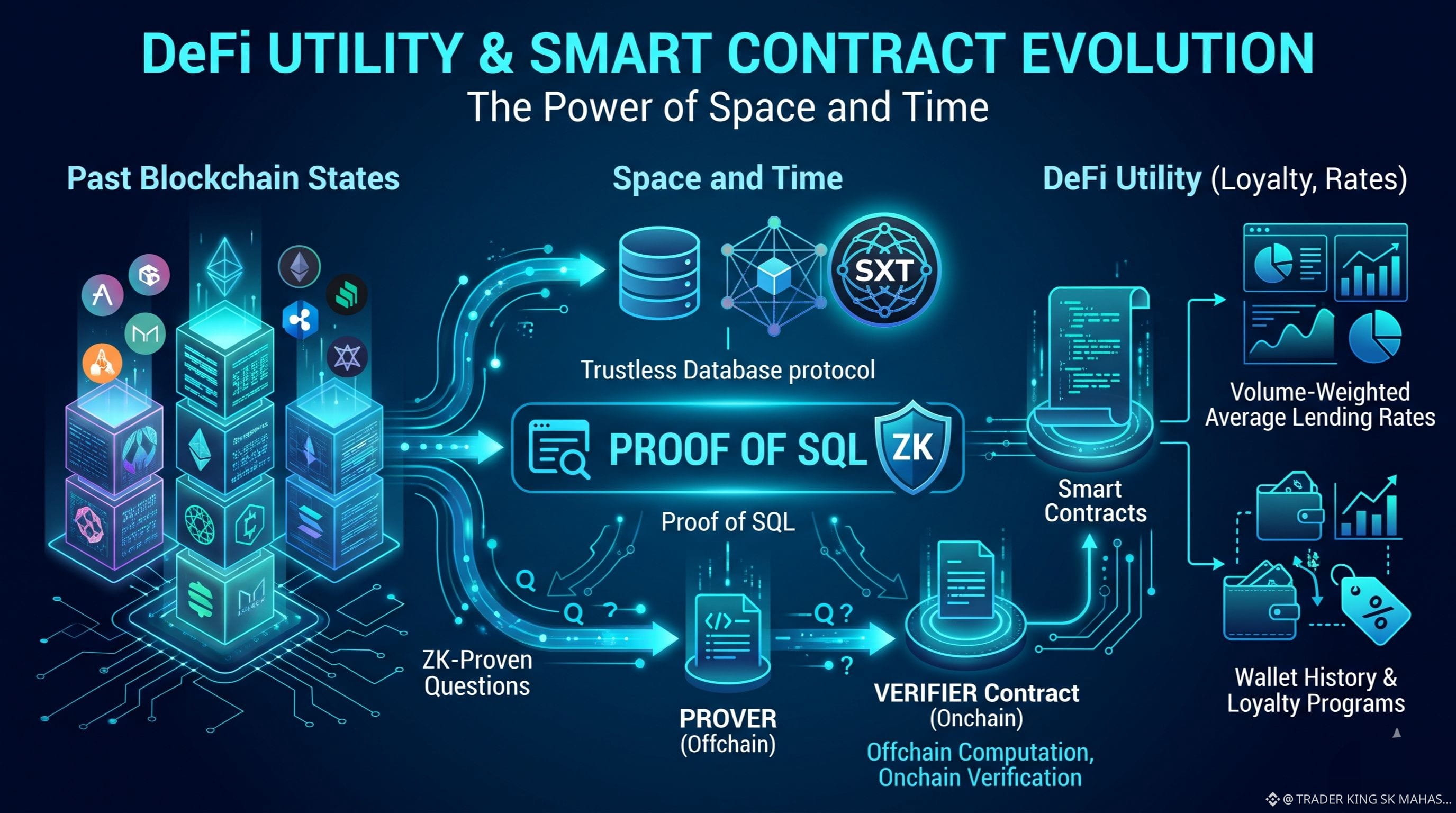
Decentralized finance relies on contracts that protect billions of dollars but smart contracts do not use data in a sophisticated way. For example the best lending markets cannot easily tell a borrower from a loyal user who has a long onchain record because smart contracts cannot ask for past blockchain states. @SpaceandTime removes this limitation completely. Because Space and Time provides data for AI, tokenization and DeFi it lets decentralized applications run complex real‑time analytics on their own.
By acting as a trustless database protocol lets DeFi platforms ask ‘ZK‑proven questions’ about activity on many chains. With Proof of SQL a decentralized exchange can launch a loyalty program that checks exactly how many trades a particular wallet address has done. Then it can give a fee discount that changes with that number. In the way lending protocols can immediately compute the volume‑weighted average lending rate across platforms such, as Aave, Maker and Compound.
The architecture is built simply: a client contract sends a request a single Prover node runs the Proof of SQL offchain and then a Verifier contract accepts and checks the ZK proof onchain. This design of a decentralized database cuts the amount of gas that is spent onchain and makes the chain scale better.
The network turns blockchain data into a commodity using the $SXT token so that users pay only for the compute costs of the queries they run not for storing the data itself.
#SXT
#sxt
#SXTToken
#SXTSimpleEarn
#SXTspot