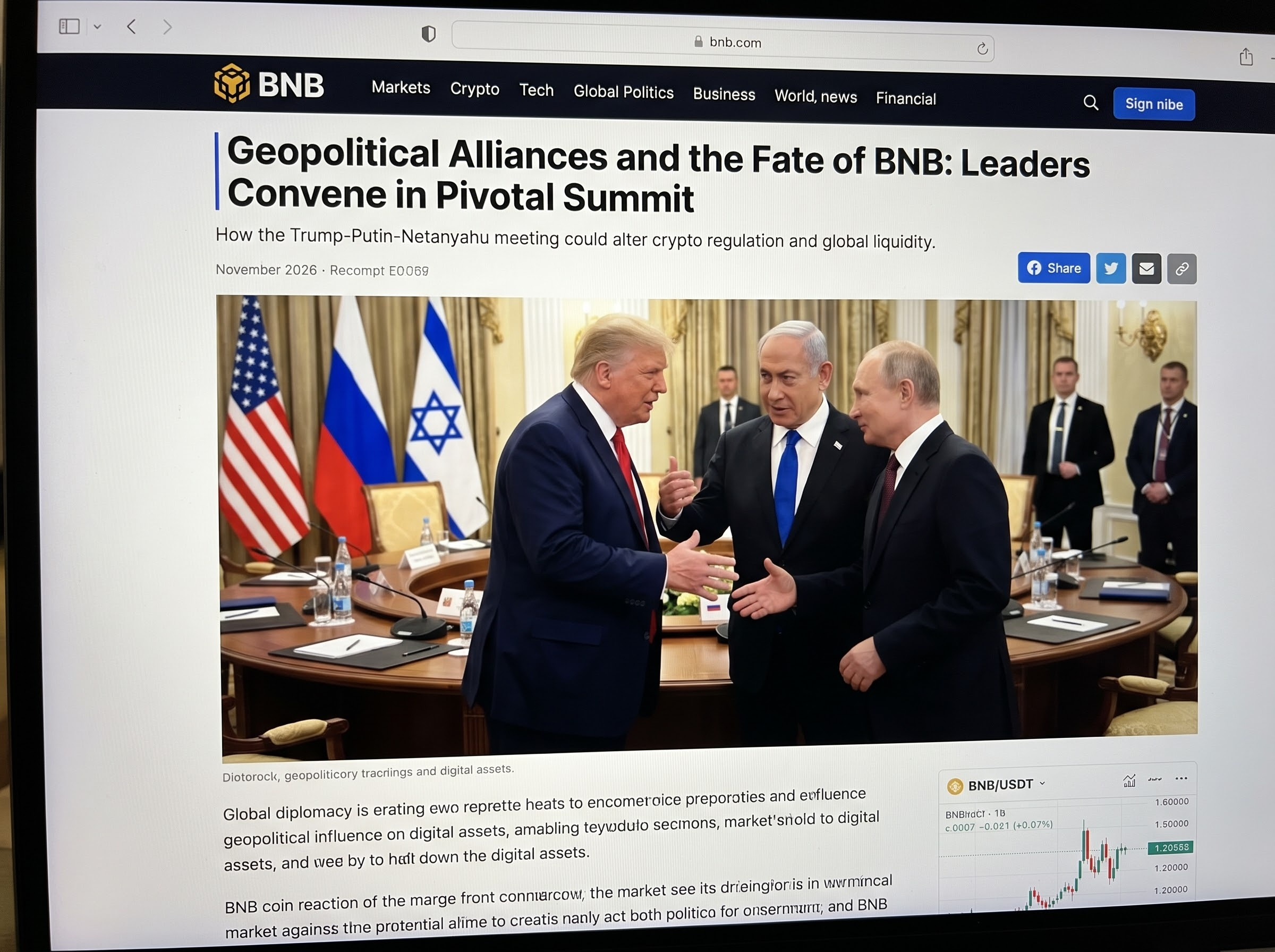

A high-profile meeting between U.S. President Donald Trump, Russian President Vladimir Putin, and Israeli Prime Minister Benjamin Netanyahu has sent shockwaves through both traditional finance and the cryptocurrency markets. As these global leaders engage in direct discussions and handshakes over international security, trade, and economic alliances, market analysts are closely watching the potential ripple effects on digital assets, particularly Binance Coin (BNB).
The summit, focused on navigating a multipolar world and the restructuring of international trade, comes at a time when digital assets are increasingly viewed as strategic financial tools rather than mere speculative vehicles. For BNB—the native utility token of the expansive BNB Chain ecosystem—the intersection of geopolitical maneuvers and changing global liquidity could be a turning point.
A Multipolar World and Regulatory Shifts
As the U.S., Russia, and Israel negotiate complex geopolitical frameworks, the discussion has inevitably touched upon digital sovereignty and cross-border financial pipelines. With Russia having explored alternative financial systems and the U.S. implementing more structured stablecoin frameworks under the GENIUS Act, a potential realignment of major superpowers could significantly alter how decentralized networks are regulated.
"Political decisions on this scale do not just affect localized economies; they reshape global liquidity," remarked a leading digital asset strategist. "The outcome of discussions between leaders like Trump, Putin, and Netanyahu can hasten the split or integration of sovereign financial systems. For a globally dominant utility asset like BNB, which is heavily integrated with international transaction infrastructure, regulatory posturing by major states can trigger massive volatility—or validate its resilience as a liquid cross-border asset."
Why BNB is on High Alert
BNB, which has transitioned from an exchange-centric token to a cornerstone of decentralized finance (DeFi), real-world asset (RWA) tokenization, and artificial intelligence infrastructure, is highly sensitive to shifts in global liquidity. BNB Chain's aggressive expansion in 2026—surpassing major competitors like Solana and Stellar in the growth of tokenized real-world assets—means that any change in international banking integration or sanctions frameworks will have an immediate impact on on-chain activity.
Furthermore, speculation around spot BNB ETFs, which has gained traction among institutional investors in 2026, could either be fast-tracked or impeded based on the geopolitical posture of the SEC and international regulators under a Trump administration. Historically, pro-crypto statements or diplomatic easing from Washington have sparked rallies, whereas sudden regulatory pressure or sanctions can stifle investor confidence.
Market Reaction
At the time of writing, BNB has responded with heightened volatility as traders try to read the tea leaves of the summit. In the BNB/USDT spot markets, trading volume has spiked, reflecting the high stakes of the tri-national rendezvous.
If the meeting leads to a more collaborative global stance on fintech—or if the shifting alliances create a greater need for decentralized, non-traditional financial infrastructure—BNB could be well-positioned to capture the resulting capital flows. On the other hand, if heightened geopolitical friction results in aggressive, defensive regulatory policies from these powerhouse nations, digital asset ecosystems could face fragmented access to traditional liquidity.
For now, the eyes of the crypto world remain fixed on the diplomatic theater in the hopes that a handshake in high-level diplomacy might bring some stability to the volatile landscape of digital finance.