

The yen slid back toward 160 to the dollar this week, and Japan's top currency diplomat, Atsushi Mimura, used the moment to remind traders what the last visit to that neighborhood cost.
He told reporters Thursday that the recent pace of the move had been quicker than he would like, and that it is "too early to forget what happened this summer." That summer saw Tokyo spend a record $96.5 billion over three days defending the currency, including its first coordinated yen purchase with the United States since 1998.
The slide has been quick. In two sessions, the dollar climbed from around 158 yen to nearly 160, touching 159.948, the weakest the yen has been in more than two months, before pulling back. It is trading near 159.67 now.
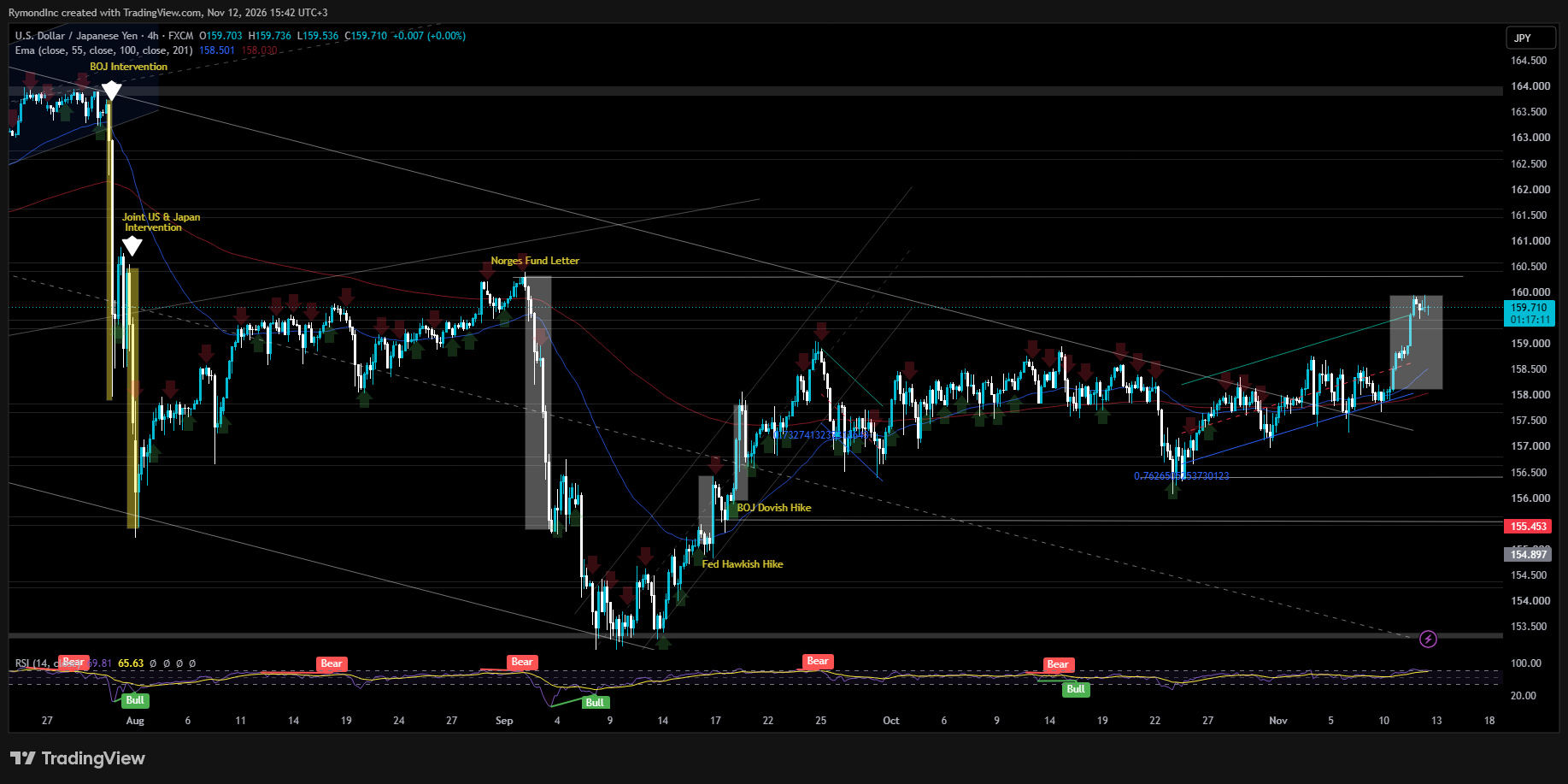
Tokyo's Finance Ministry spelled out the scale of that earlier campaign on Monday: 15.4 trillion yen of buying across three consecutive business days starting July 30, with the joint operation alongside Washington coming on July 31. The effort amplified Japan's warning to currency speculators, and it helped drag the dollar from beyond 163 yen to as low as 155.23.
Mimura declined to comment on specific exchange-rate levels, which is the traditional way of saying nothing and meaning something. His remarks were widely read as a sign that Tokyo stands ready to step in again, and with the gap between U.S. and Japanese interest rates threatening to widen, intervention is back in the conversation.
A Fed That Keeps Raising Its Voice
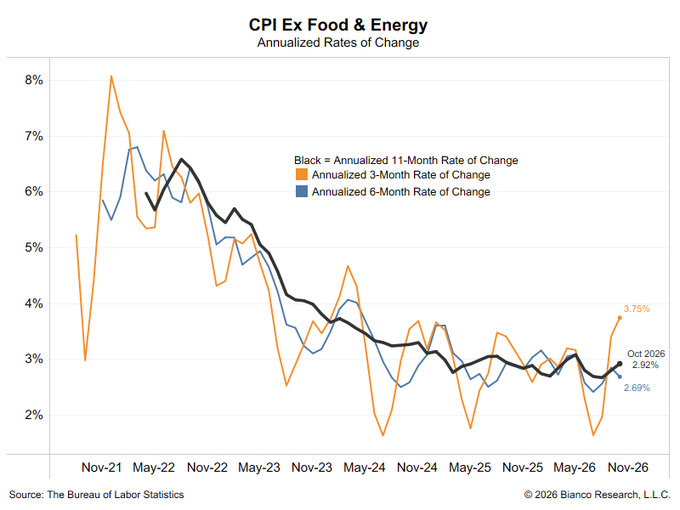
The dollar's rise this week has been broad, with the yen one of many currencies on the receiving end. Core U.S. consumer prices rose faster than forecast for a third straight month in October. US Headline CPI rose 0.4% MoM, while the Core CPI increased 0.296%. its third straight 0.3% print. The 3-month annualized rate rose to 3.75% from 1.6% in July.
Year-on-year data aren’t available because the government shutdown nixed an inflation report for last October. But the 11-month inflation rate, from November, showed a rise from last month.
This resulted in a run of hawkish remarks from Fed officials that have lifted bets that the central bank resumes raising rates next month. Few of those officials have gone out of their way to calm anyone down.
Fed Gov. Christopher Waller laid out the arithmetic before the data arrived. He would support a quarter-point increase in December even if October inflation looked better. If core consumer price index (CPI) inflation came in around 0.3% or higher, which it did, similar to the previous two months, a half-point move deserved consideration, because stopping at 25 basis points while inflation persisted would put the Fed's credibility at risk. The number, when it came, was 0.3%.
Dallas Fed President Lorie Logan, a voter this year, wants at least two more quarter-point increases and thinks the committee could move faster this winter than it has so far. Inflation running meaningfully above the 2% target is "unacceptable," she said, and the pressure is broader than tariffs or wartime energy costs and likely to last. Once those two hikes are delivered, she stated, a pause to reassess would make sense.
Chicago Fed President Austan Goolsbee called the latest CPI report "borderline disturbing." Persistent services inflation bothers him most, and he sees cost and demand pressures both pushing prices up, with overheating spreading. If inflation became embedded in expectations, he said, that would be a major concern, and every option stays open.
Philadelphia Fed President Anna Paulson, also a voter, took a gentler line: further gradual increases look appropriate, with policy staying "somewhat restrictive," and a quicker pace only if the inflation outlook worsens. Slow hikes, she said, give the economy time to adjust and officials time to judge the effect.
What Traders Are Pricing
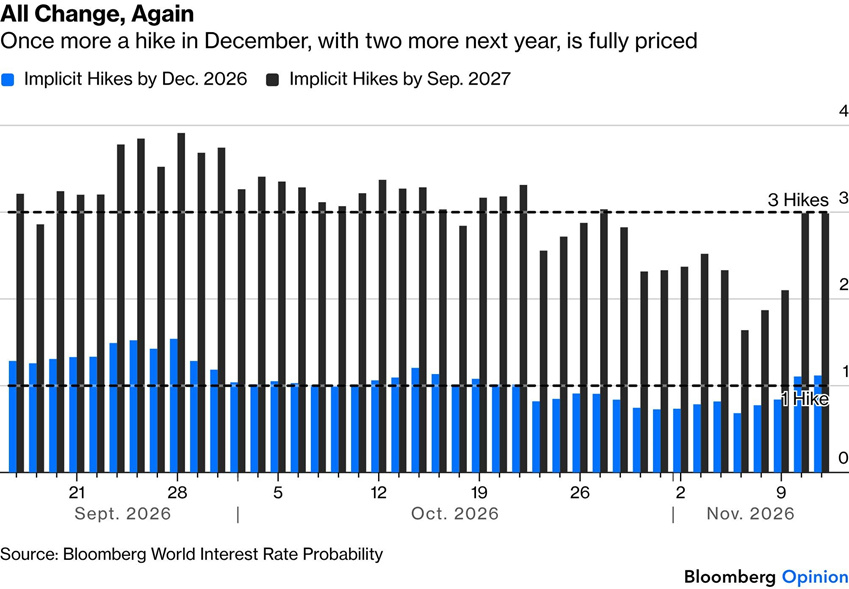
The yen has come under fresh pressure on expectations of a wider U.S.-Japan rate gap. After the Fed's recent run of comments, traders added a small chance of a half-point increase in December. A quarter-point hike is now fully priced, with roughly a 10% risk of 50 basis points, and futures lean toward further increases through 2027.
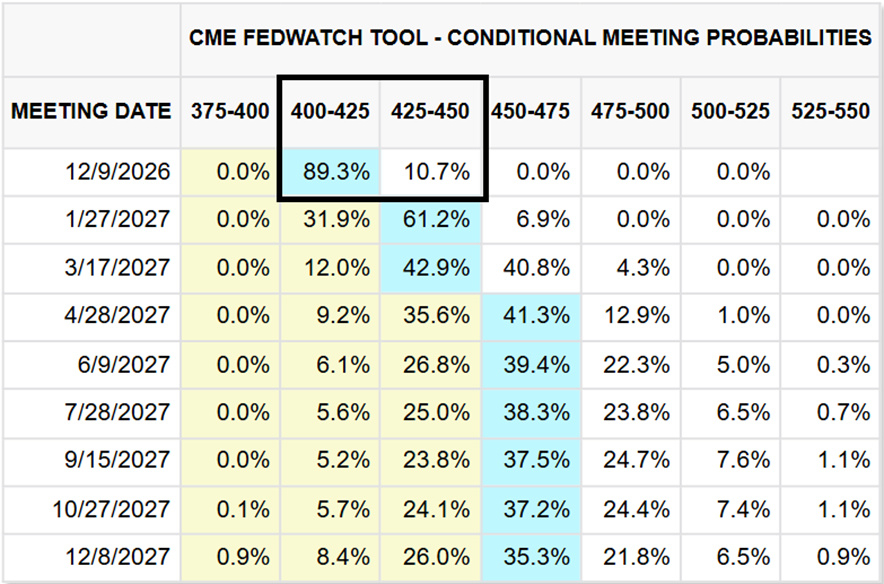
Traders are recalibrating the longer rate outlook. Expectations for hikes through end-2026 and September 2027 have shifted sharply since September. Markets Fully Price in Three Fed Rate Hikes Through September 2027. Once more, a hike in December, with two more next year, is fully priced.
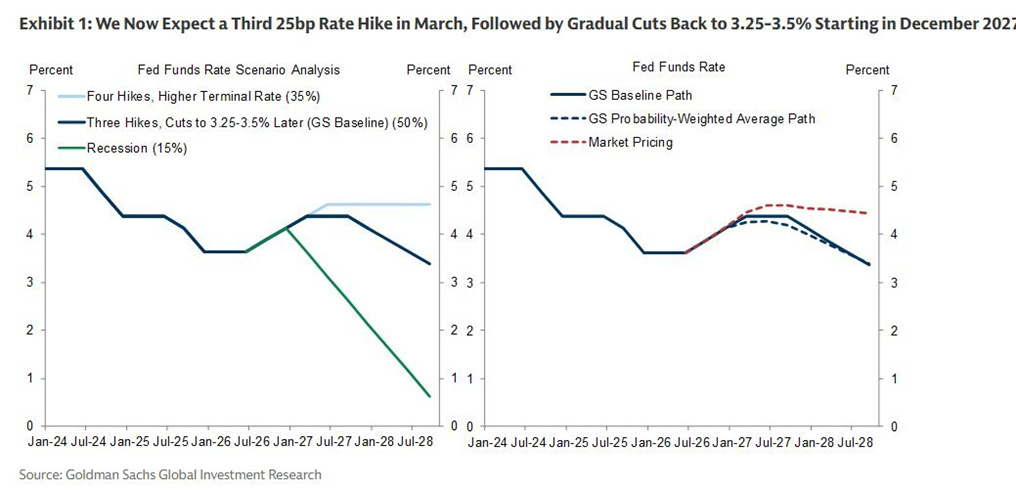
Goldman Sachs has penciled in a third quarter-point hike for March and now expects the Fed to start cutting in December 2027, eventually bringing the policy rate back to 3.25% to 3.5%.
Yardeni Research had warned on Oct. 26 that the Fed could surprise markets with a quarter-point hike at its October meeting, and that if the central bank skipped it because the midterm elections were too close, a half-point move in December might follow. Waller's remarks, the firm says, strengthen the worry that the Fed will need a more aggressive approach if inflation stays stubborn.
Tokyo's Own Inflation Problem
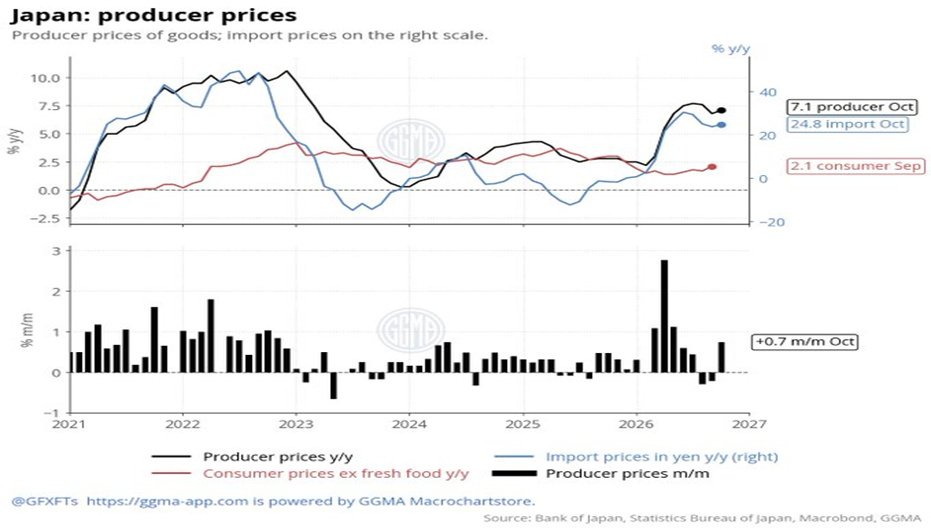
Japan's domestic data are not making the Bank of Japan's job any easier. Producer prices rose 7.1% in October from a year earlier, beating the 6.5% economists had forecast and accelerating from 6.8% in September. On the month, the 0.7% rise was the fastest since May, and import prices in yen terms are up 24.8% on the year, according to preliminary central bank figures. Consumer prices, by comparison, rose only 2.1% in September, which suggests plenty of cost pressure is still working its way down the pipeline.
Numbers like those reinforce expectations that the BOJ tightens again, and investors widely expect a hike at the Dec. 17-18 meeting. Seisaku Kameda, the central bank's former top economist, told Reuters on Friday last week that he sees the policy rate going to 1.5% in December and then rising roughly once a quarter until it reaches 2%.
The bank's own account of its Oct. 29-30 meeting points the same way. In the summary of opinions released Tuesday, several board members described a near-term hike as necessary, and one said the next increase should be decided as soon as it can be done "without becoming overly cautious." That leaves a good chance of a December move.
Policy has been speeding up. After hikes in June and September, a faster rhythm than the roughly twice-a-year pace of 2024 and 2025, the BOJ said last month that underlying inflation has reached its 2% goal for the first time since the target was set in 2013.
That judgment weakens the case for keeping policy accommodative. Several members said the policy rate should be brought up to a neutral level, neither stimulating nor restraining the economy, and one said the bank needs to get there soon now that underlying inflation is already at 2%.
The global market rout that sent Japanese stocks tumbling that day, he said, is unlikely to derail the December move unless volatility lingers into the run-up to the meeting. A full-fledged collapse in the AI boom, one severe enough to hit Japan through a sharp slowdown in U.S. growth, is what could make the BOJ pause.
The Gap Still Decides
Interest-rate differentials remain the biggest threat to the yen. The BOJ lifted its policy rate to 1.25% in September, and support for further increases is growing on the board, yet officials remain careful about fragile household spending and slow wage growth.
Toichiro Asada, among the board's more dovish members and a dissenter against both the June and September hikes, voiced that caution Thursday. Financial conditions are still accommodative, he said, but consumption may be weaker than it looks. Japan has reached its 2% inflation goal, in his view, and the reflationary measures have done their work, which leaves him questioning how much more tightening is needed.
Doubt about the BOJ's pace matters because the Fed's direction is not in doubt. If Tokyo moves more slowly than Washington, the rate gap stays wide, and a wide gap keeps the carry trade, borrowing in yen to hold higher-yielding assets, attractive. That arrangement has kept pressure on the yen and Tokyo's attention fixed on it.
The Fed meets Dec. 8-9. The Bank of Japan answers on Dec. 17-18. The yen has to cross the stretch between them from a spot a few tenths of a yen shy of the level that has already drawn Tokyo into the market this year.