
I’ve spent the last several days going through Siren (SIRENUSDT) from every angle I could — price action, on-chain holders, futures data, historical dumps, and the current structure. Here’s everything that actually matters.
### The Real Picture of This Coin
Siren is not a normal project. It’s a high-concentration token that rode an AI-meme narrative hard and then got wrecked by its own largest holders.
The all-time high was around $4.81, not the $3.83 figure some people are still quoting. From that peak, the coin is down more than 99%. That kind of drawdown already tells you a lot.
### Who Actually Controls the Supply
This is the most important part.
Top 100 wallets control roughly 93.7% of the total supply.
The single largest holder is a Binance Wallet Proxy with about 38.3%.
The second largest is a burn address holding around 27.6%.
After these two, you have exchange wallets (KuCoin, Indodax, MEXC) and a few other contracts.
What this means in simple terms:
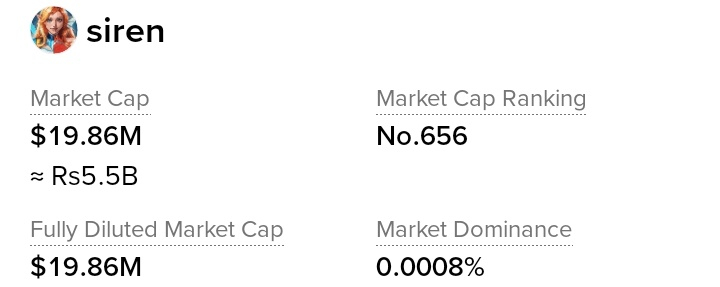
The real free float — the tokens actually available in the open market — is extremely small. Outside the top 100 wallets, only about 6.3% of supply is left. That’s roughly $1.7 million worth at current prices. This is not a widely distributed coin. A few large players can still move the price heavily whenever they want.
### What Happened in the Past
In June 2026, a dominant whale (or coordinated cluster of wallets) sold approximately 670 million SIREN tokens in a short period. That was close to 90%+ of the circulating supply at the time. They extracted tens of millions of dollars.
This wasn’t a normal unlock. It was a controlled distribution into retail demand. The project itself never delivered any real working product. It stayed mostly narrative-driven.
### Current Market Structure
Right now the price is hovering around 0.027.
Futures volume is still much higher than spot. Open interest has frequently been high relative to market cap. This means price discovery is still heavily driven by leveraged traders rather than real spot buying.
Funding has been running positive, sometimes quite high. That means late longs are already paying to stay in the trade.
We also saw a sharp spike toward the 0.0415 area in mid-October that got sold off quickly. These kinds of fast pumps and equally fast dumps have become a pattern here.
### Can It Still Go Higher?
Short-term spikes are always possible on a coin with this low free float. A sudden short squeeze or a wave of FOMO can push it 40–80% relatively fast.
But the structural problems haven’t disappeared:
- Extreme concentration is still there
- The largest holders have already shown they are willing to dump size
- There is no strong product or fundamental demand
- Previous spikes have not held
Because of this, any rally has to be treated as potentially temporary until proven otherwise.
### What Would Need to Happen for a Cleaner Long
If someone still wants to take a trade, these conditions make more sense than just buying randomly:
1. Daily close and hold above the recent range high (around 0.0287)
2. No large transfers from the top wallets into major exchanges
3. Funding not exploding higher while price is rising
4. Price staying above the 0.025 area (recent low)
If the daily candle closes below 0.0245 or the 0.0207 level breaks, the next logical area sits much lower near 0.01745.
### Final Thoughts After One Week of Looking at This
Siren is a high-risk, low-float, previously whale-dominated token. The big dump already happened, so the worst may be behind it in terms of pure size, but the character of the coin hasn’t changed. It still behaves like a speculative vehicle that can spike hard and reverse just as fast.
There is no strong case for long-term holding or DCA here. The free float is too small and the history of distribution is too clear.
If you trade it, treat it as pure risk capital. Size small, define your invalidation clearly, and don’t fall in love with the bounce.
That’s the cleanest summary I can give after going through everything