$MSTRB : Why Explicit Uncertainty Logging Improves Trade Decisions
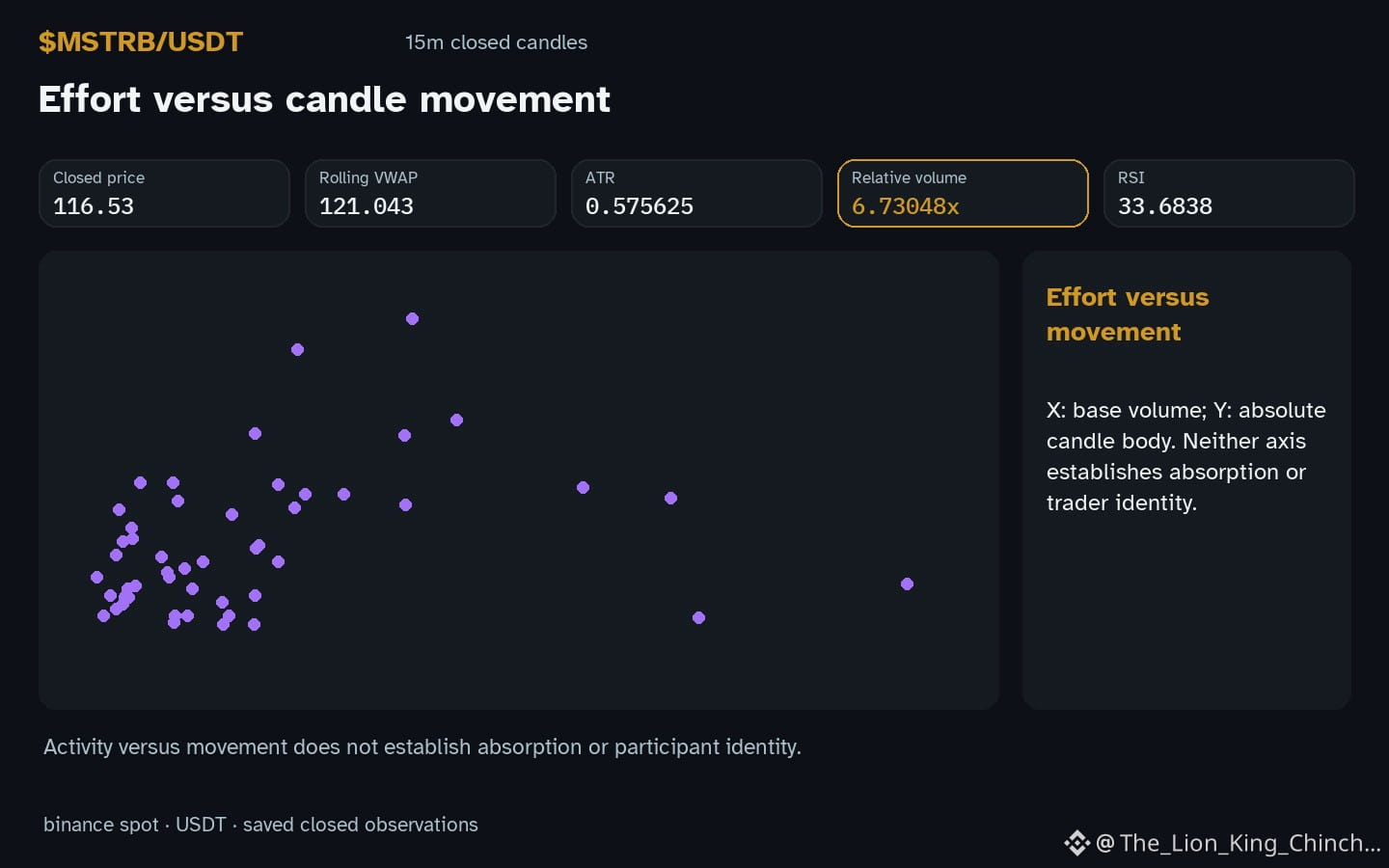
$MSTRB sits below its local support with an hourly down direction and volume above baseline. Does the lack of a documented uncertainty log make it harder to judge whether a pull‑back is a genuine entry or a chase?\n\nA common assumption is that a trader can infer entry quality from raw price and volume alone. The counterexample to consider is a thought experiment where two analysts watch the same candle. Analyst A notes the down move and writes down the uncertainty: "Price may be testing a false breakout; volume is high but could be short‑covering. If the next candle closes above 116.55, the signal gains credibility; if not, the trade may be invalid." Analyst B makes no note and simply enters on the next dip. The trade‑off emerges: documenting uncertainty adds a step that can prevent chasing, but it also delays entry, potentially missing a small move.\n\nWhat could change the reading? A future closed‑candle that shows 6.73x baseline volume paired with 33.7 indicating oversold conditions would weaken the initial assumption of a pure bearish bias and prompt a reassessment of the trade plan. The self‑check highlights that explicit logging turns vague intuition into a testable hypothesis, allowing the trader to invalidate the idea without increasing stop distance unnecessarily.
Probabilistic market research, not a recommendation or guaranteed return.
For a wider view: $ETH has hourly direction down and volume above its baseline; $ERA has hourly direction up and volume above its baseline. This alone does not establish correlation.
#MSTRB #ETH