$PAXG: Slowing Down the Signal
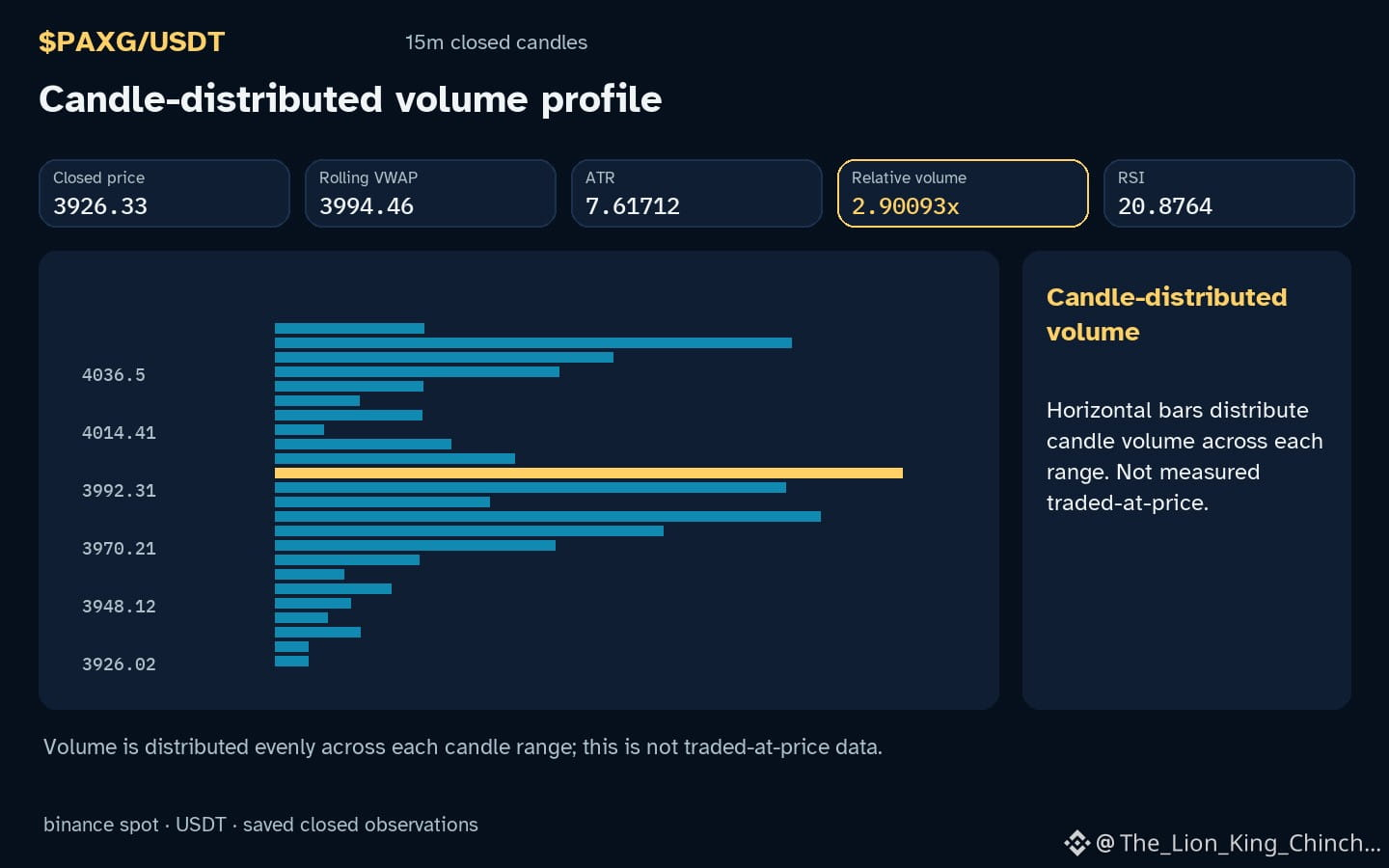
$PAXG: Is a quick post a useful pause or a rushed conclusion? $PAXG sits below local support with relative volume at 2.90x baseline. Hourly direction is down. This creates tension between reacting to the break and waiting for confirmation.
Suppose a trader sees the price drop and posts immediately. That is a reactive response. Now imagine a deliberate alternative: asking what evidence would change the view before acting. The observation shows a clean break below the prior bar low. Volume is elevated, which often coincides with volatility, but high volume alone does not prove sustained momentum. It only describes participation in that specific window.
The trade-off is entry quality versus chasing. Chasing the initial drop assumes the move continues. Waiting for a pullback to the broken level treats the support as potential resistance. This is a hypothetical framework, not advice. The risk is that waiting costs opportunity if the price never retraces, while chasing risks a quick reversal if the volume was thin or one-sided.
A counterexample helps clarify. If the price breaks support and immediately reclaims it, the initial break was noise. Posting on the break would have been incorrect. The self-check is simple: ask if the next closed candle confirms the direction. If not, the initial reaction was premature.
The limits of this evidence are clear. These metrics describe a snapshot. They do not reveal intent or future price. RSI at 20.9 is just a reading, not a guarantee of exhaustion. The mechanism here is the discipline of waiting for a second data point. A useful reassessment condition is observing whether the price holds the new lower level on the next candle. If it fails to hold, the initial reaction was too fast. Slow analysis reduces the error rate of reactive posting.
Probabilistic market research, not a recommendation or guaranteed return.
#PAXG #RiskManagement #CryptoLearning