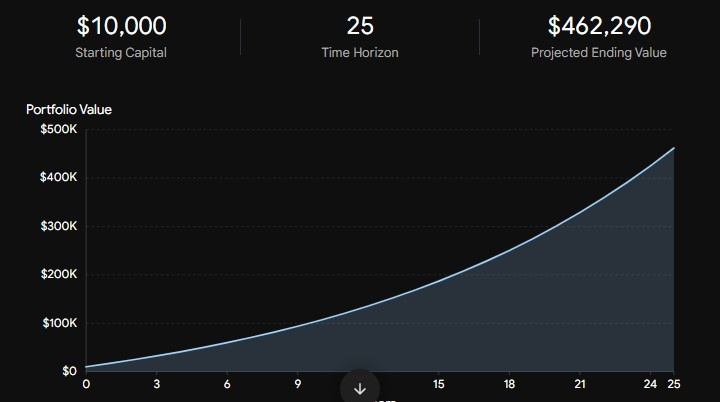
In traditional finance, time horizon is one of the most powerful levers in portfolio design. It directly dictates how aggressively you can invest, how much volatility you can absorb, and how exponentially compound interest can work in your favor.
1. The Mechanics of Compounding Over Time
Compounding occurs when your investment earnings generate their own subsequent returns. While the initial years of compounding can feel slow, the growth curve turns exponential as time increases.
The Exponential Curve: Mathematically, compound growth is expressed as $A = P(1 + r)^t$, where time ($t$) is an exponent rather than a linear multiplier. Every additional year in the market does not just add returns; it compounds the gains of all previous years.
Early Contributions Matter Most: A dollar invested at age 25 is worth significantly more at retirement than a dollar invested at age 45, purely due to the extra decades of compounding runway.
2. Time Horizon vs. Risk Tolerance
Risk tolerance is often thought of as an emotional trait (how well you sleep when the market drops), but in professional wealth management, time horizon dictates your structural capacity for risk.
Long Time Horizons (10+ Years):
Capacity for Risk: High. If you have a multi-decade horizon (such as retirement or long-term wealth accumulation), short-term market crashes, recessions, and volatility become microscopic blips on a long-term upward chart.
Asset Allocation: Heavily weighted toward growth assets like equities (stocks) and alternative investments, which historically outperform cash and bonds over long periods.
Short Time Horizons (Under 3–5 Years):
Capacity for Risk: Low. If you need the capital soon (e.g., buying a house next year or paying tuition), you cannot afford a sudden 20% market correction right before your withdrawal date.
Asset Allocation: Weighted toward capital preservation assets like cash equivalents, short-duration bonds, and high-yield savings accounts where principal protection is the priority.
3. Visualizing Long-Term Compounding Growth
The simulation below models how different time horizons and compounding rates transform regular contributions into long-term capital.