$NIGHT : Confusing High Activity With High Productivity
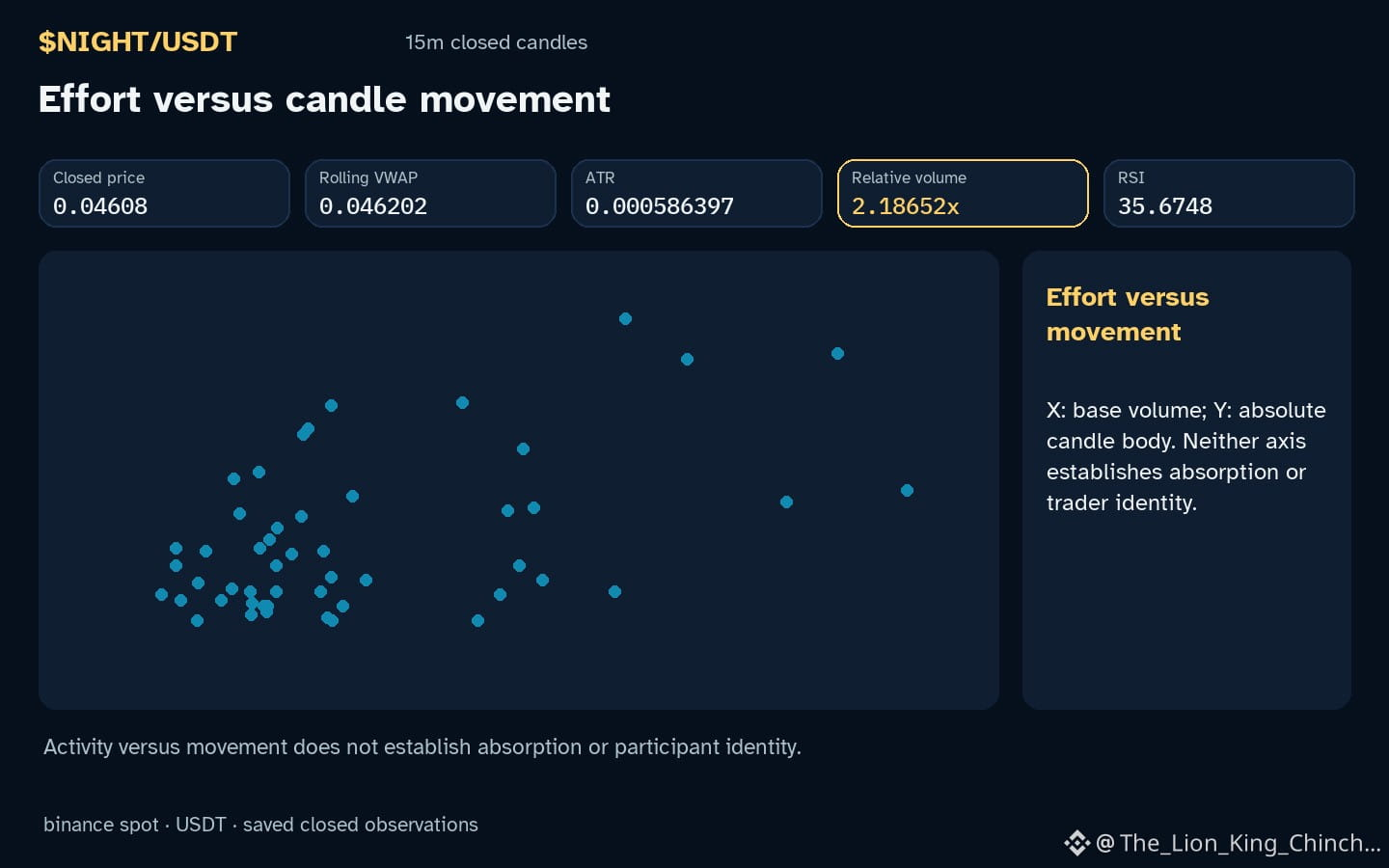
Does frequent trading show better discipline on $NIGHT ? Hourly change -3.0711% and RSI 35.7 provide the context. A researcher might imagine a trader who links constant action to professional effort. This bias treats visible movement as proof of skill. In this hypothetical mechanism, the trader watches the price drop below support at 0.04633. The relative volume is 2.19x baseline. They may feel idle watching the chart, so they buy or sell just to act. This behavior anchors their identity to the activity itself. The screen provides immediate feedback, unlike holding a position which feels like doing nothing. This mechanism confuses process with outcome. Candles cannot confirm motives or causation. A counterexample exists when a trader waits for a retest. They feel anxious because the relative volume is rising, yet they have a planned level to watch. They reassess the interpretation by checking if their trade rationale relies on feeling busy rather than structure. A practical self-check asks if they would still place the trade if the screen was off and no one was watching. This limits the power of the badge. The current observation includes a daily change of 7.36253% for context only. The evidence does not prove exhaustion. The view that activity equals productivity is a thought experiment. Reassess by removing the judgment of effort from the decision criteria. Focus on the local recorded range and relative volume tokens. This approach avoids the trap of mistaking constant interaction for actual edge. The primary measurement available is relative volume 2.19x. This is a base-volume ratio, not buying pressure. It marks activity, not intent. Future closed-candle evidence could weaken the interpretation of panic. Do not assign current measurements to a future candle. This concludes the exploration of this specific bias.
Probabilistic market research, not a recommendation or guaranteed return.
#NIGHT #TradingPsychology