




We live in a world where almost every digital activity generates data. Every blockchain transaction, financial operation, AI interaction, and application generates information. But there is a fundamental problem: how do we know whether the data we receive is actually correct?
Let's understand this with a simple example.
Imagine asking a bank how much money you received last month. The bank gives you a statement showing your total incoming transactions. You can read that number, but what if you want to independently verify how the bank calculated it? You would need access to the underlying transaction records and a way to confirm that the calculation was performed correctly.
This is the basic idea behind verifiable data.
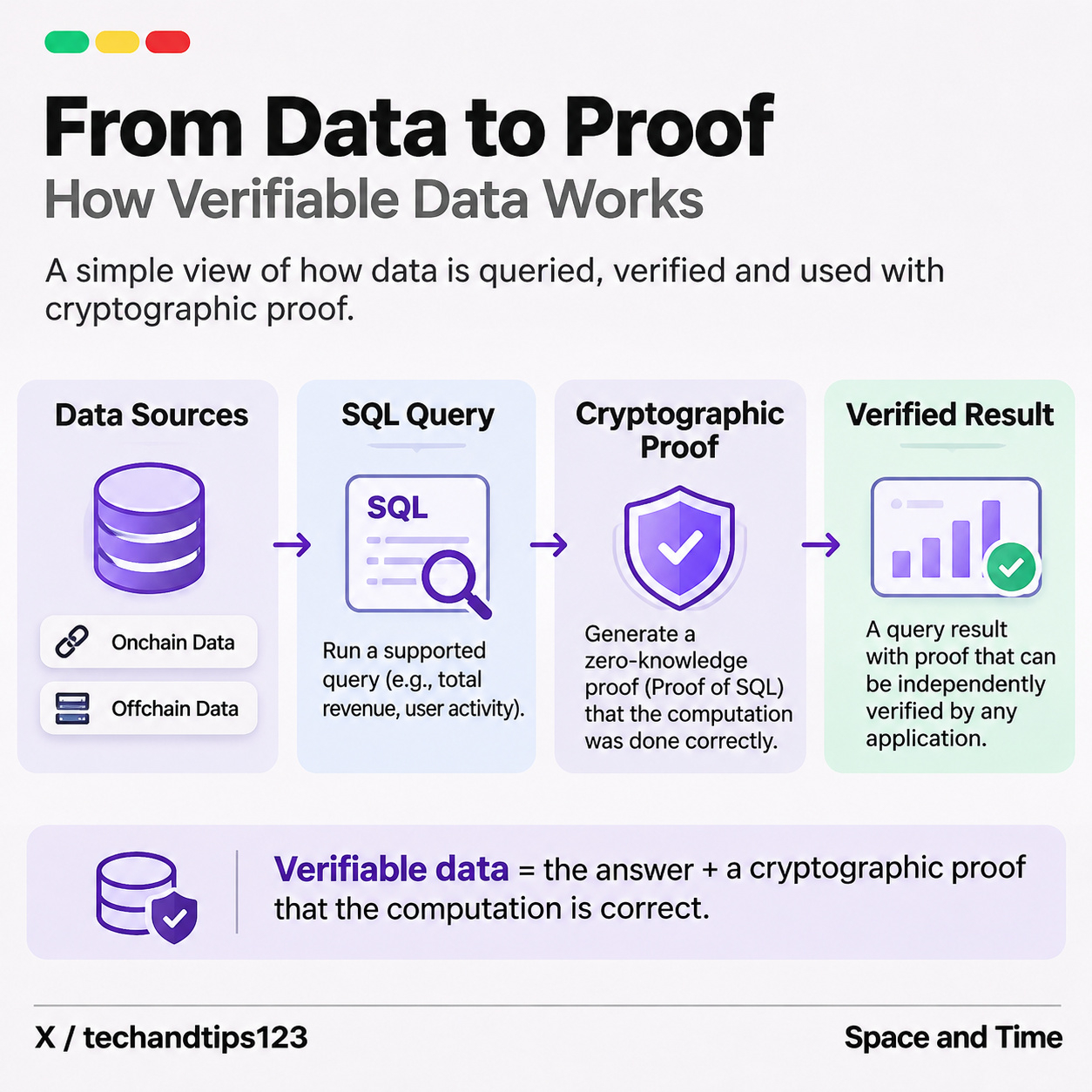
In simple terms, verifiable data is information that comes with a way to independently check its accuracy or verify that a particular computation was performed correctly.
There is an important difference between receiving an answer and being able to verify how that answer was produced.
In technical terms, cryptographic proofs can help establish that a computation was executed correctly against a particular dataset without requiring the receiving application to blindly trust the database operator.
This becomes particularly important when financial applications and AI systems start making decisions using external information.
II. Why Does Verifiable Data Matter?
Verifiable data is not just another blockchain feature. It addresses a fundamental requirement across three rapidly developing areas: Artificial Intelligence, tokenization, and decentralized finance.
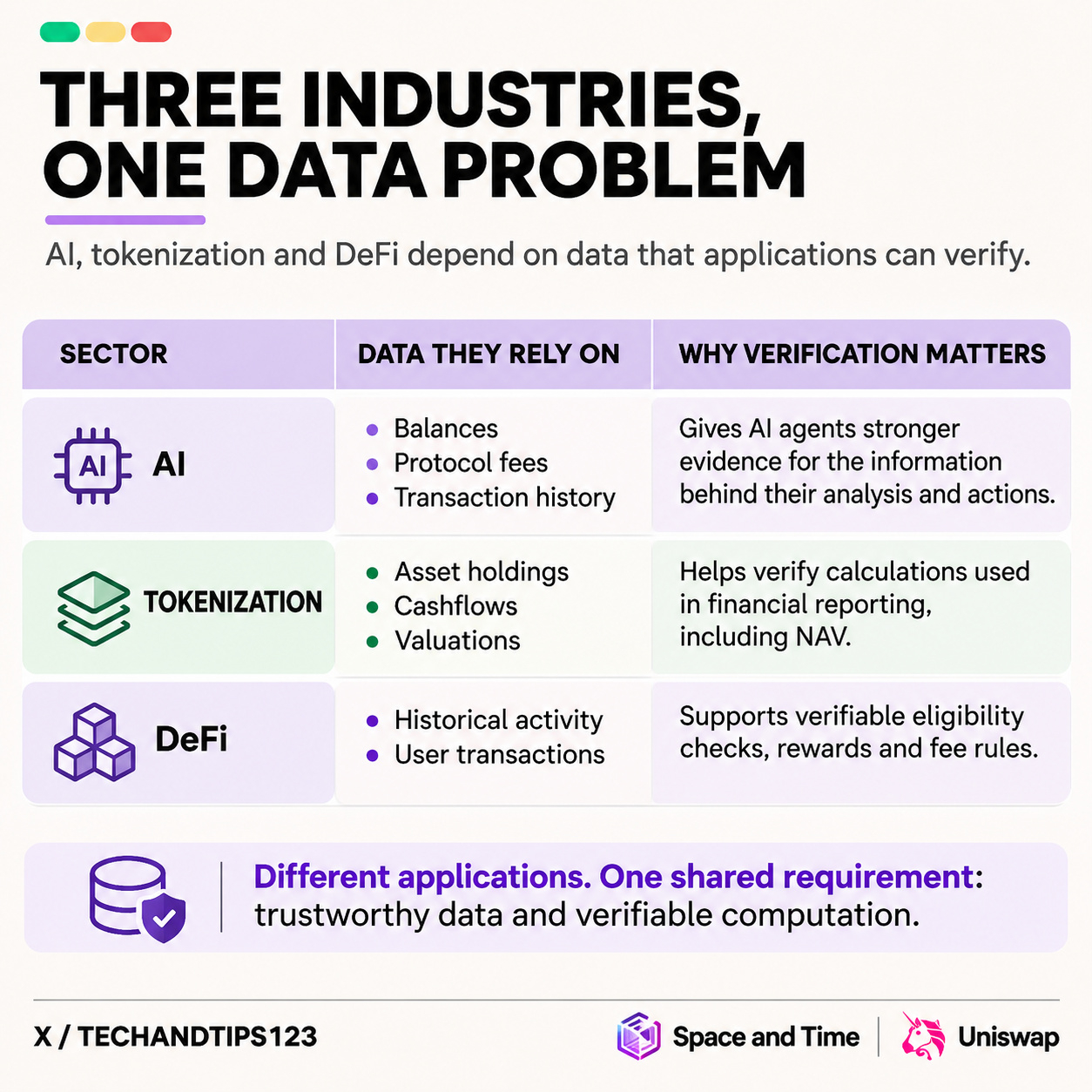
A. Artificial Intelligence: AI Needs More Than Just Data
AI systems are becoming increasingly capable of performing tasks independently. The next stage involves AI agents interacting with financial applications, analysing markets, managing workflows, and executing transactions.
But there is a problem. An AI agent is only as reliable as the information it receives.
Imagine an AI agent evaluating a DeFi protocol. Before making a decision, it might need to examine the protocol's historical fees, transaction activity, user balances, and other financial information. If the underlying information is incomplete, manipulated, or incorrectly calculated, the agent could reach an incorrect conclusion.
This is where verifiable data becomes important.
Instead of simply receiving a database response, an application can consume a supported query result accompanied by cryptographic proof that the computation was performed correctly against committed data.
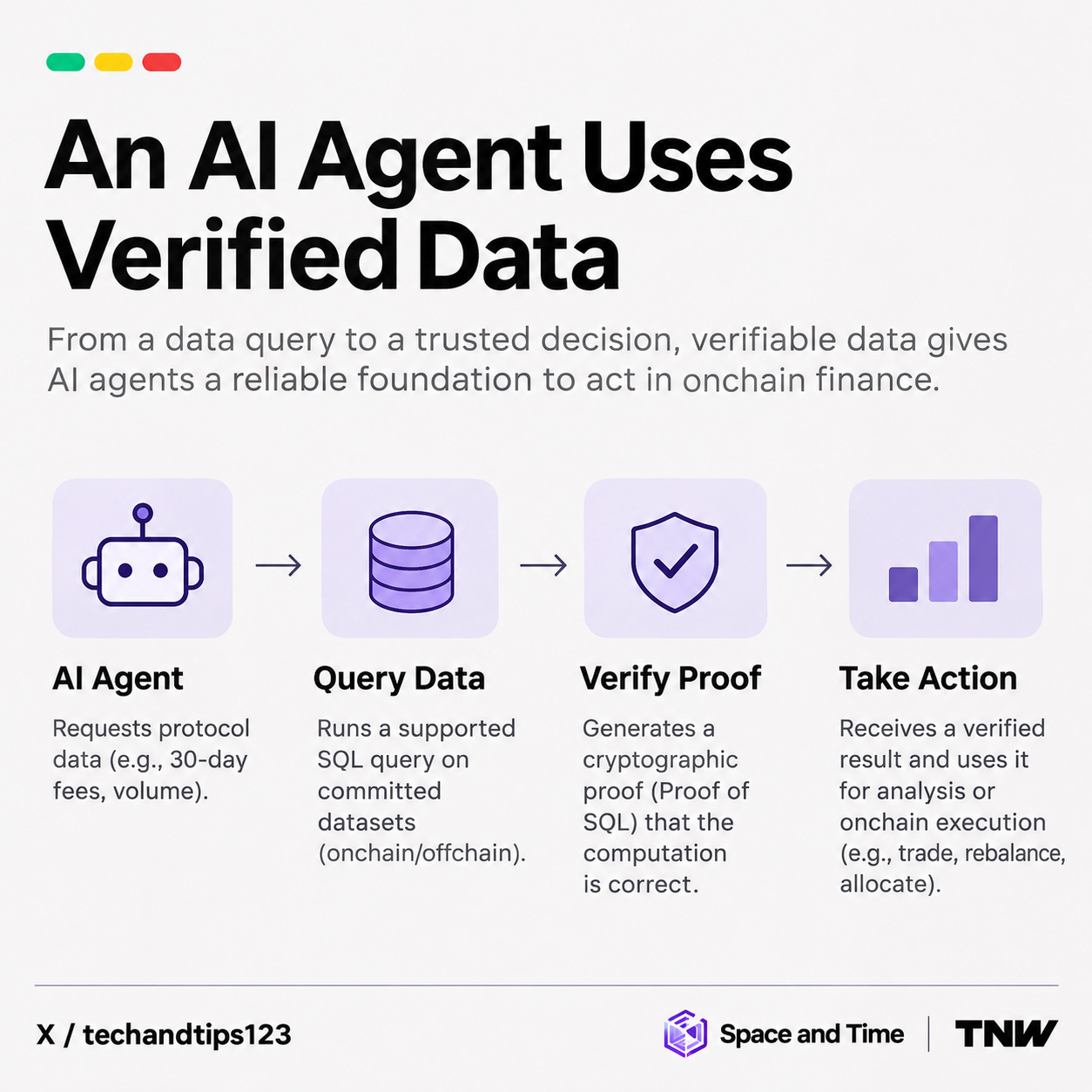
This creates an additional layer of confidence in the information AI agents use. As AI agents become more involved in financial operations, the ability to verify their data inputs could become an important part of the infrastructure supporting them.
B. Tokenization: Financial Assets Need Verifiable Records
Tokenization involves representing real-world assets, such as stocks, bonds, and other financial instruments, on blockchain networks.
However, putting an asset on a blockchain does not automatically make every piece of information associated with that asset transparent or verifiable.
Consider a tokenized financial asset.
Applications dealing with that asset may need information about its holdings, cashflows, valuations, and net asset value (NAV).
Some of this information exists onchain, while other information comes from external or institutional databases.
The challenge is bringing these different datasets together and establishing confidence in the calculations performed on them.
Space and Time addresses this through infrastructure designed to combine blockchain data with custom offchain datasets and provide cryptographic proofs for supported computations.
For example, imagine calculating the trading activity of a tokenized stock across several liquidity pools.
Instead of examining each pool separately, an application could query the combined activity and obtain a verifiable result showing that the calculation was performed correctly against the committed data. This is particularly relevant as tokenized financial markets become more interconnected.
C. DeFi: Historical Data Can Power Smarter Financial Applications
Decentralized finance already generates enormous amounts of useful information.
Every swap, liquidity provision, transaction, and interaction creates historical records that can help applications understand user activity.
However, accessing historical data and using it reliably in financial applications are two different challenges. Consider a DeFi protocol that wants to reward users based on their historical activity.
It could offer loyalty discounts to users who have consistently interacted with the protocol or provide rewards based on specific transaction criteria.
But how can the application establish that a user actually meets those conditions?
This is where verifiable historical queries become useful. Space and Time enables applications to query historical blockchain activity and produce proofs for supported computations.
One practical example is the use of historical-data queries to inform swap-fee discounts through Uniswap hooks. This opens the door to more transparent reward systems, historical eligibility checks, and data-driven DeFi mechanisms.
III. How Does Space and Time Make Verifiable Data Possible?
Now that we understand why verifiable data matters, let's examine how Space and Time approaches the problem.
Space and Time describes itself as a data blockchain designed to support onchain finance through verifiable data infrastructure.
Its technology combines data processing, database capabilities, and cryptographic verification.
The key technology to understand here is Proof of SQL.
Imagine asking a database a question:
"How much total revenue did a particular DeFi protocol generate over the last 30 days?"
A traditional database processes the request and returns a number. But how can another application establish that the database performed the calculation correctly?
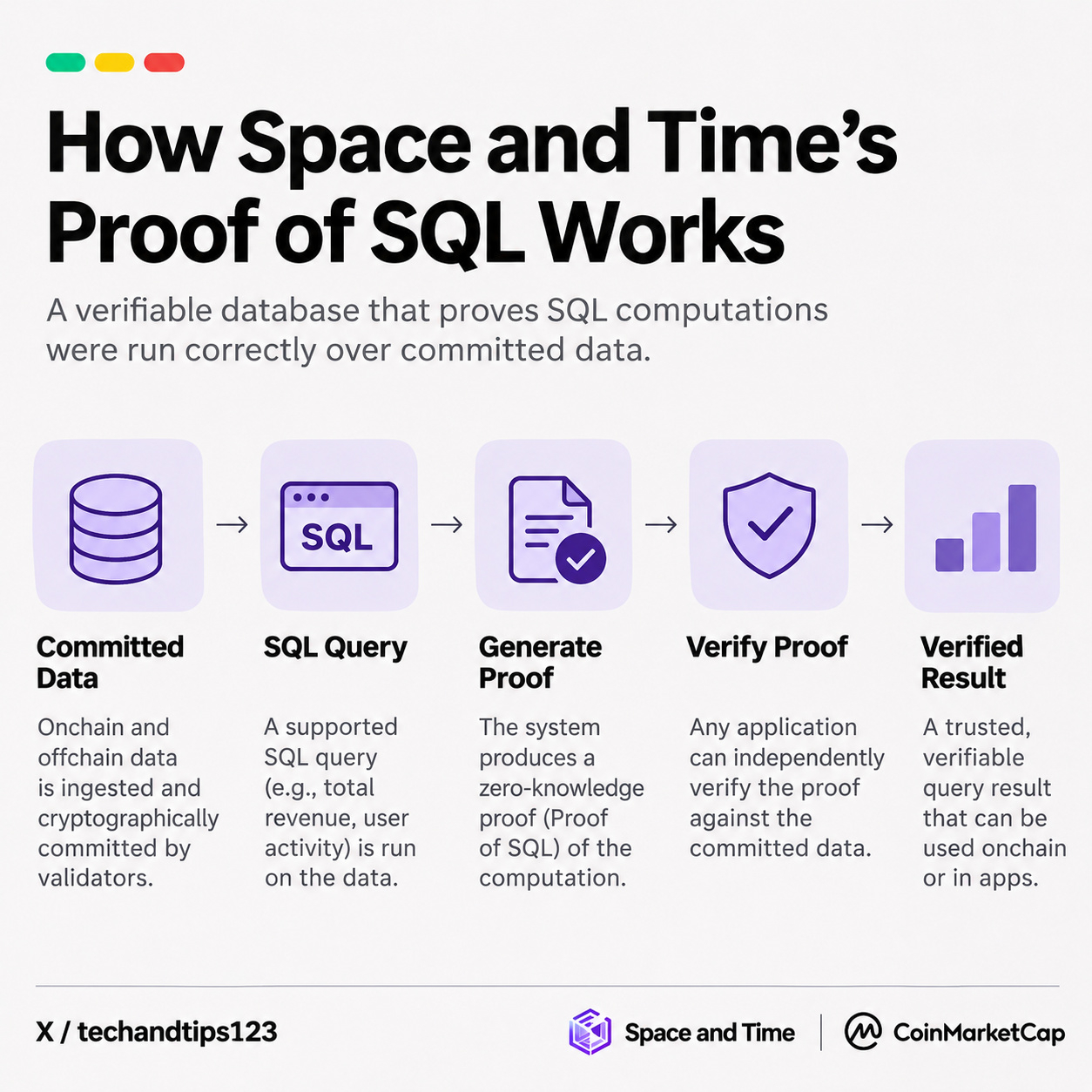
Space and Time approaches this problem by allowing supported SQL queries to generate cryptographic proofs alongside their results.
Think of it as receiving both the answer and a mathematical verification that the computation was performed correctly.
The application receiving the result can verify the proof rather than simply trusting the database operator.
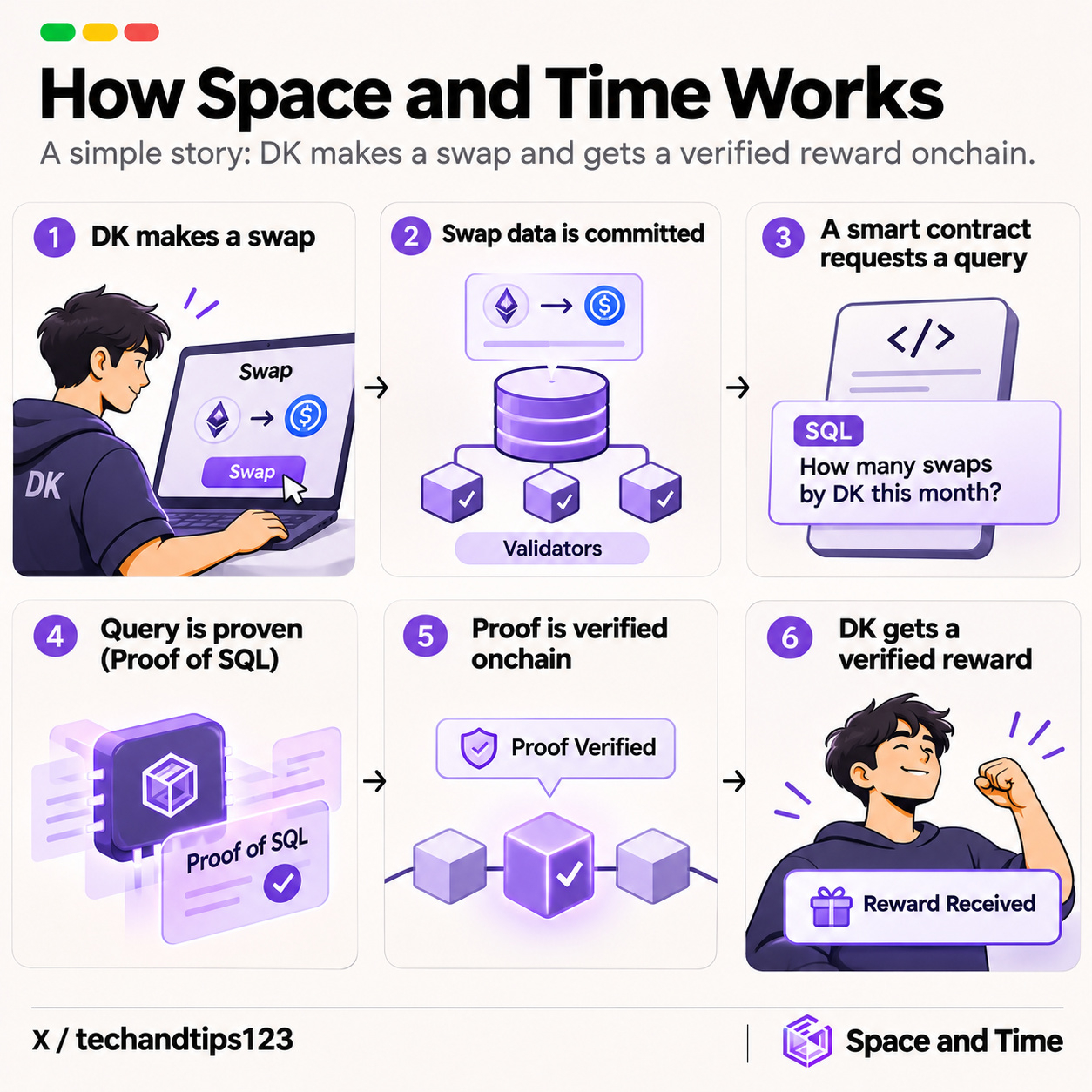
Proof of SQL is Space and Time's zero-knowledge proof-based SQL verification technology.
In simplified technical terms, a SQL query is executed against committed data, and the system generates a cryptographic proof that allows the result of the supported computation to be verified.
This is important because applications do not always need to trust the party executing the query. Space and Time also supports combining onchain blockchain information with custom offchain datasets.
This is particularly useful for financial applications because important financial information is not always stored directly on a blockchain.
For example, an application might need to combine onchain transaction activity with external financial records before calculating a particular metric.
Space and Time's infrastructure is designed to make these datasets usable together while supporting verifiable computation.
The broader idea is straightforward: applications should be able to access data, process it, and verify the computations behind the results.
This is the infrastructure layer Space and Time is building for AI, tokenization, and decentralized finance.
IV. Utility of $SXT?
The $SXT token has a functional role within the Space and Time network.
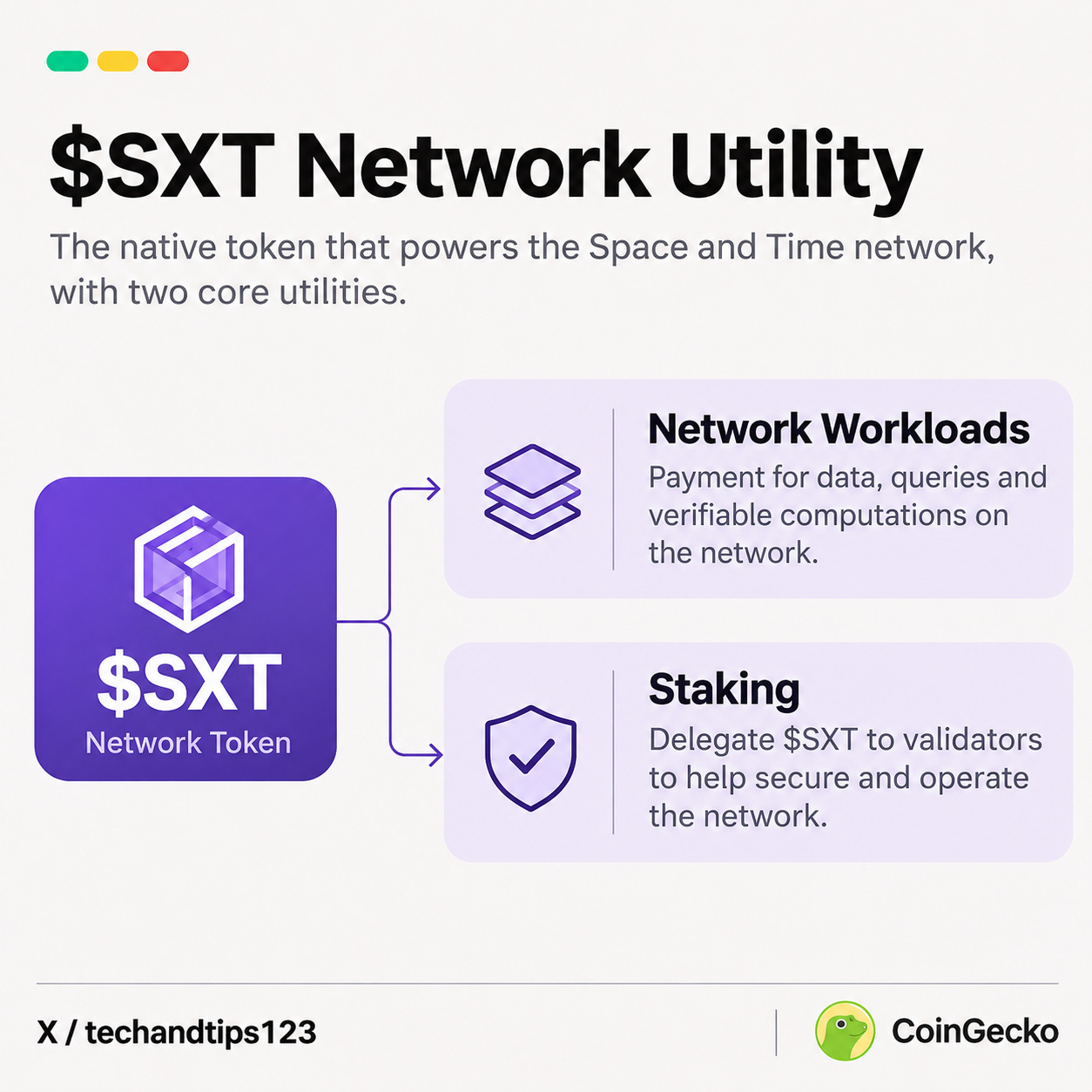
Its two key utility functions are:
1. Network Workloads: $SXT is used to pay for workloads on the network, connecting the token to the data-processing services the infrastructure provides.
2. Validator Security: SXT can be staked to support validator security and the operation of the network.
These functions connect the token to the underlying infrastructure rather than relying solely on its existence as a transferable digital asset.
This article is a collaboration between Techandtips123 and Space and Time. It is intended for educational and informational purposes only and should not be considered financial or investment advice.
Purchasing SXT is risky. You are encouraged to DYOR and to consult professional advice before buying SXT or any other cryptocurrency.