
TRON, Freedom & Surveillance
I believe KYC and AML requirements for exchanges are necessary.
But can we really expect exchanges alone to detect and stop state-backed actors such as North Korea?
Recent events have made me question that.
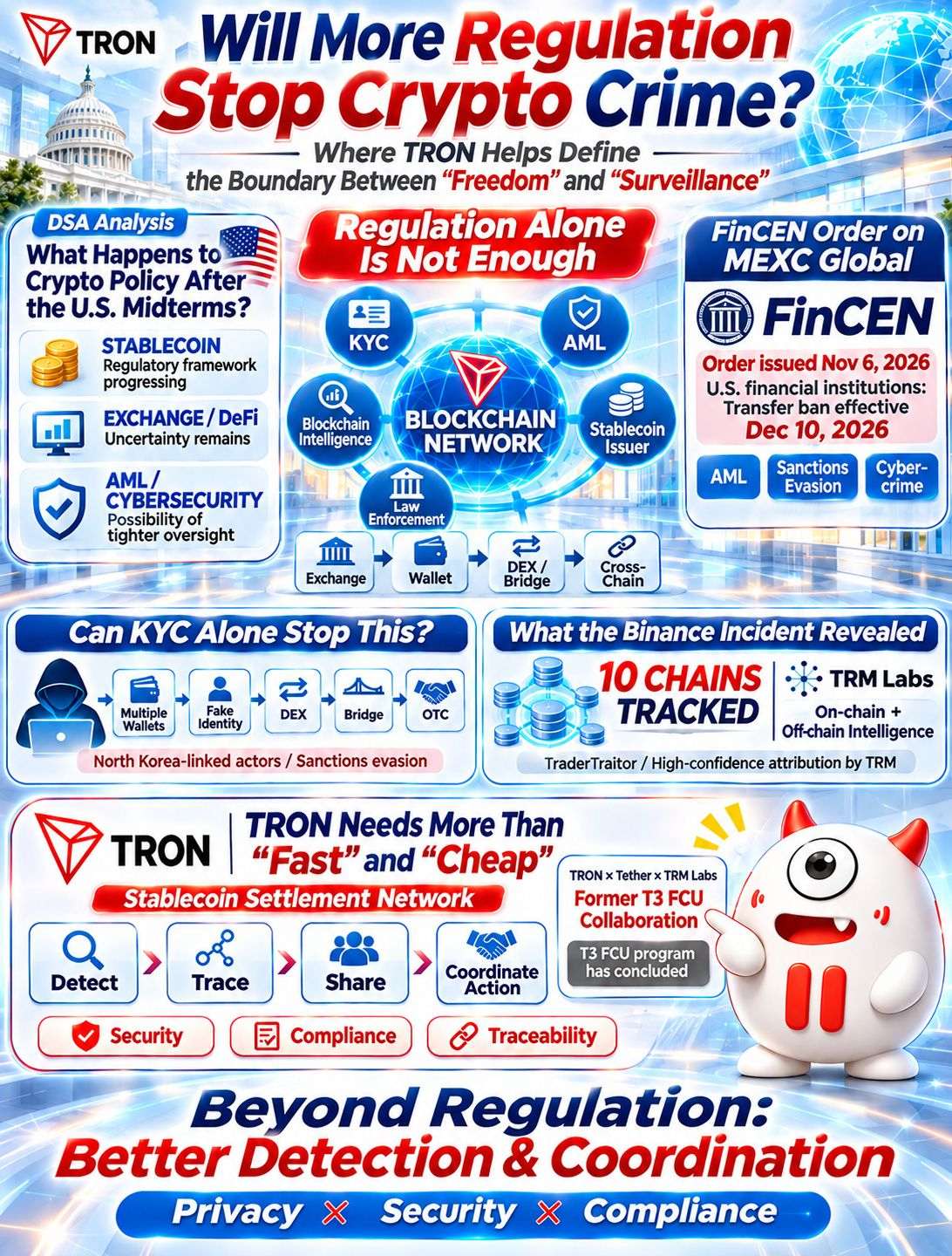
🔶 Crypto Policy After the U.S. Midterms
Democrats won both chambers of Congress, meaning the committees overseeing the SEC and CFTC are set to change.
A new Digital Sovereignty Alliance (DSA) analysis outlines a possible two-speed future:
🔹 Stablecoins: Greater regulatory clarity under the GENIUS Act
🔹 Exchanges / DeFi: Uncertainty around the CLARITY Act
🔹 AML / Cybersecurity: Potentially tougher oversight
One of the paper's co-authors is Sam Reynolds, Research Lead at TRON DAO.
🔶 Then Came the MEXC Action
On Nov 6, FinCEN issued an order to cut MEXC Global off from U.S. financial institutions' funds transfers.
The U.S. Treasury linked the exchange to transactions involving sanctions evasion connected to Iran, North Korea and Russia, as well as cybercrime.
If an exchange has serious AML weaknesses, it must be held accountable.
But state-backed actors can use:
Fake identities
↓
Multiple wallets
↓
DEXs
↓
Bridges
↓
OTC desks
KYC alone cannot guarantee that every threat will be stopped.
🔶 Public Blockchains Aren't Fully Anonymous
On-chain records can show where funds move, even when the real-world identity behind a wallet is unknown.
The difficult part is linking those wallet addresses to actual people or organizations.
That requires both:
On-chain Analytics
+
Off-chain Intelligence
🔶 The Binance Incident Shows Why
After the Oct 29 Binance theft, TRM Labs traced funds across 10 blockchains and attributed the attack to North Korea-linked TraderTraitor with high confidence.
TRM later documented laundering methods on TRON involving self-minted tokens, liquidity pools and lending receipt tokens.
That is why stopping state-backed actors requires coordination across:
🔹 Blockchain intelligence firms
🔹 Stablecoin issuers
🔹 Law enforcement
🔹 Sanctions authorities
Not exchanges alone.
🔶 Where TRON Fits In
TRON is a major settlement network for USDT.
As its use grows, speed and low fees aren't enough.
Defensive infrastructure matters too:
Detect
↓
Trace
↓
Share
↓
Freeze when legally appropriate
TRON, Tether and TRM Labs previously worked in this area through the T3 Financial Crime Unit.
Note: The T3 FCU program has since concluded.
🔻 My Take
We need to fight financial crime.
But more regulation doesn't automatically mean better protection.
The goal shouldn't be blanket surveillance of everyone.
It should be identifying illicit funds faster and more accurately, then enabling the right parties to act together.
As stablecoins become more integrated into regulated finance, blockchains will be judged not only by TPS and fees, but also by compliance, security and trust.
For a network carrying so much USDT, this matters to TRON.
What do you think?
How do we protect users without sacrificing financial freedom?