
The Crypto Market: Independent in Theory, One Big Bet in Practice
Does Satoshi Nakamoto really exist? The name attached to Bitcoin’s 2008 white paper and the first blocks is still a pseudonym. No one has produced a verifiable cryptographic signature from the early keys that would settle the identity.
Court cases have rejected claims (Craig Wright was ruled not to be Satoshi), and recent investigations naming candidates have been denied by those candidates. The code and the network exist. The person or group behind the name has never been proven. That anonymity was intentional. It also leaves the largest single holder of Bitcoin (estimated around 1 million coins that have mostly never moved) as a permanent mystery.
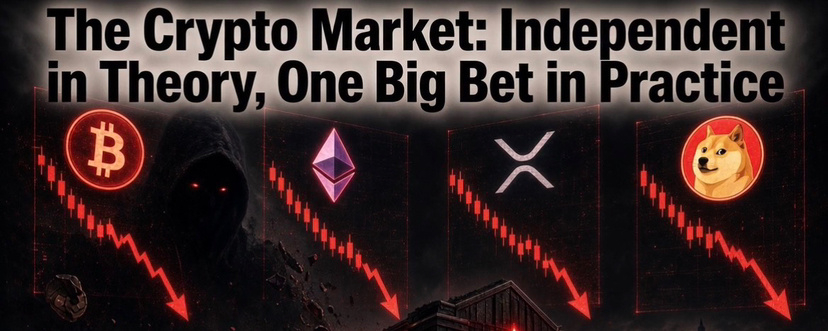
Why do almost all cryptocurrencies fall at once if they are “independent”? Technically the blockchains are separate. In the market they are not. Bitcoin still accounts for roughly 60% of the total crypto market capitalization (around $2.5 trillion as of mid-November 2026). When risk appetite drops—higher interest-rate fears, equity sell-offs, or simple fear—capital leaves the entire risk bucket. Leverage amplifies it: liquidations cascade across exchanges and wipe out long positions in hours. Shared liquidity pools, the same traders, and Bitcoin’s role as the benchmark mean a move in BTC usually drags the rest with it. “Independent” technology does not equal independent capital flows or independent psychology.
Why do SEC announcements, government statements, or interest-rate news move prices? Because regulatory clarity (or the lack of it) determines whether large institutions can buy, hold, or offer the assets. Spot Bitcoin ETFs and similar products brought traditional money into the market; the reverse happens when the outlook darkens. Governments did not invent Bitcoin—it emerged from cypherpunk ideas after the 2008 financial crisis—but they can shape its accessibility, tax treatment, and perceived legitimacy. That power is real even if the protocol itself is open-source.
What are we actually investing in? For Bitcoin the case is digital scarcity and a fixed supply schedule. For the thousands of other coins the picture is weaker. Most altcoins and virtually all meme coins have no cash flow, no scarce utility, and no durable demand beyond speculation and narrative. Market capitalization is a valuation number (price × circulating supply), not a pile of cash that must stay high. When more people want to sell than buy at the current price, the price falls. Holders do sell—panic, margin calls, stop-losses, profit-taking, or simple need for cash. Liquidation data regularly shows hundreds of millions of dollars in forced selling on down days.
XRP was never a realistic $50,000 asset under any serious analysis; that figure would require a market capitalization measured in the tens of trillions. Even a $50 target implies a multi-trillion valuation larger than the entire current crypto market. After more than a decade it trades near $1. Dogecoin moves when a high-profile figure comments on it because its value is almost pure narrative and attention. Celebrity influence is real precisely because the fundamentals are thin.
Exchanges earn fees on every trade whether prices rise or fall. A recent example: in late October 2026 Binance suffered what appears to be the largest crypto theft on record—roughly $6.3 billion drained from hot wallets in a short window, attributed to a North Korea-linked group. The exchange said it would cover the losses from company resources and has reported replenishing the bulk of the shortfall; some assets were frozen with help from issuers and partners. Markets still reacted with broader weakness. The incident did not permanently reprice the entire asset class upward.
My Thoughts
Most of the criticisms above are fair observations about how the market actually behaves. Crypto as a whole is a high-volatility, sentiment-driven asset class. The majority of tokens will go to zero or near-zero. Correlation is the rule in risk-off environments, regulatory news matters because institutional capital matters, and “trillions circulating” does not prevent prices from falling when sellers dominate. Exchanges and early large holders have captured a disproportionate share of the realized gains; that is typical of any new speculative market.
At the same time, Bitcoin has survived multiple 50–80% drawdowns and continues to trade with deep liquidity and institutional access that did not exist a few years ago. A small number of other networks have real usage (settlement, computation, stablecoin rails). The rest is mostly narrative. Retail participants who treat every coin as an “investment” with guaranteed upside and no control over the outcome are operating under a mismatch of expectations. The market is not broken when prices drop; it is working as a speculative arena where conviction, leverage, and attention set the price until the next shift in sentiment.#cryptouniverseofficial #BinanceSquareTalks