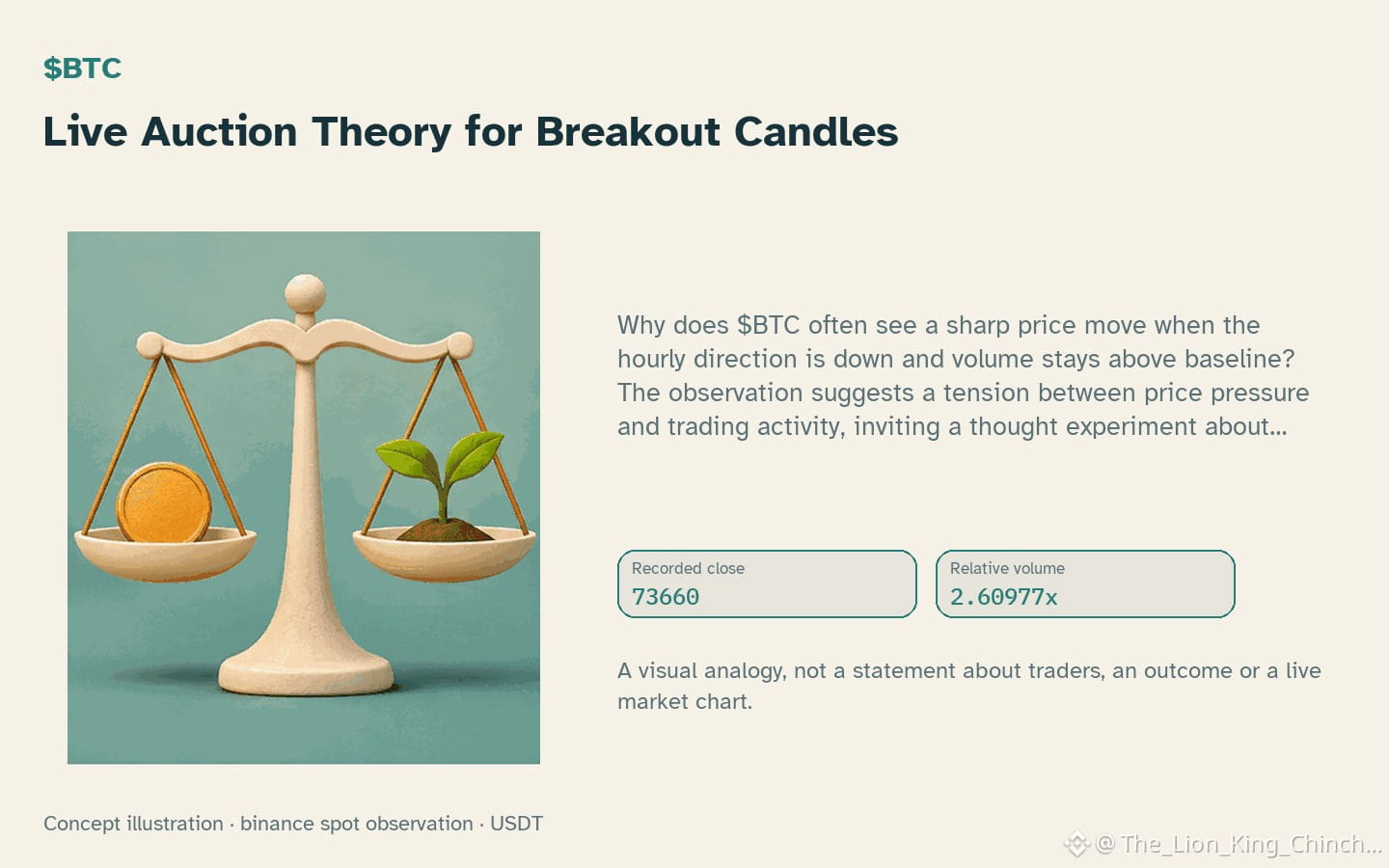
$BTC: Live Auction Theory for Breakout Candles
Why does $BTC often see a sharp price move when the hourly direction is down and volume stays above baseline? The observation suggests a tension between price pressure and trading activity, inviting a thought experiment about live auction dynamics.
Imagine a gallery auction where each bidder raises a paddle in real time. The fastest participant can win the item, but often pays a premium because others have not yet reacted. In a crypto market, a breakout candle can act like the auctioneer’s hammer: the price jumps, and many limit orders sit on the new level. If a market order arrives first, it may consume the shallow liquidity at that price, pushing the candle higher. The subsequent limit orders then fill at a worse price, similar to a late bidder paying more.
A counterexample helps clarify limits. Suppose a deep order book with tight spreads surrounds the breakout level. In that case, the first market order would only move the price marginally, and later participants would not overpay. This shows that the auction analogy depends on liquidity depth, not just volume.
To test the idea, one could compare the price gap between the opening of a breakout candle and the next few limit fills against a metric like relative volume 2.60977. If larger gaps correlate with higher 2.60977, the auction‑style overpayment hypothesis gains support. However, the approach cannot prove causality, as other factors such as hidden orders or exchange latency may influence results. The experiment remains a hypothesis, useful for framing how rapid price moves interact with order placement without claiming any predictive power. 🤔
Probabilistic market research, not a recommendation or guaranteed return.
The label or the mechanism behind it?
#BTC