

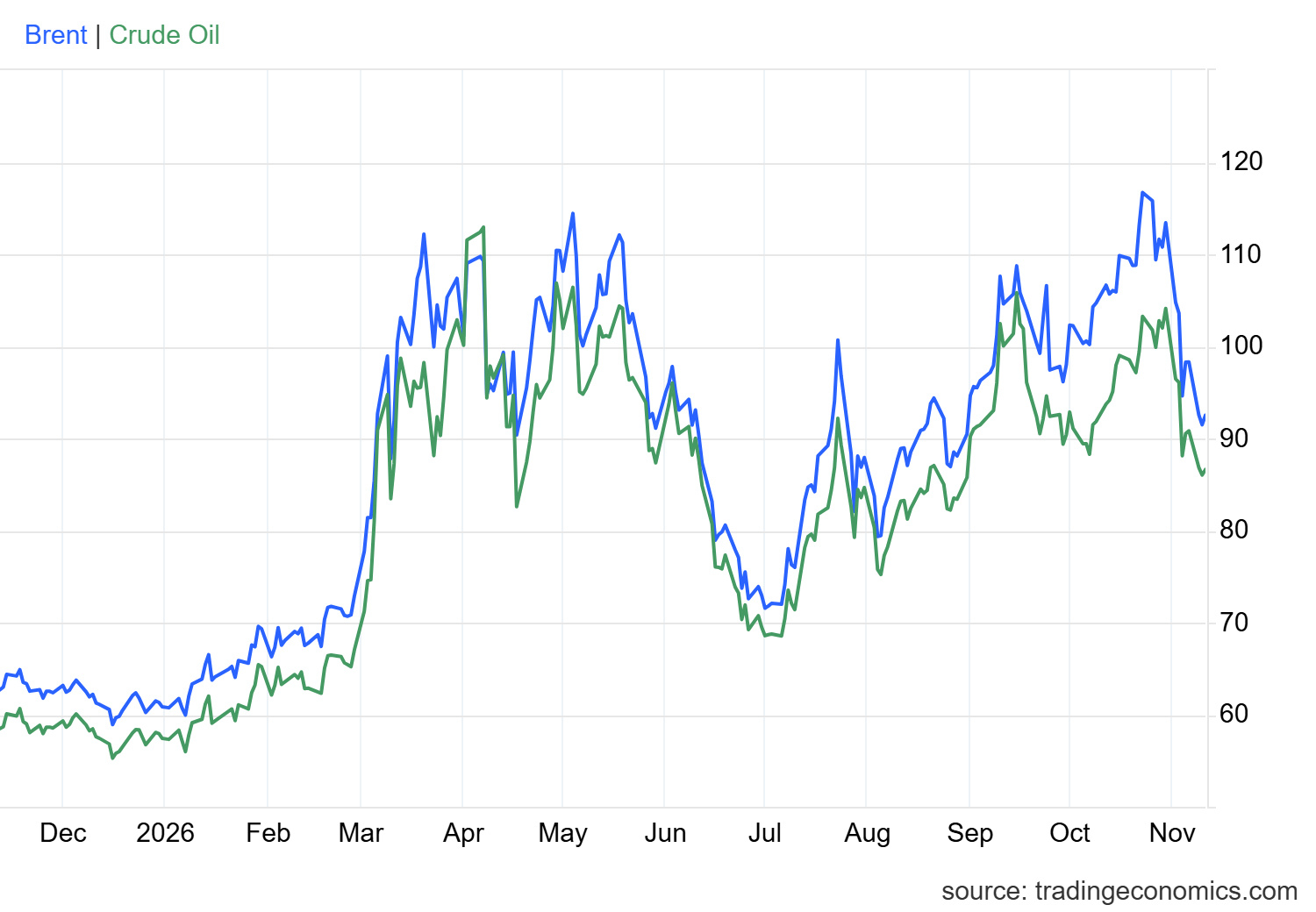
Brent crude dipped under $90 a barrel on Tuesday for the first time since the end of August. It did not stay there. The international benchmark closed at $91.49, down 1.17% on the day, after touching a session low of $89.16, while West Texas Intermediate, the U.S. gauge, settled 0.93% lower at $86.04.
The nudge came from the White House. Speaking Monday after a meeting with Qatar's prime minister, Sheikh Mohammed bin Abdulrahman Al Thani, President Donald Trump said Iranian officials were talking to Washington in courteous terms and that the war, now deep into its ninth month, could wind down before long.
Politics sits underneath all of it. Trump has been under pressure to close out the conflict since Republicans lost the midterm elections, and by all appearances he is looking for the exit. On Monday he indicated that further military action was not needed at this point. Democrats, who take control of both chambers of Congress in January, are weighing whether to use the Dec. 11 government funding deadline to push him along. The risk attached to that plan is a shutdown.
Oil has taken the hint. November has brought a sharp reversal, with crude sliding from a late-October peak above $115 as hopes of de-escalation grew and energy exports from the Gulf kept climbing. Brent is still up almost 50% for the year, which puts the retreat in proportion.
Hamad Hussain, a senior economist at Capital Economics, put most of the decline down to investor optimism that diplomacy will end the war soon. Steady crude flows out of the Middle East, he added, may be helping too.
Two Weeks, Possibly
Trump left the threat on the table. U.S. forces, he said, remain ready to act again if circumstances change. Qatar, meanwhile, serves as the mediator between Washington and Tehran.
Doha's part came into sharper focus in Paris. Al Thani told G7 foreign ministers that Qatar had secured "at least two weeks" to pursue an understanding between the two capitals, according to the Jerusalem Post, which cited diplomatic sources. He also acknowledged that wide gaps remain.
Secretary of State Marco Rubio, at the same gathering, said sanctions and the U.S. naval blockade are working well enough that major combat operations are unnecessary for the moment. Economic pressure on Tehran is set to increase, he added. He also described this week's Abu Dhabi talks on Russia and Ukraine as productive.
Politer Words, Same Demands
Under the friendlier vocabulary, the positions have barely shifted. Tehran's price for talking is an end to the naval blockade of its ports and relief from sanctions. Washington wants attacks on vessels in the Strait of Hormuz to stop, along with concessions on the nuclear program. Months of stop-start negotiations have not closed that distance.
Iran's Mohsen Rezaei, a major general who serves as secretary of the Supreme National Security Council, said Tehran has asked the U.S. for a clear, unambiguous reply to its conditions and is still waiting for one.
Barrels Are Leaving Anyway
Futures traders tend to care more about physical oil than about anything said at a podium, and physical oil is moving. A wave of Hormuz crossings over the past couple of months has brought overall Middle East shipments close to prewar levels, which has tilted the bias in futures toward lower prices even with ships still coming under fire. On Tuesday, Saudi shipping company Bahri said it is sending some tankers through the waterway in coordination with the U.S. military. Khalid Alhammad, president of Bahri Ship Management, told an event in Dubai that four of its vessels crossed that day.
The Risks Have Not Gone Anywhere
Iran keeps attacking ships in the strait, hitting several a week on average, even as oil continues to flow out. A third U.S. aircraft carrier is heading to the Middle East. In Israel, a U.S. partner, political uncertainty has deepened since Prime Minister Benjamin Netanyahu, an Iran hawk, lost his bloc's parliamentary majority in last month's election.
Early Wednesday brought the latest shipping incident. The U.K. Maritime Trade Operations center, known as UKMTO, said it had received a report involving a tanker in the Strait of Hormuz. The condition of the crew, the extent of any damage and the environmental impact were all unknown at the time. Vessels were advised to transit with caution and report suspicious activity while authorities investigate.
Energy infrastructure on land is exposed too. Saudi Arabia's East-West pipeline, the kingdom's main route around Hormuz, was targeted Monday in the Medina region, the state-run Saudi Press Agency reported. A fire broke out and was put out, and operations were not affected. U.S. forces, for their part, have carried out limited action on Iran's Qeshm Island twice since early last week.
Half a World Away, Another Energy Fight
The same pattern is playing out on the other side of the globe. Ukraine keeps hitting Russian refineries, and Moscow keeps answering with attacks on Ukrainian energy and civilian sites. U.S.-mediated talks between the two sides are under way in Abu Dhabi, where the presence of higher-level diplomats than in earlier rounds has been read as a sign of greater openness to substantive negotiation after months of stalemate.
The fighting did not wait for the diplomats to finish. Drones hit Russia's Ust-Luga port on the Baltic Sea overnight, and the regional governor reported a fire in the port area, citing preliminary data. Ukrainian officials, in the same hours, reported a heavy Russian attack on Kryvyi Rih.
A Defense Secretary Survives a Vote
Back in Washington, Trump gave Defense Secretary Pete Hegseth an emphatic endorsement, signaling that the Pentagon chief's job is safe for now as a congressional drive to impeach him over his handling of the Iran war gathered speed. Republican Rep. Thomas Massie of Kentucky introduced an impeachment measure Monday, and House Minority Leader Hakeem Jeffries, a Democrat, said he was a "hard yes."
The momentum did not last. On Tuesday night, the House voted 211 to 204 to refer the resolution to the Judiciary Committee, which effectively shelves it for the rest of this Congress. Democrats take over the chamber in January and could try again.
A Mock Classroom at a Climate Summit
Iran has found an unlikely venue for its side of the story. At the COP31 climate summit in Antalya, Turkey, its national pavilion, normally a space devoted to global warming, depicts a deadly U.S. missile strike on an elementary school in the southern city of Minab. Photographs of schoolchildren killed in the attack are on display, along with a mock classroom of strewn backpacks, desks and a chalkboard arranged to look like the aftermath.
An investigation into the incident is ongoing, and a senior Trump administration official said the United States does not target civilians. The U.S. government has no official delegation at COP31 after withdrawing from the Paris Agreement.
The Squeeze Reaches Saudi Banks
The financial strain is showing up in Saudi Arabia, too. The kingdom is grappling with renewed liquidity pressure as the war prompts a pullback in deposits by government entities and by banks in the United Arab Emirates. Deposits are arriving at a slower pace, which makes it harder for lenders to keep up with demand for credit and widens the spread between Saudi interbank lending rates and U.S. rates. That spread is a closely watched liquidity gauge in a country that pegs its currency to the dollar.
Jean-Michel Saliba of Bank of America pointed to spillover from tighter liquidity in the UAE, combined with a rapid slowdown in the Saudi economy under the weight of the war, as the forces heightening the stress.
Tuesday's slide in crude took some heat off the oil screen. It did nothing for those balance sheets. Traders are trading on hope for now, and nobody has signed anything.