$ZEC: ZEC: Why Peer Moves Don't Prove Shared Cause
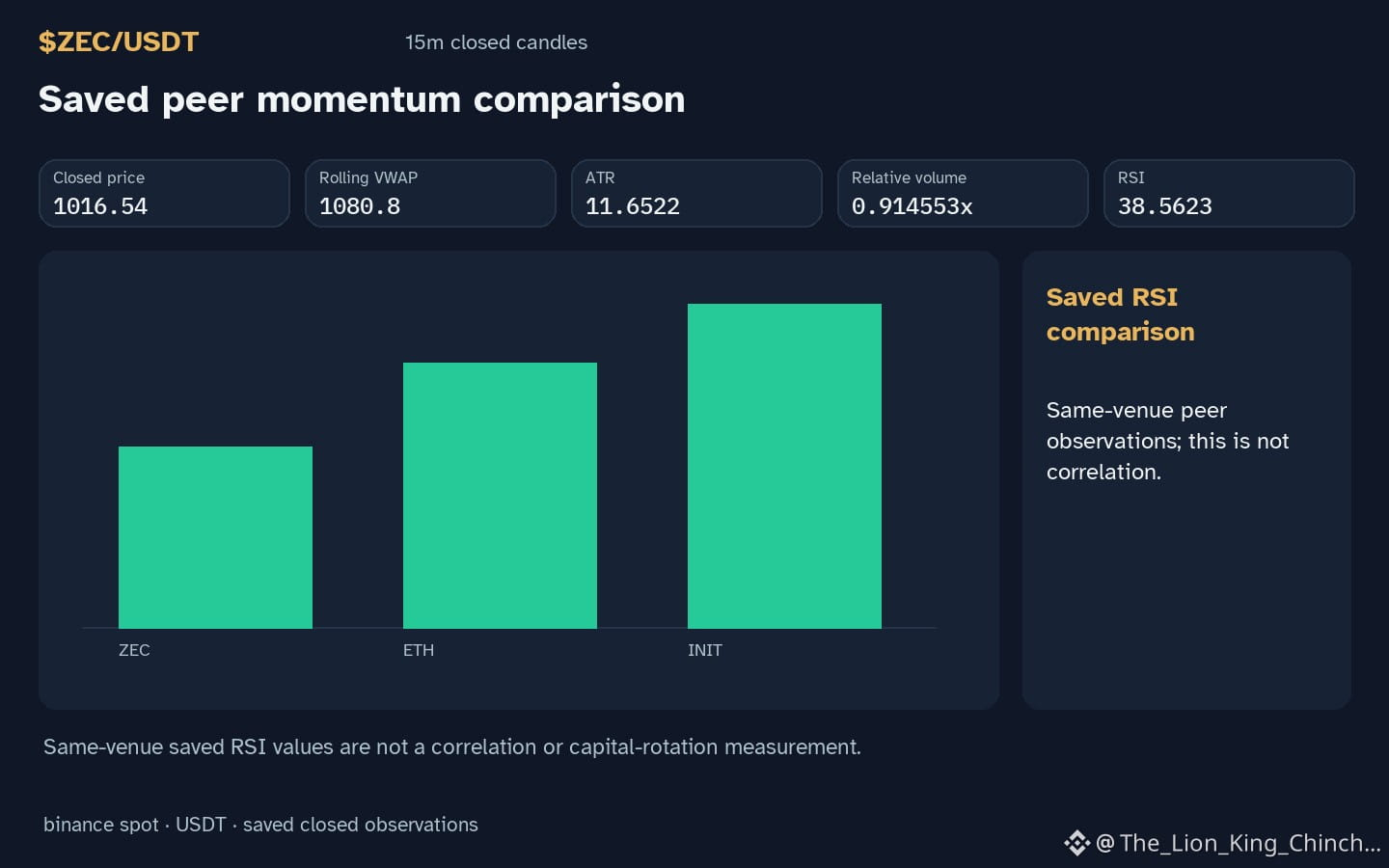
$ZEC: ZEC shows a downward hourly direction while its volume stays below baseline. Does the fact that ETH and INIT both move upward on the hour with higher volume imply a common driver for ZEC? The question invites a brief thought experiment about epistemic humility in multi‑asset notes.
A hypothetical decision might treat the three assets as independent signals. The analogy works when each coin’s chart reflects its own supply‑demand balance, and the hourly frame isolates short‑term sentiment. In that scenario, noting that ETH and INIT share an uptrend does not automatically validate a similar expectation for ZEC. The mechanism fails when one assumes that shared direction equals shared structure, because the underlying market participants, order‑book composition, and technical thresholds differ. ZEC’s recent hourly move stays within its recorded range, with price hovering near 1008.14 and 1049.85 levels, and its relative volume stays modest.
A self‑check highlights the limit of the comparison: even if peers display a common directional bias, ZEC’s own metrics – such as -1.20128 and a calm range bar count 20 – suggest a distinct micro‑environment. To reassess, analysts can isolate each asset’s hourly momentum, then re‑evaluate any inferred link only after a clear cross‑asset trigger emerges. This cautious approach respects uncertainty while still allowing useful peer context.
Probabilistic market research, not a recommendation or guaranteed return.
For a wider view: $ETH has hourly direction up and volume above its baseline; $INIT has hourly direction up and volume above its baseline. This alone does not establish correlation.
Shared direction or different structure?
#ZEC