
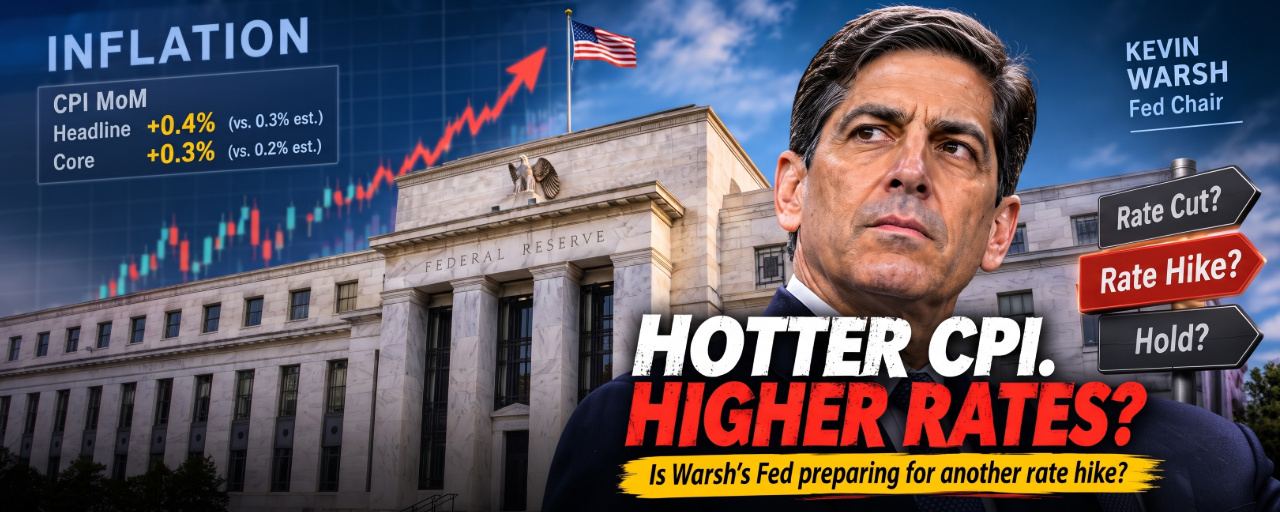

The latest US inflation report has given the Federal Reserve another reason to stay hawkish. And this time, the discussion is no longer just about delaying rate cuts.
It's increasingly about whether the Fed needs to raise rates again.
Inflation Isn't Cooling Fast Enough
October's US CPI came in hotter than expected:
Headline CPI: +0.4% MoM vs. 0.3% expected
Core CPI: +0.3% MoM vs. 0.2% expected
Headline inflation did ease from September's 0.6%, partly as energy inflation slowed. But core CPI remained at 0.3% for the third consecutive month.
That's the part markets cannot easily ignore.
The Fed's inflation target is 2%, and persistent price pressures suggest that getting inflation back under control may take longer than investors had hoped.
One important detail: the BLS did not publish the usual October year-over-year CPI figures because data collection for October 2025 was disrupted by last year's government shutdown. So, for now, the monthly figures deserve particular attention.
The Fed Is Getting More Hawkish
Even before the CPI release, Fed Governor Christopher Waller had already indicated that he would support a 25-basis-point rate increase at the December 8–9 meeting.
He also warned that if core CPI came in at 0.3% or higher, a larger 50-basis-point increase should be considered.
Well, that's exactly where core CPI landed.
Other Fed officials have also expressed concerns that monetary policy may still be too accommodative given persistent inflation.
This has strengthened market expectations for another rate hike in December.
However, there's an important distinction: Waller's position is his own, not a final decision by the entire FOMC. A 50-basis-point hike is being discussed, but it is far from guaranteed.
What Could This Mean for Financial Markets?
If the Fed continues tightening, the effects could spread across several asset classes.
1. US Dollar
Higher interest rates can make dollar-denominated assets more attractive, potentially supporting the USD against other currencies.
For emerging markets, including Indonesia, this could add pressure to the rupiah, especially if capital flows favor US assets.
2. Gold
Gold doesn't pay interest. When Treasury yields rise, holding gold becomes relatively less attractive.
That doesn't mean gold must fall every time yields increase. Safe-haven demand, geopolitical risks, and currency movements can still support prices.
3. Stocks
Higher borrowing costs can pressure company valuations, particularly growth and technology stocks whose expected earnings are further into the future.
Companies that rely heavily on debt financing could also face higher funding costs.
4. Crypto
Crypto could face additional pressure if tighter monetary conditions reduce liquidity and investors become more cautious about risk.
Bitcoin and other digital assets are not mechanically tied to Fed decisions, though. Market positioning, institutional flows, and crypto-specific developments still matter.
My Take: Don't Assume the Next Move Is a Rate Cut
For a while, markets have been looking forward to easier monetary policy. But persistent inflation is making that expectation harder to maintain.
The latest CPI report doesn't automatically mean a new rate-hiking cycle is coming. Still, it changes the conversation.
The Fed now has to balance two competing risks: keeping rates too high for too long could hurt economic growth, but easing too early could allow inflation to become entrenched.
For investors, this is a reminder not to build an entire strategy around the assumption that interest rates will soon fall.
Sometimes, the bigger risk isn't the decision the Fed makes next month. It's being positioned for a market scenario that may no longer be realistic.
Are we still waiting for rate cuts, or should investors start preparing for another round of rate hikes?
#HotCPI #FedInterestRate $BTC $PAXG $XAUT
