

Disclosure: This article is part of a partnership with the BiyaPay Content Creator Program. All opinions are my own and this is not financial advice.
The news around Nvidia this week is serious enough to read carefully. It is also easy to collapse two different questions into one.
The first is whether anything about the business itself has changed: demand for AI chips, revenue, margins, or the ability to ship product. The second is whether investors will pay a different price for the same earnings while they wait for more information.
I would start with what official statements actually confirm, keep unproven reporting in a separate column, and only then decide whether this is an earnings story or a valuation story.
What official statements confirm, and what they do not
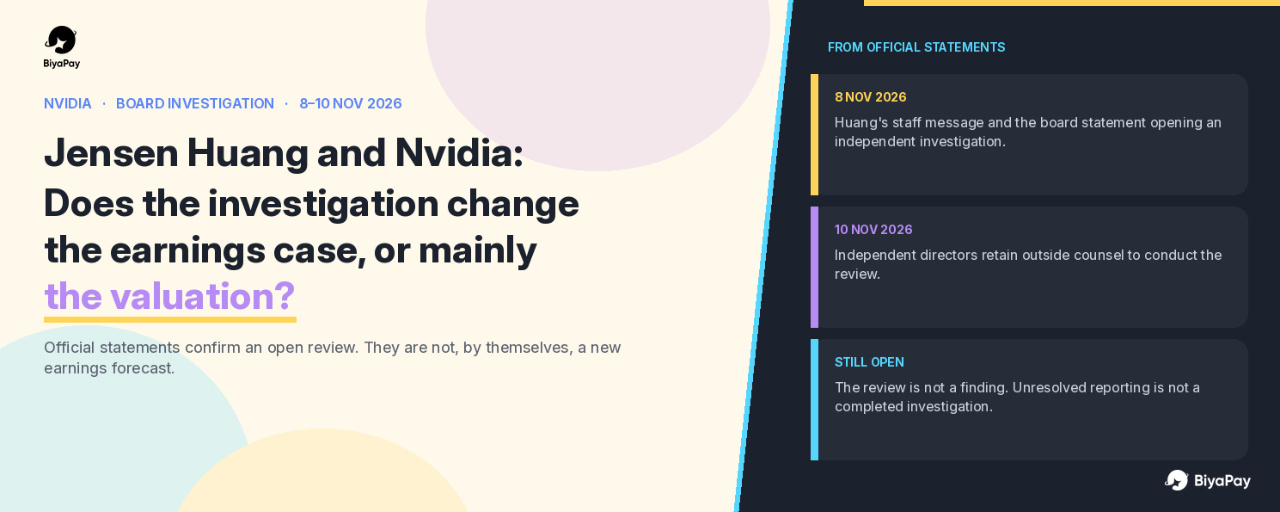
On November 8, 2026, Nvidia published a staff message from founder and CEO Jensen Huang. In that message, Huang apologized and wrote that he was unfaithful to his wife.
He also wrote that Nvidia's board had initiated an independent investigation regarding national security concerns raised in news reports, and that he supports the investigation and will cooperate fully. He said he is fully committed to Nvidia.
The same day, Nvidia's board published its own statement. The board said it is initiating an independent investigation in light of recent reporting that Huang has been the target of a foreign intelligence effort.
A committee of independent directors, assisted by outside independent counsel, will oversee the review.
The board also stated that it has no reason to believe that either national security or Nvidia secrets were compromised, that the inquiry will examine all available information, that Huang fully supports the review, and that the board has confidence in Huang and his leadership team.
On November 10, 2026, the independent members of the board published a short follow-up. They said they have retained former acting U.S. Attorney of the Southern District of New York Joon H. Kim and his firm, Wachtell, Lipton, Rosen and Katz, to conduct a thorough and independent investigation, as announced on Sunday.
CNBC also quoted a company statement saying Huang is committed to continuing as CEO without interruption.
Those are the facts I would treat as confirmed: a personal admission, an open board review, named outside counsel, and a board that has both expressed confidence in current leadership and said it currently has no reason to believe secrets or national security were compromised.
The review is not a finding. The reporting that prompted the inquiry is the reason the board gave for opening it, not a completed investigation, and I would not treat those reports as settled fact.
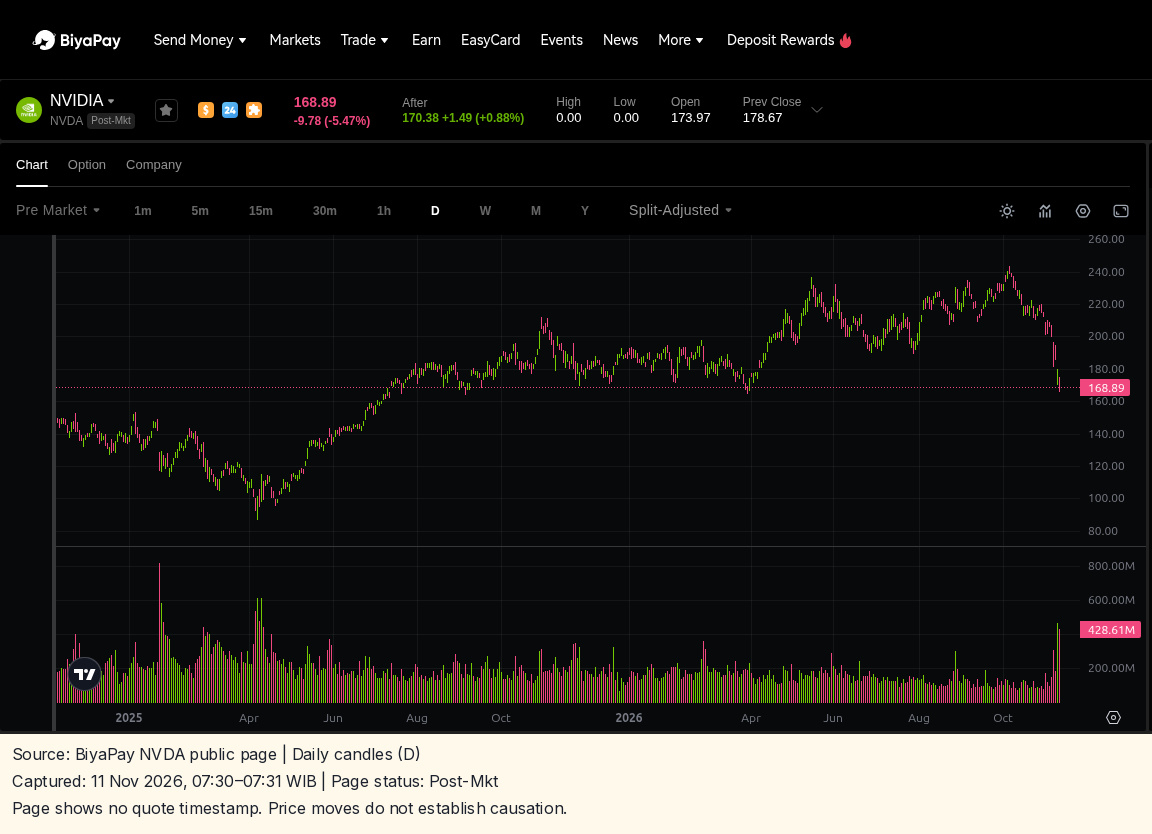
A pre-market or early headline print can tell you that investors are uneasy. It does not, by itself, tell you whether the company's earnings power has changed, and I would not hang a thesis on one intra-day number.
Earnings first, then the multiple
A controversy can reprice a stock in two ways.
It can change the cash flows people expect, through weaker orders, tighter export rules, slower customer deployment, thinner margins, or a leadership disruption that actually affects operations. Or it can change the multiple people will pay for the same cash flows, because uncertainty, governance questions, and key-person risk make those earnings feel less secure.
Right now, the official record does not show a new earnings figure, a new demand number, or a new export rule that arrived with this news. It shows a personal admission, an investigation, and a board statement that secrets and national security are not, at this stage, believed to have been compromised.
That is why I would treat the first market reaction as more likely a valuation and risk-premium story, unless later facts start to touch the business itself.
That is not an argument that the news is unimportant. Leadership and governance can matter a great deal for a company closely identified with its founder.
If the investigation later affected customer confidence, regulatory treatment, or Huang's role, the earnings case could change. The discipline is sequence: a headline should not automatically rewrite the revenue and margin forecast.
What would actually make me reassess the earnings case
I would keep the watch list short and specific.
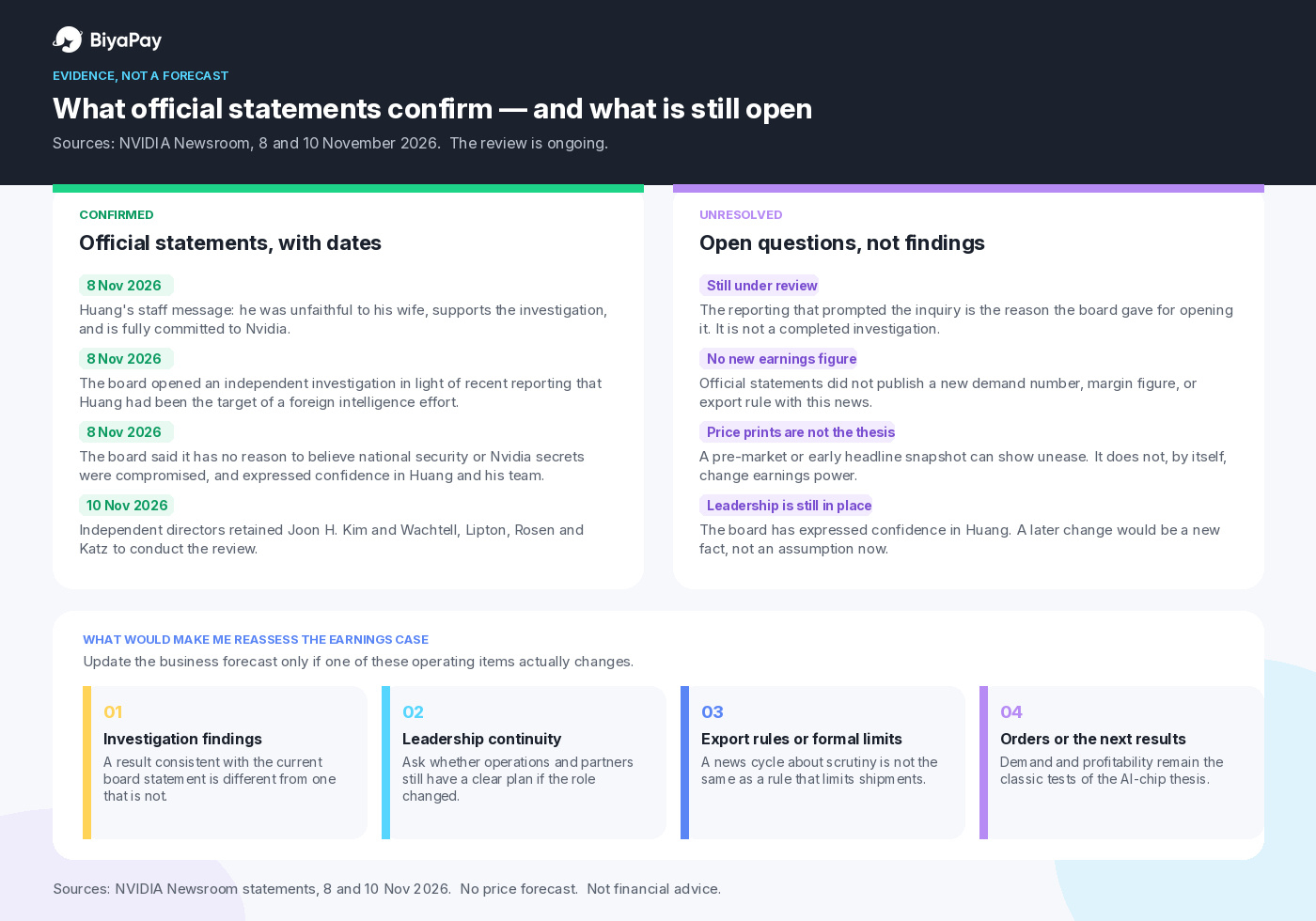
Investigation findings. A review that stays consistent with the board's current statement is different from a review that concludes otherwise, or that leads to a leadership change. Until there is a finding, "under investigation" is a reason for caution, not a substitute for evidence.
Leadership continuity. The company has expressed confidence in Huang and said he continues in the role. If that changed, I would ask whether the business still has a clear operating plan and a team that customers and partners will follow, not only whether the stock moved.
Export controls and regulatory scrutiny. Nvidia already operates inside a closely watched policy environment. New or tighter restrictions, or a formal process that actually limits shipments, would be an earnings issue. A news cycle about scrutiny is not yet the same thing.
Customer orders and the next earnings report. Weaker orders, delayed deployments, or a disappointing results update would speak directly to demand and profitability. Those remain the classic tests of the AI-chip thesis, and they still matter more to the long-term case than a single news day.
If none of those items changes, and the only thing that moved is the price investors will pay while they wait, then the controversy has mainly affected valuation. If one of them does change, I would update the earnings case, not just the mood.
How this connects to watching NVDA on BiyaPay
This is not a reason to trade more often. It is a reason to be precise about the product, if the goal is to hold or monitor NVDA exposure while the review is still open.
For the actual share, BiyaPay offers U.S. stock trading with 0 commission. That figure is only the commission line. Official fee explanations on BiyaPay make clear that platform fees and other charges can still apply.
The published U.S. stock platform fee is 0.005 U.S. dollars per share, with a minimum of 0.99 U.S. dollars per order and a maximum of 1 percent of the transaction value. External institution fees, trading activity fees, and other items can also appear, and sell orders may include additional charges.
I would read the fee schedule and the order preview before sending anything, especially on a smaller ticket, where the minimum fee is a larger share of the cost.
That stock route is ownership of the equity, subject to U.S. market hours, settlement, and ordinary market risk. It is the cleaner way to express a view on Nvidia's earnings if that is actually the view.
BiyaPay also lists an NVDAUSDT equity perpetual contract, which tracks the price of Nvidia common stock (Nasdaq: NVDA). Under the platform's TradFi perpetual 0 trading fee program, maker and taker trading fees on TradFi perpetual pairs are 0 percent.
The program is described as effective immediately and valid long-term, but it applies only to those trading fees. Funding fees and other charges still follow existing rules, and the company can modify or end the campaign.
Perpetuals are not the same as holding the stock. Official risk language is blunt: contract prices can move sharply, you can lose the amount you put in, and in an adverse move your margin can be liquidated.
If the story is mainly about a changing multiple, a leveraged perpetual will amplify a valuation swing. That can suit a trader who already accepts that risk.
It is a poor substitute for wanting to own the shares while waiting for the investigation. I would not treat zero trading fees as zero cost, and I would not treat NVDAUSDT as a share of NVDA.
A calmer way to read the week
The useful split is simple. Confirmed facts belong in one column: the admission, the board review, the named counsel, the current statement that secrets or national security are not believed to have been compromised, and the company's position that Huang remains in place.
Unresolved reporting belongs in another: it is why the review exists, and it is still under investigation.
Earnings drivers belong in a third: demand, margins, export rules, orders, and whether leadership continuity later becomes an operating issue.
Until one of those business items changes, I would describe this as a debate about what investors are willing to pay, not as a proven change in Nvidia's earnings power. That can still move the stock. It should not be dressed up as a new fundamental forecast.
This is not a recommendation to buy, sell, or hold NVDA, and it is not financial advice. Official statements, fees, and product rules can change. I would re-read the latest company statements and the latest fee and risk pages before acting.