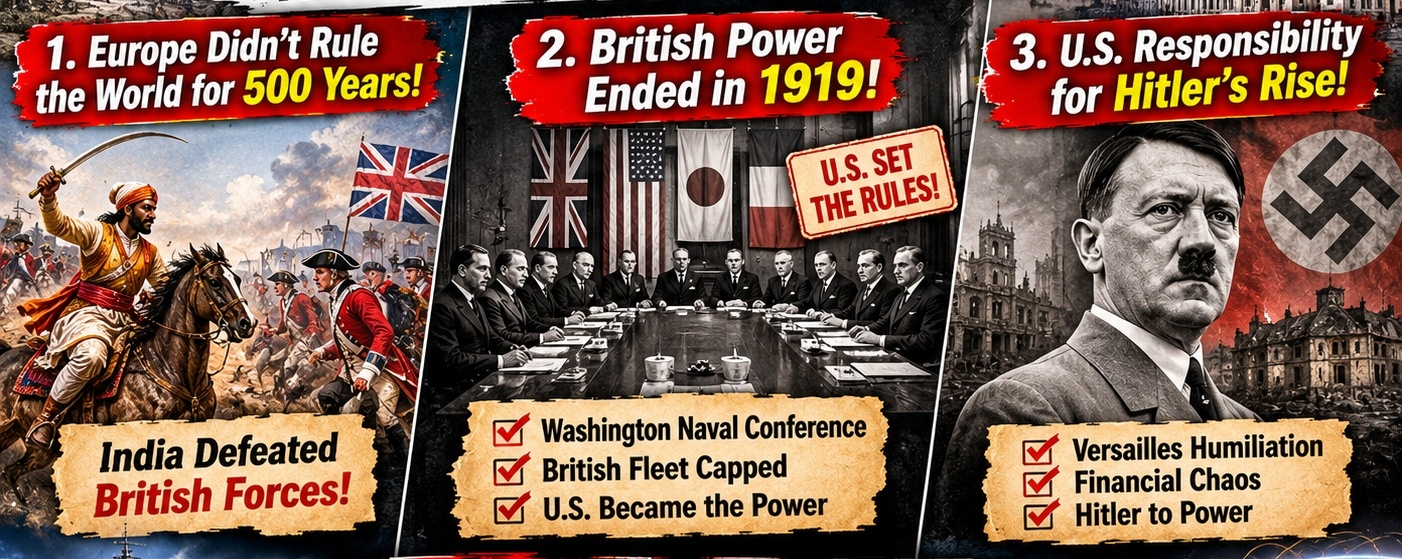

There are 3 points that many people do not understand about the history of European dominance over the world, and I believe they fundamentally change the way we read modern history.
First: Europe did not dominate the world for 500 years. This is a historically mistaken idea. Europe’s actual dominance over the world only took shape after the end of the Napoleonic Wars and the Congress of Vienna in 1815, and lasted only about 100 years. It was centered mainly on the British Empire, which the other European empires could not match in naval power or global reach.
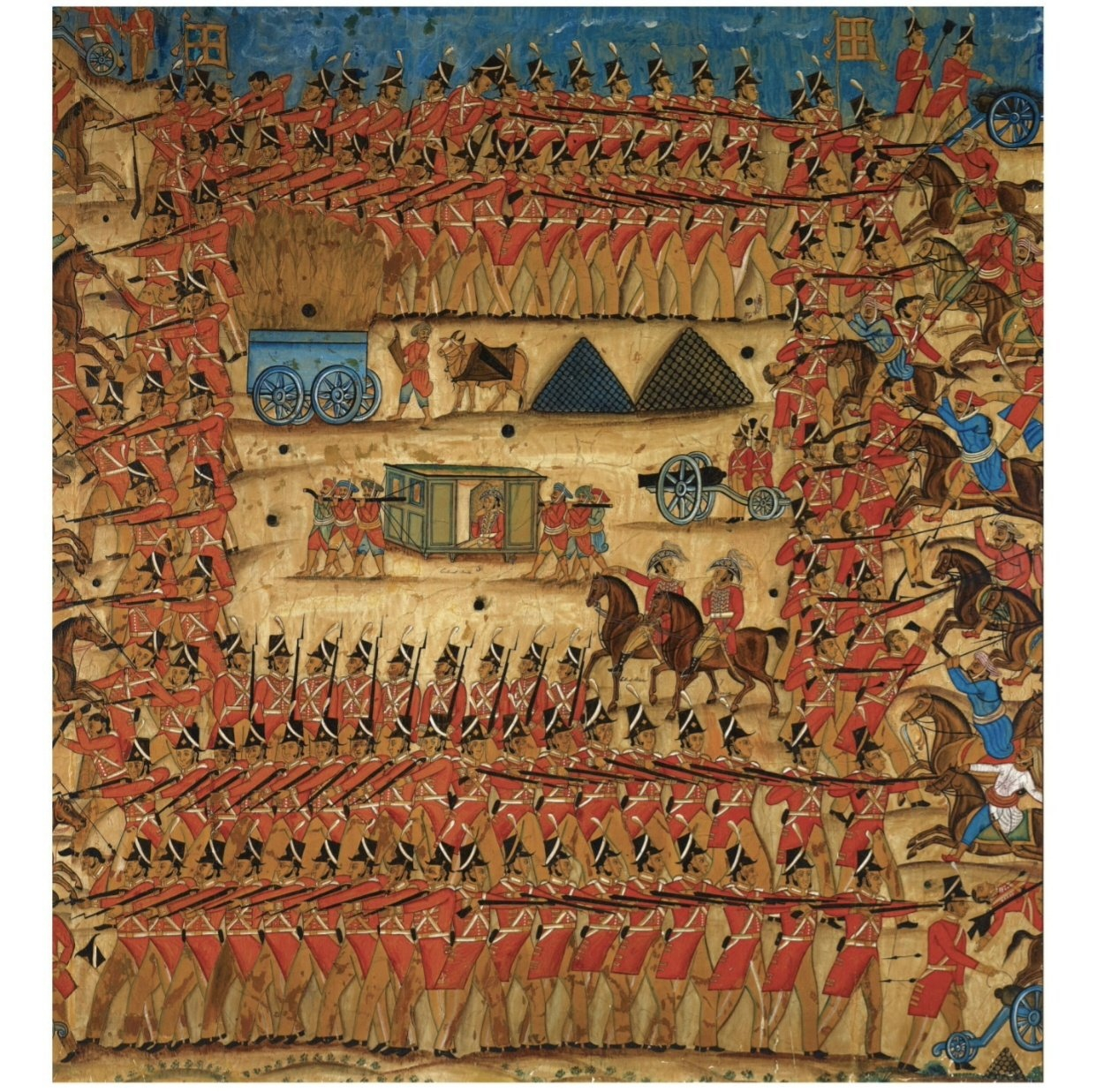
To understand this, read about the Battle of Wadgaon in 1779, which ended in a British defeat and surrender to Indian Maratha forces, and the Battle of Pollilur in 1780, in which the army of the Kingdom of Mysore crushed British forces led by Colonel William Baillie, with thousands of his soldiers killed or captured.
These battles took place in the last quarter of the eighteenth century and showed an overwhelming Indian military superiority over British forces. So how can anyone speak of absolute European control over the world since the sixteenth century, when Indian armies were still crushing British forces at the end of the eighteenth century?
British dominance over most of the Indian subcontinent only took shape during the nineteenth century, after the collapse of the Mughal Empire’s central authority and the fragmentation of India into competing powers and principalities, and after the defeat of the Marathas in 1818. This came after Britain lost its American colonies and Napoleon was defeated in 1815, which allowed it to concentrate its imperial power in Asia.
And even direct British rule over India, from 1858 to its independence in 1947, lasted only 89 years! That is a very short period by historical standards. For comparison, the Mongols ruled a unified China under the Yuan dynasty for about 89 years as well, from 1279 to 1368.
More importantly, India and China were the center of the world economy throughout all these centuries that they say Europe dominated. For example, in 1700 India produced about 24.4%, or a quarter, of the world economy, and China 22.3%. Even in 1820, China alone produced about 32.9%, or a third, of the planet’s economy, and India and China together accounted for more than half the world’s population and more than half its economy.
In other words, when Europeans were colonizing the Americas, India and China were still the demographic and economic center of gravity of the world. And even Europe itself had vast parts of it fully subject to a Middle Eastern power; the Ottoman army besieged Vienna for the last time in 1683, that is, in the late seventeenth century.
Confusing European colonization of the Americas with European dominance over the entire world is what produced the myth of 500 years of European control.
Second: British dominance over the world effectively ended with the First World War, not the Second, and the center of global power shifted to the United States.
Here I want you to read about the Washington Naval Conference, held between 1921 and 1922, after the end of the First World War.
Do you know what happened at this conference?
Britain, Japan, France, Italy, and other countries came to Washington. On the first day, November 12, 1921, U.S. Secretary of State Charles Evans Hughes imposed an American plan that set the size of the great powers’ battle fleets, required a halt to the construction of major warships, and mandated the disposal of others.
Imagine that!
The United States imposed a cap on the size of the British and Japanese fleets.
Under the treaty that emerged from the conference, the tonnage of major warships for the United States and Britain was capped at 525,000 tons each, compared with 315,000 tons for Japan, according to a 5:5:3 ratio. Restrictions were imposed on Britain preventing it from building new warships, and the signatory countries were forced to dispose of existing ships and cancel other construction projects.
Imagine Britain, which had emerged victorious from the First World War and possessed the largest colonial empire in history, coming to Washington to submit to limits set by the United States on the size of its naval power!
Britain, which had ruled the seas throughout the nineteenth century and whose naval power was the foundation of its empire, was now prohibited under a system imposed by Washington from exceeding a set ceiling for its fleet of major warships. Japan, the victorious Asian power in the war, was subjected to a ceiling far lower than the American one.
Who actually ruled the world after the First World War? The British or the Americans?
The Washington Conference answers this question conclusively. The United States became the power that set the rules for naval armaments for the great powers, including the British Empire itself.
And the shift was not just military, but economic as well.
Britain emerged from the First World War financially bankrupt and burdened with enormous debts to the United States, after having been one of the world’s largest creditors before the war. New York became a major center for financing European countries, including Britain itself.
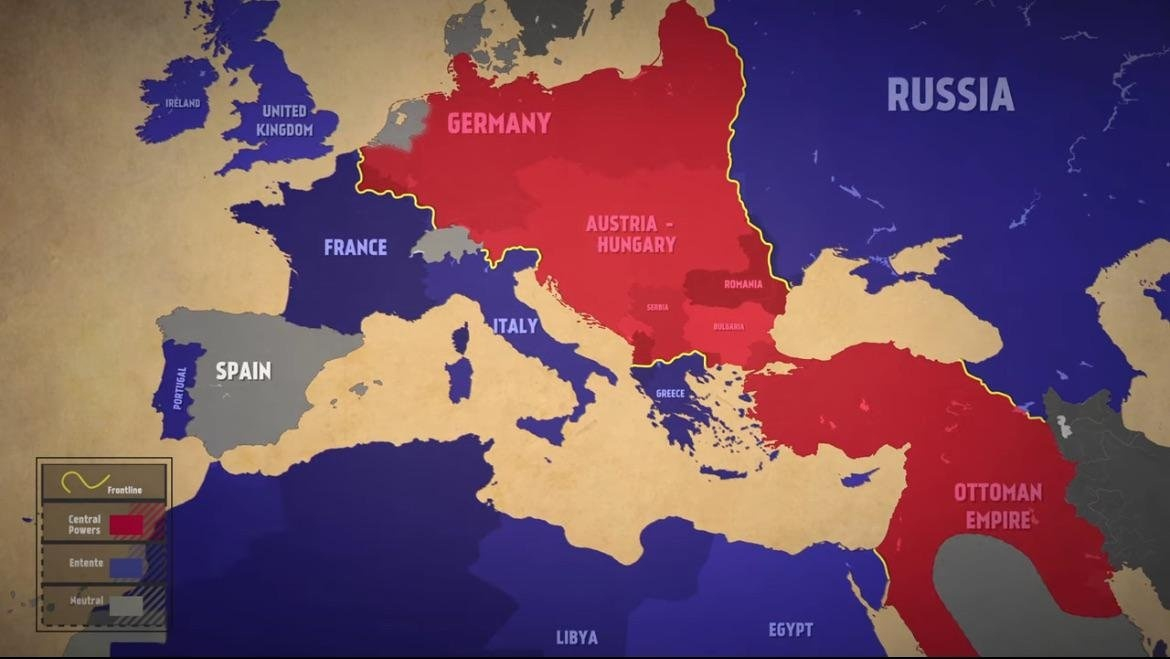
In fact, I would go even further... Germany had effectively won the First World War.
Germany succeeded in 1917 in breaking the Russian front, then imposed the Treaty of Brest-Litovsk on Russia in March 1918, and was able to transfer massive forces to the Western Front to launch a decisive offensive against the British and French.
Germany had a real military opportunity to decide the war on the Western Front. But the United States’ entry into the war in 1917, and the arrival of some two million Americans in Europe by its end, decisively changed the balance of power and saved Britain from the threat of defeat.
The main reason that drove the Americans to enter the First World War was British debts and the fear that they would not be repaid if Britain were defeated.
Britain depended enormously on American money and loans during the First World War. New York banks, led by J.P. Morgan, had provided massive financing to the Allies in 1916.
The collapse of Britain and France would have directly threatened the interests of American creditors and their ability to repay their debts. Therefore, protecting these financial interests and preventing the collapse of the European system tied to American capital was the fundamental reason for the United States’ entry into the war.
The Americans did not save Britain for free. They saved the British Empire militarily because its fall would have meant the American creditors’ money vanishing into thin air.
If America had not entered the war on Britain’s side in 1917, the Germans would have been able to crush the French and British forces on the Western Front and end the war.
Third: The primary historical responsibility for Hitler’s rise to power, and thus for the outbreak of World War II, lies with the United States of America.
Here I am not talking about the conventional accounts of American corporations financing Hitler or their ties to the Nazi Party, but about direct political and economic responsibility for creating the conditions that brought him to power.
The United States emerged from World War I as the world’s leading financial and military power, having played the decisive role in saving Britain and France from defeat at Germany’s hands. Yet it allowed its European allies to impose a system of economic and political humiliation on Germany after the war.
The Treaty of Versailles, imposed on Germany in 1919, brought territorial losses, military restrictions, and enormous reparations, later set in 1921 at approximately 132 billion gold marks.
But why did the United States allow these enormous reparations to be imposed on Germany? Because Britain and France owed the United States huge sums they had borrowed to finance the war—debts that Americans entered World War I to ensure would be repaid, while also saving their allies from defeat.
Thus, America allowed Britain and France to impose enormous reparations on Germany so that they could use them to repay their debts to the United States. But Germany itself was unable to pay these reparations, so what did the Americans do? They went and lent Germany the money so that it could pay reparations to Britain and France, who in turn used them to repay their debts to America!
Then came the Dawes Plan in 1924, named after the American banker Charles Dawes, which turned this cycle into a full-fledged financial system and tied the stability of the German economy to loans from the United States.
Consider this insane cycle: America lends money to Britain and France, then enters the war to save them from defeat and ensure repayment of its loans. After the war, it allows them to impose enormous reparations on Germany, then lends Germany the money needed to pay those reparations!
In other words, Germany borrows from America to pay Britain and France, and Britain and France take the money from Germany to repay their debts to America, which then lends money to Germany again so that it can continue paying reparations!
This insane financial cycle, which served no purpose whatsoever, led to the collapse of the German economy, then tied it to the American economy and made it dependent on American loans. When the American markets collapsed in 1929, this entire financial system collapsed with them.
American capital withdrew from Germany, and the economic crisis worsened until the German economy collapsed, with unemployment reaching approximately 6 million people in 1932.
And this crisis, which could have been avoided by not tying the German economy to the American economy, is what turned the Nazi Party into the largest party in the Reichstag and made Hitler’s rise to the chancellorship possible.
Notice the historical sequence: The United States enters the war and saves Britain and France from defeat, then allows the imposition of the Versailles system, which humiliated Germany and destroyed its economy. It then lends Germany money to pay reparations to its European allies so that they can repay their debts to America, thereby tying the stability of the German economy to American financing. When the American economy collapses in 1929, the German economy collapses with it, and the economic crisis turns into a political catastrophe that paves the way for Hitler’s rise to power.
That is why I hold the United States primarily responsible for Hitler’s rise and for creating the conditions that led to the outbreak of World War II.
Humiliating Germany after World War I was not a historical necessity, nor was turning its economy into one dependent on American loans. These were the consequences of political and economic decisions made by the victorious powers, and the United States had the influence needed to change their course.